


























Views
Downloads

Printable Compare Rates Worksheet | Grade 9 Algebra I
Paste this activity's link or code into your existing LMS (Google Classroom, Canvas, Teams, Schoology, Moodle, etc.).
Students can open and work on the activity right away, with no student login required.
You'll still be able to track student progress and results from your teacher account.
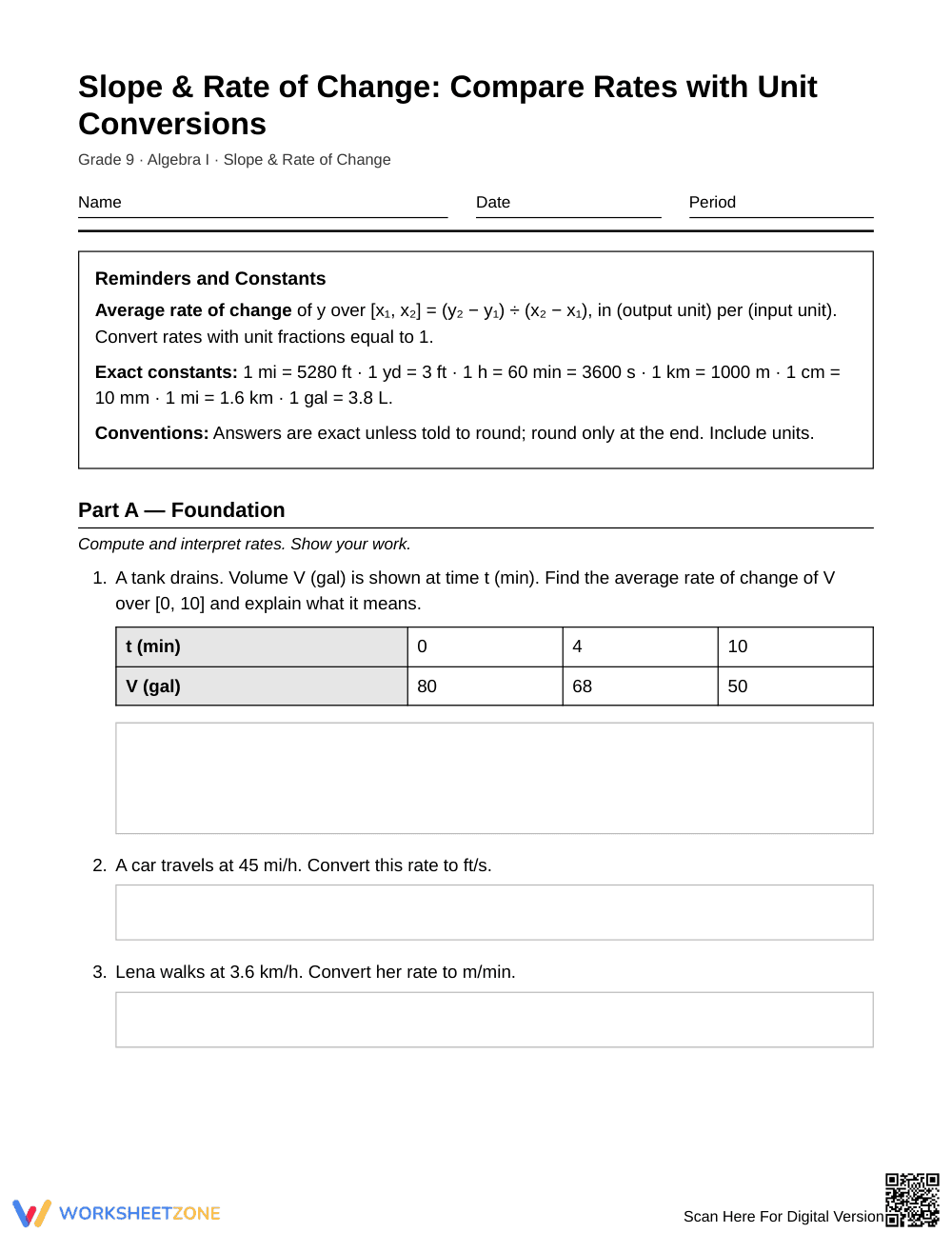
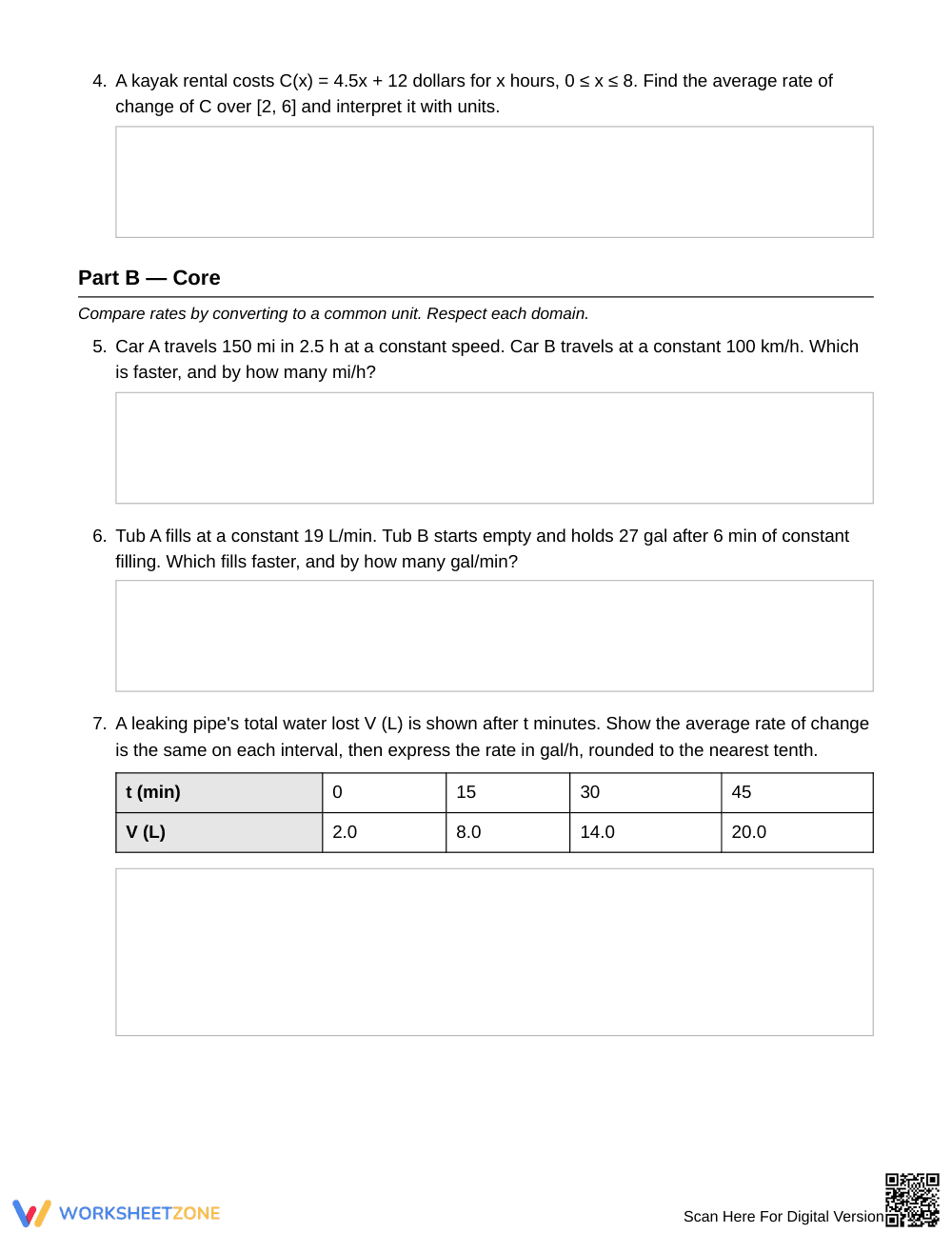
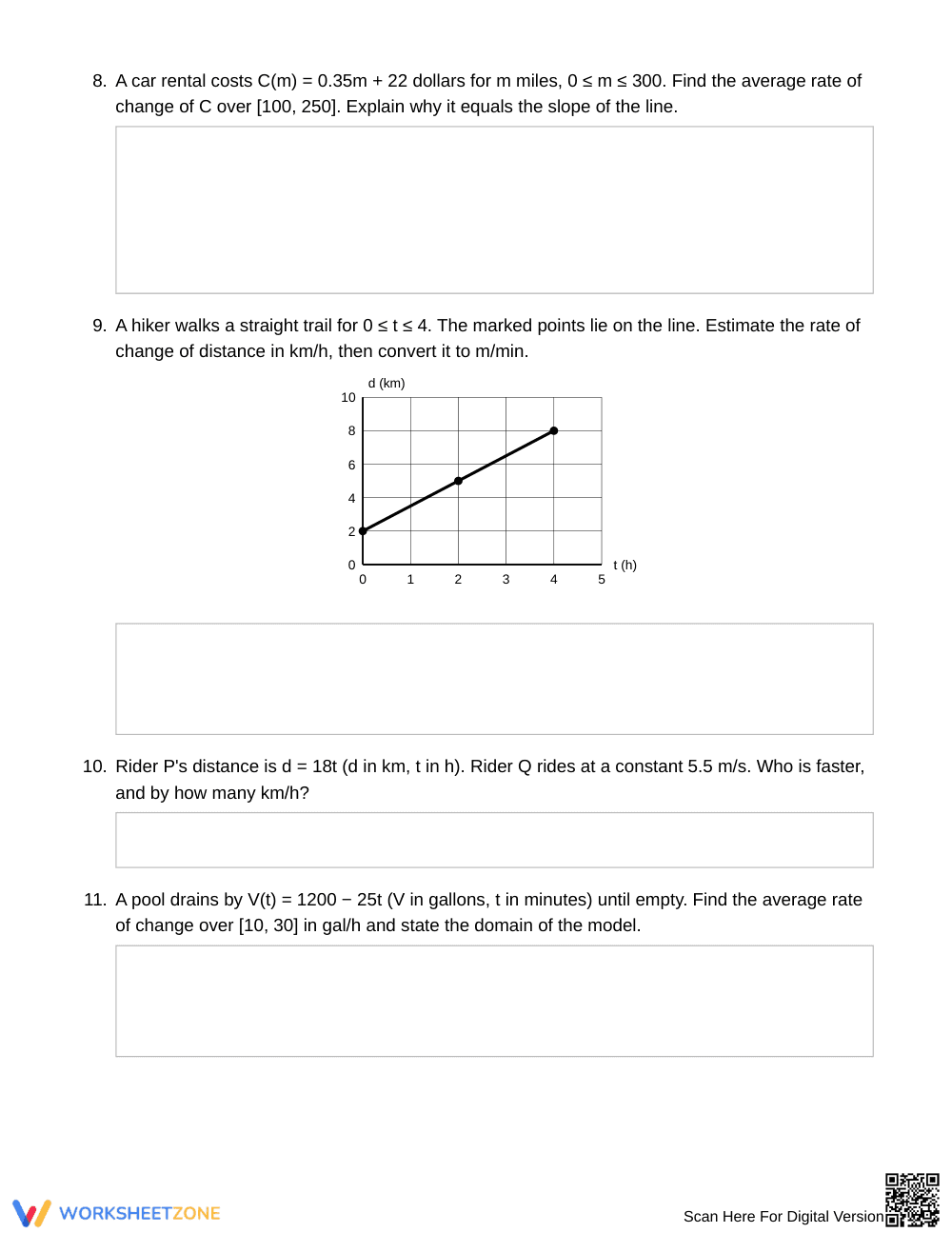
Students calculate average rate of change from tables, equations, and a graph, then convert units so two rates can be compared fairly. This Grade 9 Algebra I worksheet builds fluency with unit fractions and rate interpretation, so students can decide which rate is greater and justify the answer.
At a Glance
- Grade: 9 · Subject: Algebra I
- Standard:
HSF-IF.B.6— Calculate and interpret average rate of change over an interval, with units- Skill Focus: Compare rates with unit conversions
- Format: 5 pages · 18 problems · Answer key included · PDF
- Best For: Rate-of-change practice and review
- Time: 40–50 minutes
What's Inside
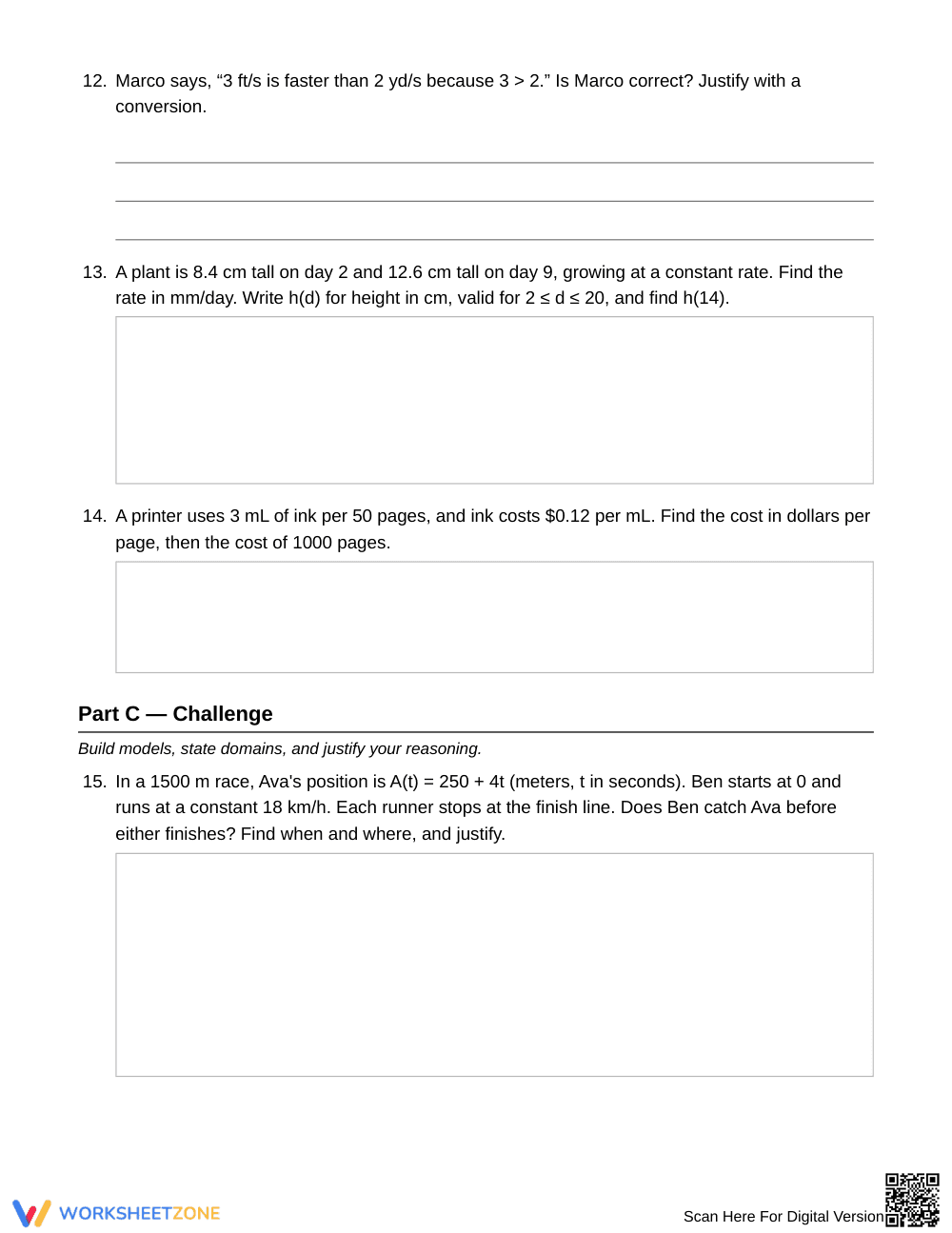
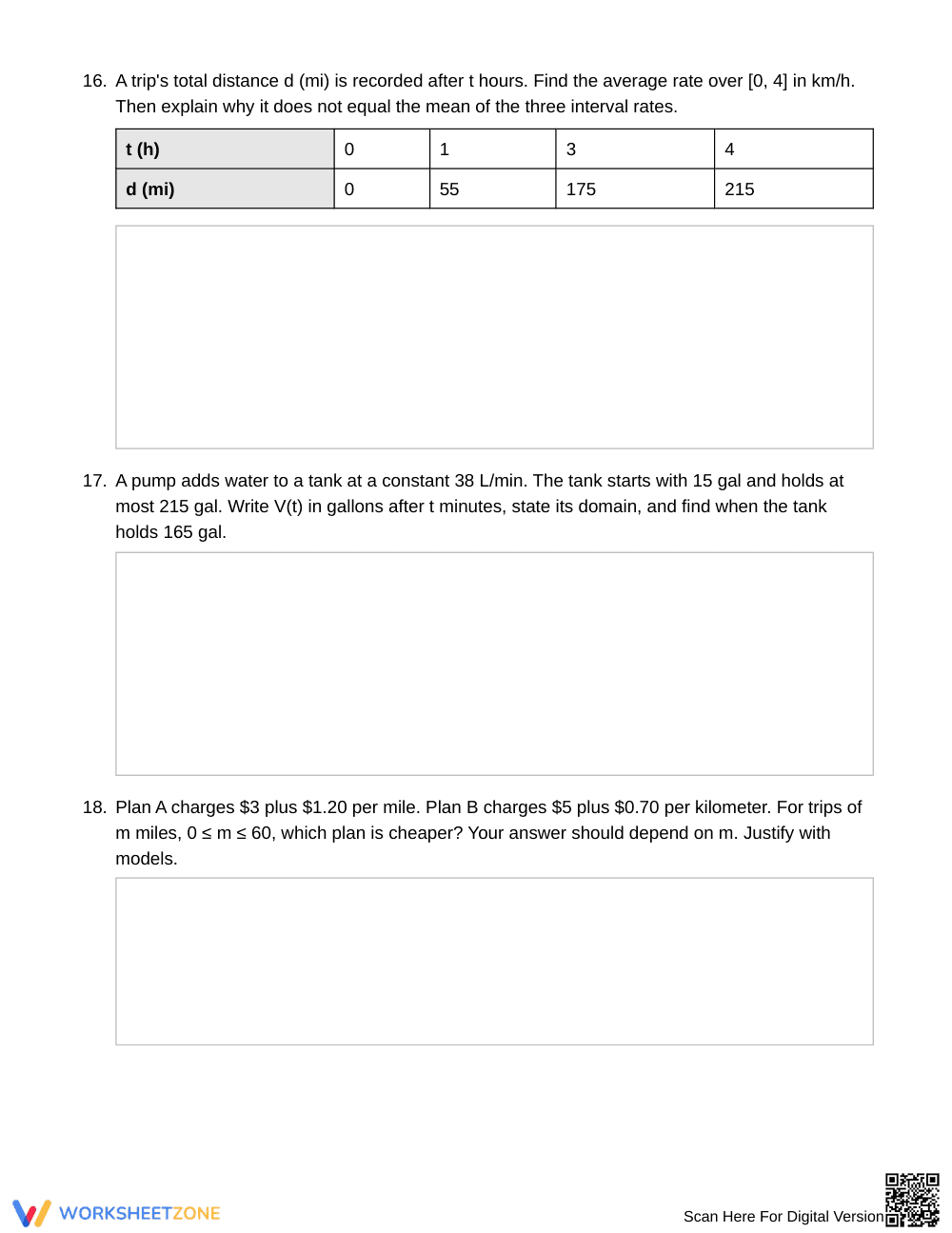
The 5-page worksheet opens with a reminders box listing the rate formula and exact conversion constants. Tasks include tables, linear models with domains, one graph, unit conversions, and error-analysis prompts. Students show work, include units, and round only at the end. A 2-page answer key follows with worked results.
Skill Progression
- Guided practice (Part A, 4 problems): Compute and interpret rates from a table and a linear model, and make single unit conversions.
- Supported practice (Part B, 10 problems): Convert to a common unit, compare rates, and respect each domain. Constants stay visible on page one.
- Independent practice (Part C, 4 problems): Build models, state domains, and justify conclusions in multi-step contexts such as a race and a rental plan comparison.
The sequence follows gradual release: I Do, We Do, You Do.
Standards Alignment
HSF-IF.B.6 — Calculate and interpret the average rate of change of a function, presented symbolically or as a table, over a specified interval, and estimate the rate of change from a graph. This standard code can be copied directly into lesson plans, IEP goals, or district curriculum mapping tools.
How to Use It
After direct instruction: assign Part A and Part B as independent practice once students have seen slope as average rate of change. Before an assessment: use Part C as a review set in pairs. While students work, watch whether they write units on every answer and set up unit fractions correctly. Expect 40–50 minutes for the full set, or about 15 minutes for Part A alone.
Who It's For
Designed for Grade 9 Algebra I students in a slope and rate of change unit. Students who need more support can start with Part A and use the constants box. Stronger students can go straight to Part C. Pair it with an anchor chart on unit fractions or a short lesson on interpreting slope.
Compare Rates with Unit Conversions is a 5-page Grade 9 Algebra I worksheet aligned to HSF-IF.B.6, which asks students to calculate and interpret the average rate of change of a function over a specified interval. It contains 18 tasks drawn from tables, linear models, and one graph, and every answer requires units. Students convert between unit systems before comparing rates, then build models with stated domains. A 2-page answer key is included. Fisher & Frey (2014) describe gradual release of responsibility as a dependable structure for building independent transfer, and this worksheet applies it by moving from four foundation tasks to ten core tasks and four challenge tasks. The task set asks students to justify which rate is greater instead of only computing a number, which makes reasoning visible. Teachers can use it for practice, review, or formative checks.


