


























Views
Downloads




Printable Climate Evidence Worksheet | Grade 12 Science
Paste this activity's link or code into your existing LMS (Google Classroom, Canvas, Teams, Schoology, Moodle, etc.).
Students can open and work on the activity right away, with no student login required.
You'll still be able to track student progress and results from your teacher account.
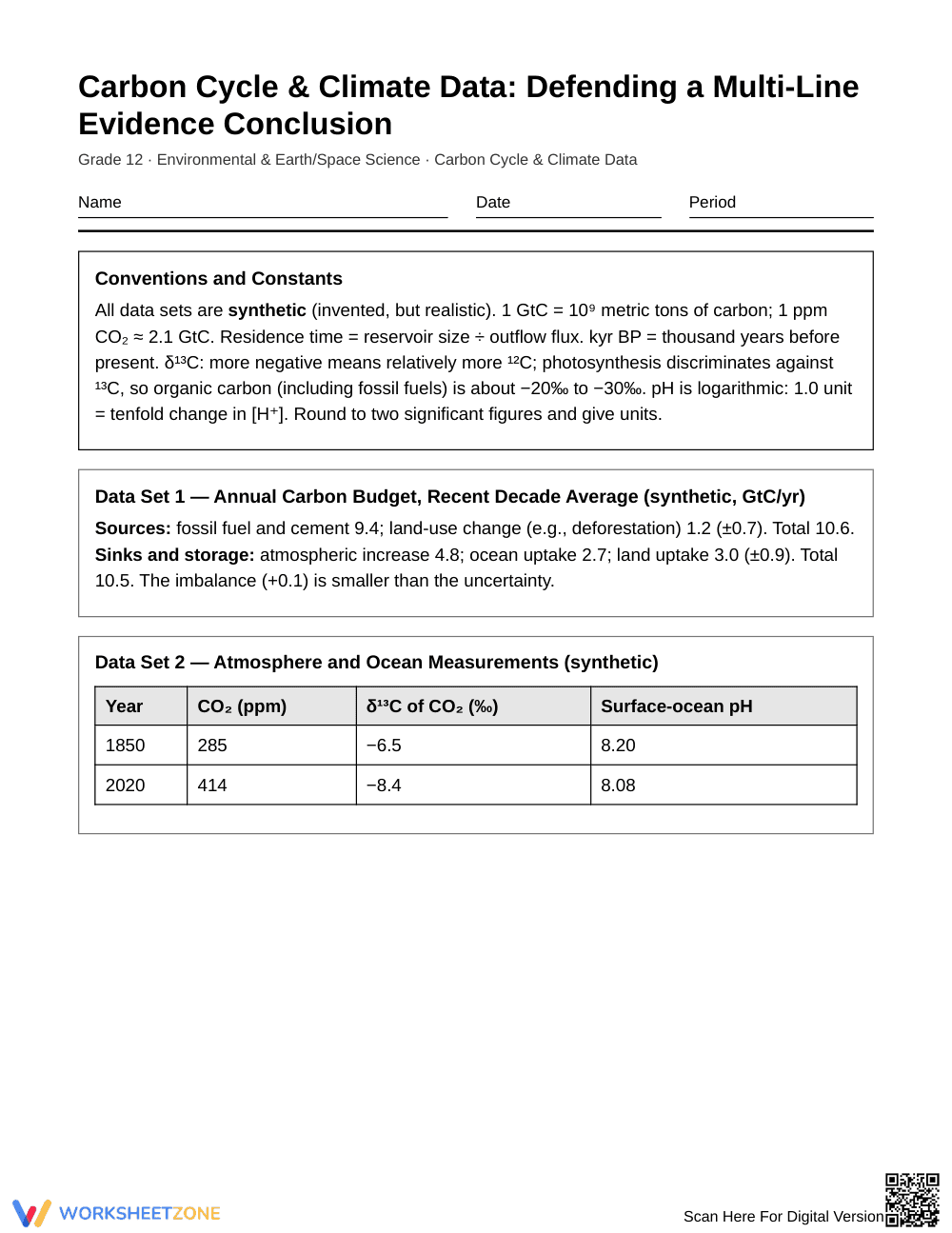
This worksheet teaches Grade 12 students to defend a climate conclusion using several independent lines of evidence. Students pick relevant data, link each measurement to the Earth-system process behind it, and weigh competing claims while stating how confident they are. Eight tasks use four synthetic data sets on the carbon cycle.
At a Glance
- Grade: 12 · Subject: Environmental & Earth/Space Science
- Standard: Argument from evidence — choose data, explain mechanisms, and defend a conclusion with stated uncertainty
- Skill Focus: Defending multi-line climate-evidence conclusions
- Format: 5 pages · 8 problems · Answer key included · PDF
- Best For: End-of-unit carbon cycle data analysis
- Time: 45–60 minutes
What's Inside
The 5-page worksheet opens with a conventions box (unit conversions, residence-time formula, δ¹³C and pH reminders) and four synthetic data sets on the carbon budget, atmosphere and ocean measurements, a deglaciation ice-core record, and carbon reservoirs. Eight tasks follow in three parts: identify evidence, link evidence to mechanism with calculations, and evaluate competing claims. A 4-page answer key is included.
Skill Progression
- Guided practice (Part A, 2 tasks): select the most relevant data points from supplied data and statements, and say what each shows.
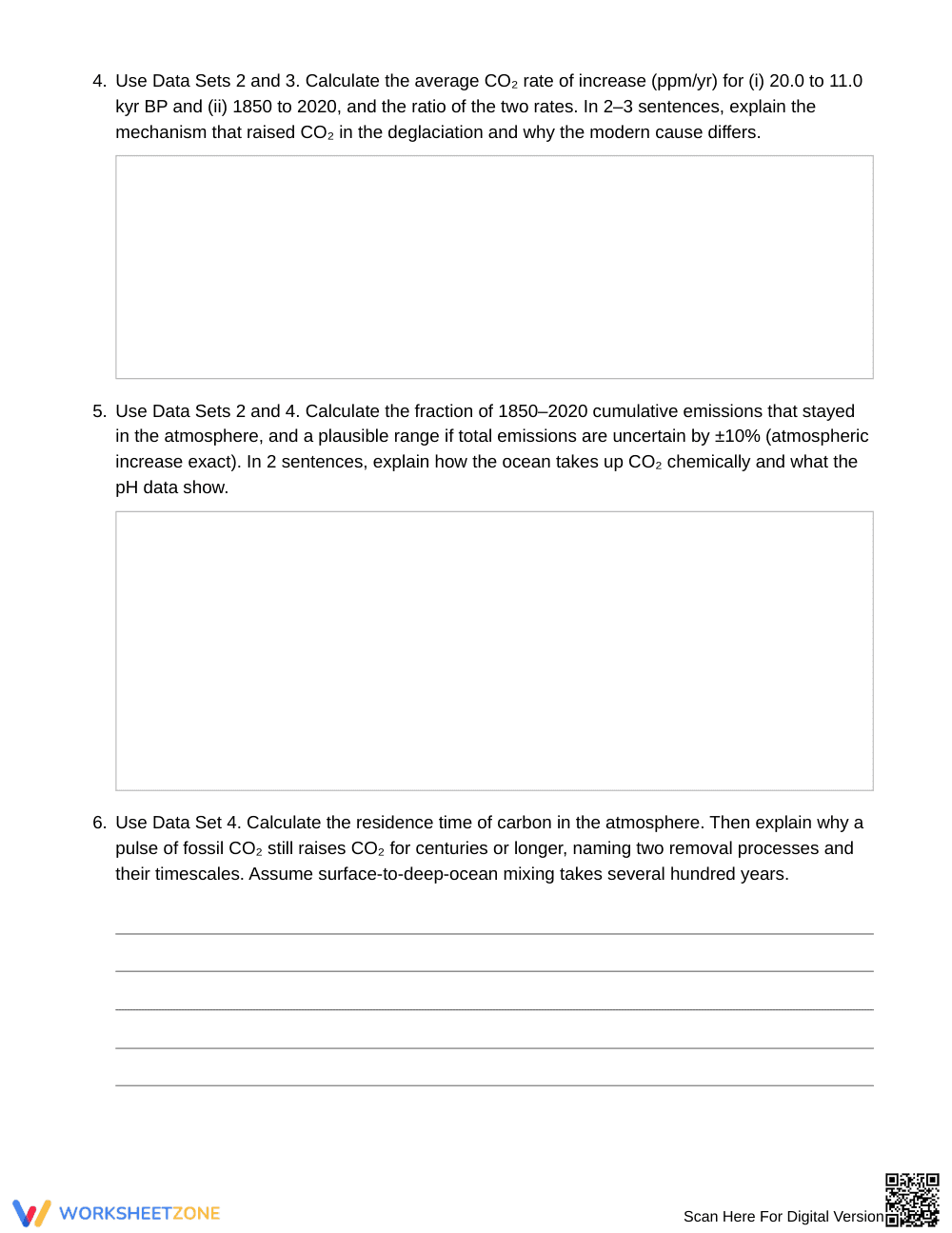
- Supported practice (Part B, 4 tasks): calculate rates, fractions, and residence time, then explain the mechanism behind each result.
- Independent practice (Part C, 2 tasks): take a position on competing claims, cite two lines of evidence, and state uncertainty.
The sequence follows gradual release: I Do, We Do, You Do.
Standards Alignment
No standard code is assigned to this worksheet. It practices argument from evidence: analyzing and interpreting data, constructing explanations from calculations and mechanisms, and evaluating competing claims. Add your state or district code when mapping it into lesson plans, IEP goals, or curriculum tools.
How to Use It
Use it after direct instruction on the carbon cycle as an end-of-unit task: assign Part A in class, Part B as a work session, and Part C as individual writing. Or use Part C alone as a review discussion before an assessment. While students work, listen for whether they cite specific values and state uncertainty rather than only restating claims. Expect 45–60 minutes.
Who It's For
Written for Grade 12 environmental science and Earth science courses. Students who need support can start with Part A and the Part B calculations, keeping the conventions box open, while advanced students can concentrate on Part C. Pair it with a lesson on isotopes and ocean chemistry.
The Carbon Cycle & Climate Data worksheet for Grade 12 Environmental & Earth/Space Science asks students to defend a climate conclusion with several independent lines of evidence. Across 8 tasks and 5 pages, learners select relevant data, calculate quantities such as CO₂ growth rates, the fraction of emissions remaining in the atmosphere, and atmospheric residence time, then explain the mechanism behind each result and judge competing claims while stating their uncertainty. Its structure follows the gradual release of responsibility model described by Fisher & Frey (2014), moving from guided evidence selection to supported calculation and finally independent argument. All four data sets are synthetic but realistic, so students practice scientific reasoning without relying on memorized figures. A 4-page answer key supports scoring and feedback. The worksheet suits end-of-unit practice, data-analysis review, or preparation for evidence-based written responses in environmental and Earth science courses.


