


























Views
Downloads


Printable Asymptotes & End Behavior Worksheet | Grade 12
Paste this activity's link or code into your existing LMS (Google Classroom, Canvas, Teams, Schoology, Moodle, etc.).
Students can open and work on the activity right away, with no student login required.
You'll still be able to track student progress and results from your teacher account.
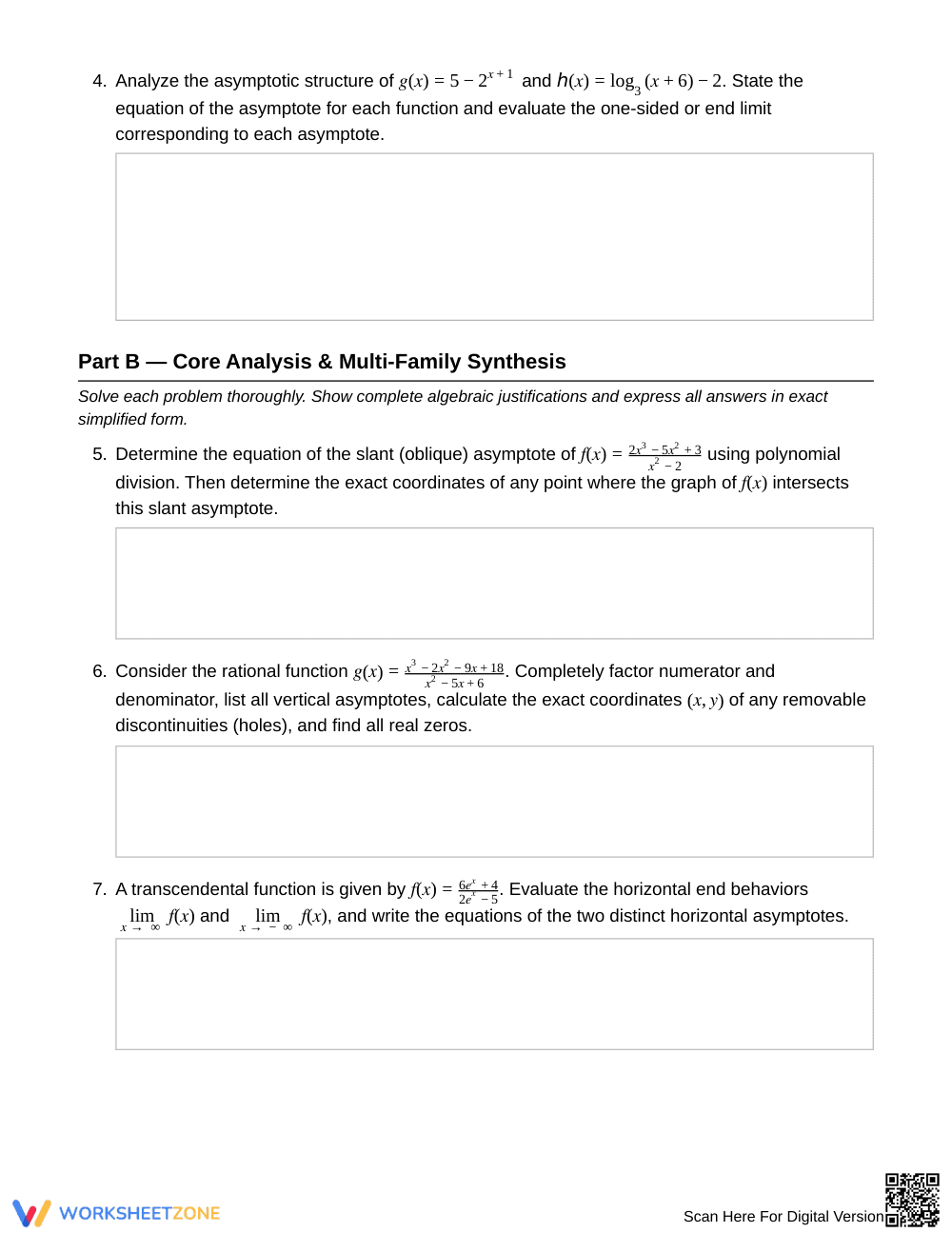
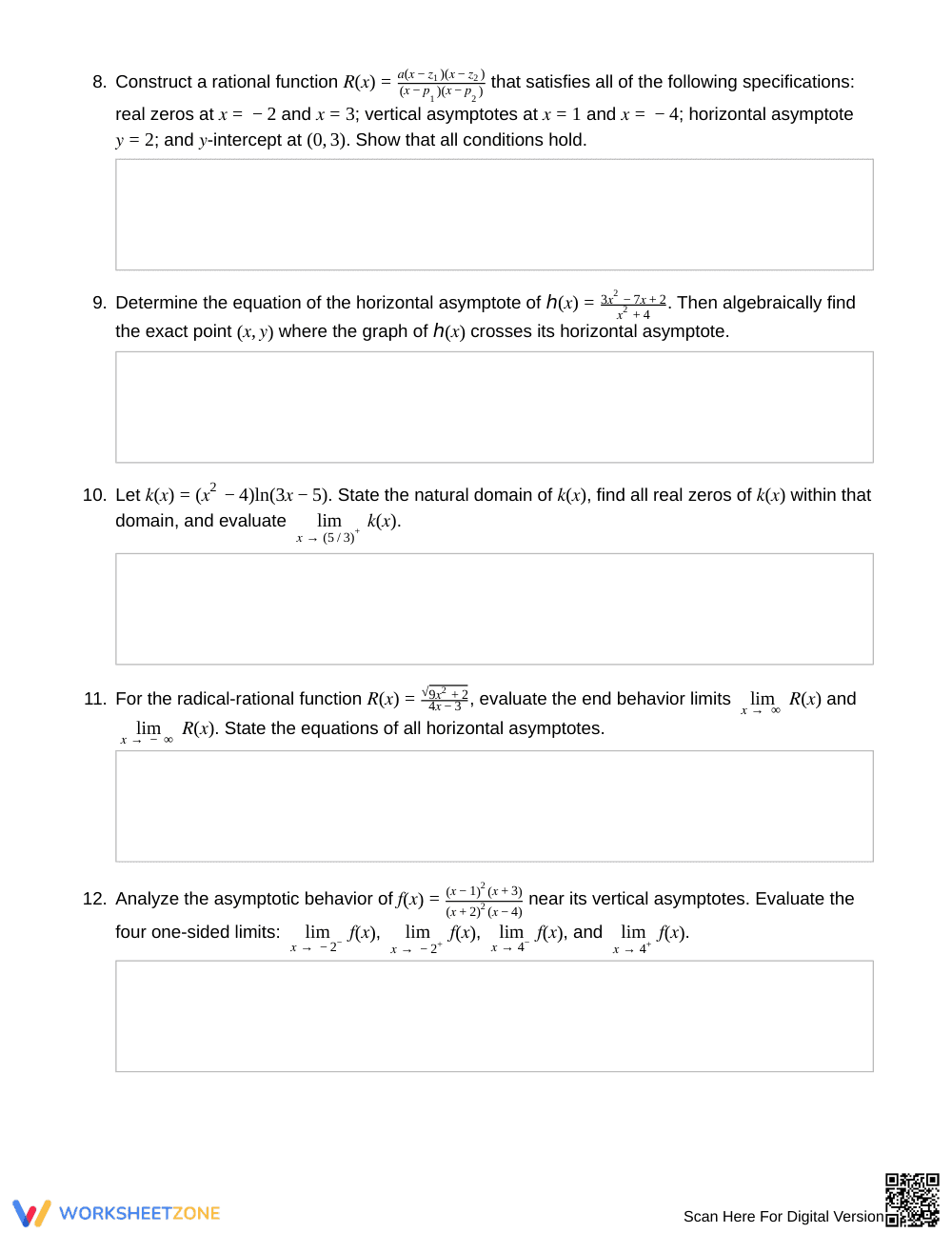
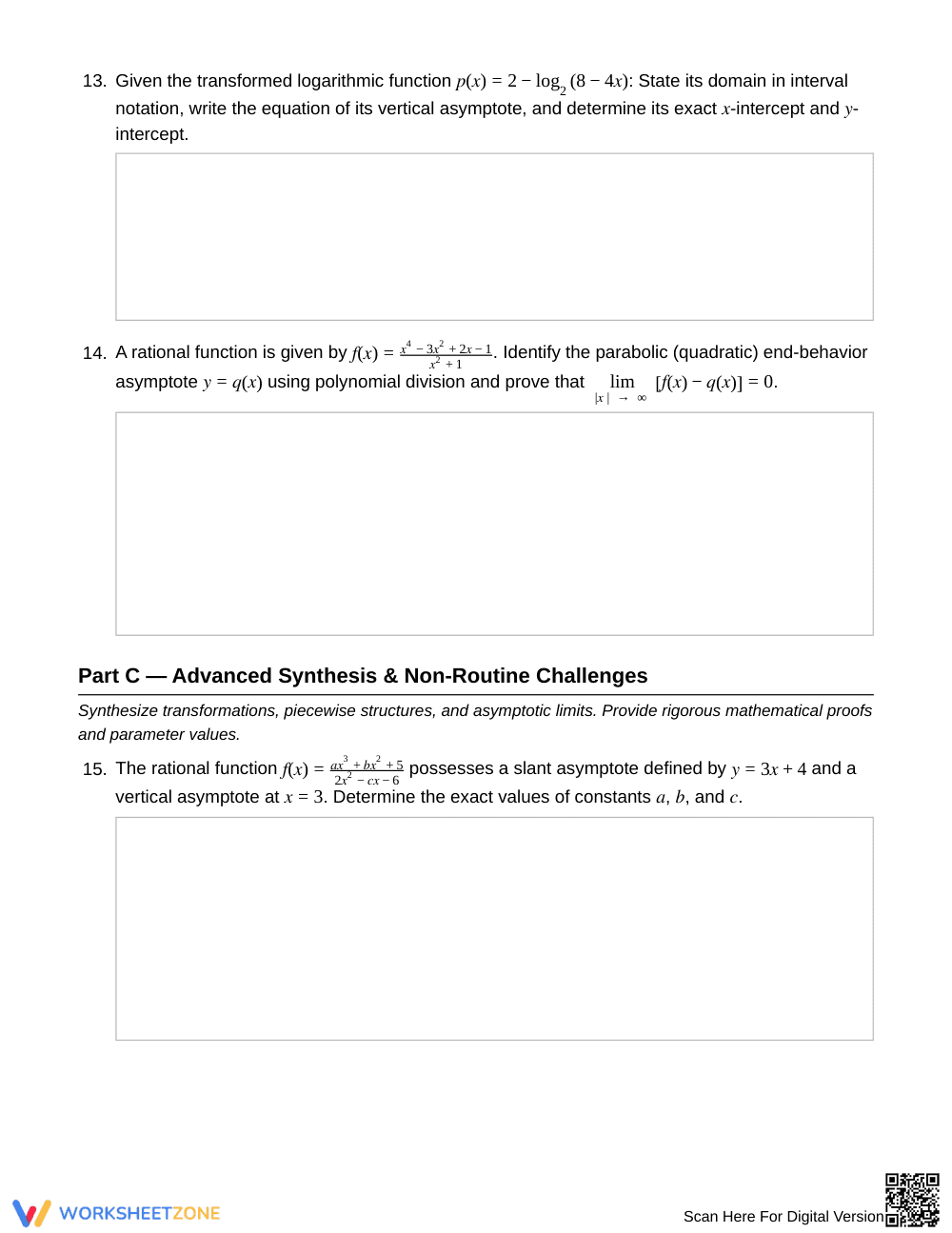
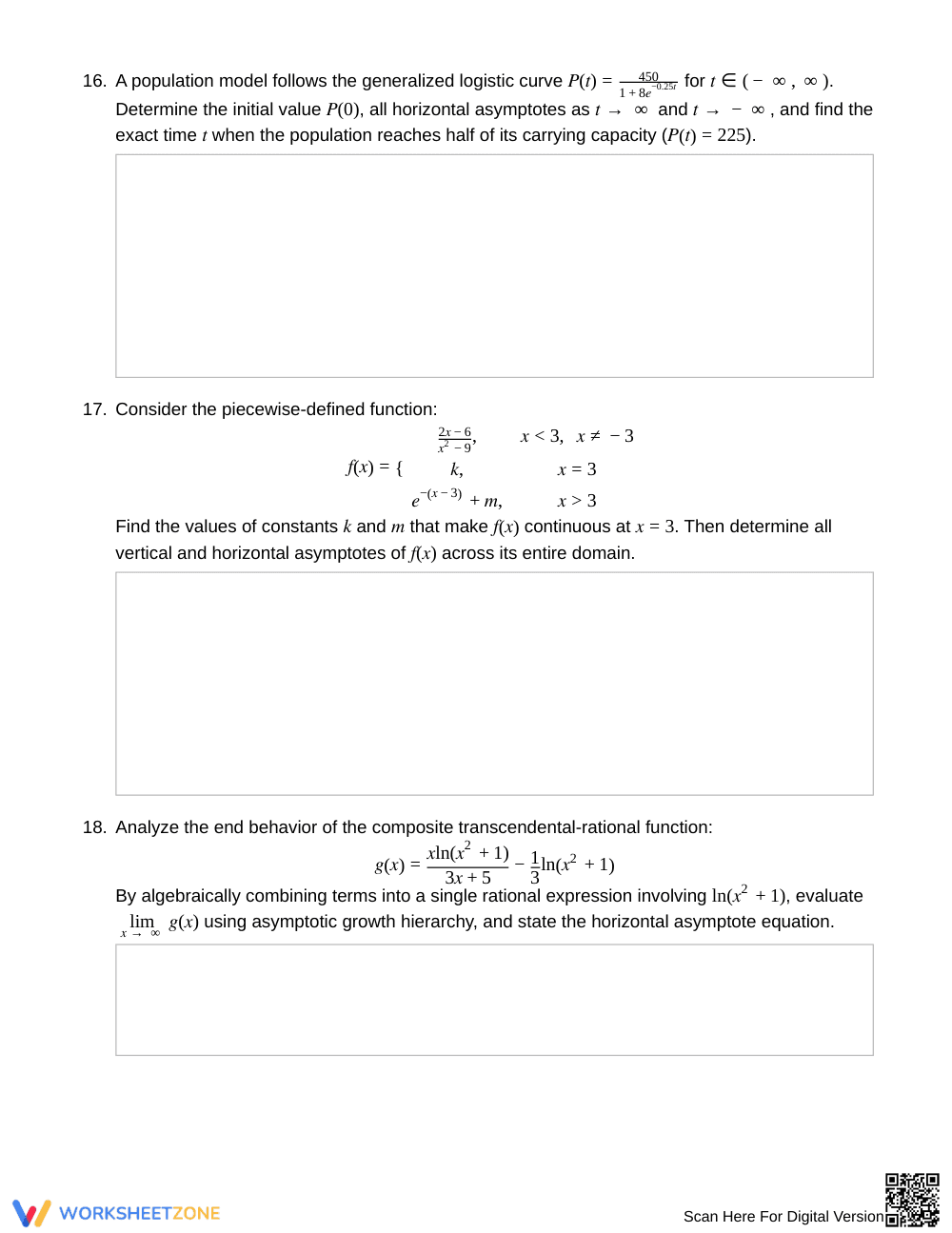
This Grade 12 Precalculus worksheet develops students' ability to analyze asymptotes, zeros, and end behavior across polynomial, rational, exponential, logarithmic, and composite functions. Across 18 structured problems, students apply formal limit notation, polynomial division, and asymptotic growth hierarchies to establish rigorous conclusions about function behavior.
At a Glance
- Grade: 12 · Subject: Precalculus
- Standard:
HSF-IF.C.7— Graph functions and show key features including intercepts, asymptotes, and end behavior- Skill Focus: Asymptotes, zeros, and end behavior across multiple function families
- Format: 5 pages · 18 problems · Answer key included · PDF
- Best For: Advanced practice before function analysis assessments
- Time: 45–65 minutes
The 5-page worksheet is structured into three distinct sections that build in analytical complexity. Part A (4 problems) reinforces foundational mechanics, Part B (10 problems) demands multi-step algebraic justification and one-sided limit analysis, and Part C (4 problems) presents non-routine synthesis tasks involving parametric constraints and composite functions. A Core Analytical Reference box and full answer key are included.
- Guided practice (Part A, 4 problems): Students apply analytical rules to identify leading terms, state zeros with multiplicities, determine vertical and horizontal asymptote equations, and evaluate end-behavior limits using limit notation.
- Supported practice (Part B, 10 problems): Students construct rational functions from target specifications, locate asymptote-crossing coordinates, evaluate one-sided limits near discontinuities, and derive slant asymptotes using polynomial division.
- Independent practice (Part C, 4 problems): Students determine unknown parameters from asymptotic constraints, model logistic population growth, and evaluate composite transcendental limits.
Instructional Implementation
Primary standard: HSF-IF.C.7. Assign Parts A and B following direct instruction on rational and transcendental functions as a 35–45 minute consolidation activity. Use Part C (20–25 minutes) for AP Calculus preparation or collaborative problem-solving. Educators can monitor Part B problem 8 as a formative checkpoint: students struggling to enforce horizontal asymptote constraints while matching intercept values benefit from targeted review of leading coefficient ratios.
Aligned to HSF-IF.C.7, this worksheet targets the core high school function standard requiring students to graph and interpret key analytical features—intercepts, asymptotes, and end behavior—across polynomial, rational, exponential, and logarithmic function families. Empirical research strongly supports the instructional effectiveness of structured, multi-step problem sets for building procedural fluency alongside conceptual understanding: Fisher and Frey (2014) demonstrate that gradual-release instructional frameworks, in which teacher-modeled examples systematically transition to guided and independent practice, produce measurably stronger long-term retention of complex algebraic reasoning. Featuring 18 tiered problems progressing from direct formula application to open-ended synthesis, this resource operationalizes that evidence-based framework within a single coherent assignment. The included answer key empowers educators to provide prompt corrective feedback, an instructional practice consistently associated with higher mastery rates on advanced function analysis assessments in secondary mathematics classrooms.


