


























Views
Downloads




Essential Statistics Worksheet: Grouped Data | Grade 10 Math
Paste this activity's link or code into your existing LMS (Google Classroom, Canvas, Teams, Schoology, Moodle, etc.).
Students can open and work on the activity right away, with no student login required.
You'll still be able to track student progress and results from your teacher account.
This Grade 10 statistics worksheet provides a comprehensive pathway for students to master the organization and presentation of raw numerical data. By transitioning from simple frequency counts to complex grouped distributions, students learn how to condense information without losing statistical integrity, preparing them for advanced data visualization and analysis in higher-level mathematics.
At a Glance
- Grade: 10 · Subject: Math · Data
- Standard:
CCSS.MATH.CONTENT.HSS.ID.A.1— Represent data with plots on the real number line including histograms.- Skill Focus: Grouped frequency distributions and cumulative frequency
- Format: 5 pages · 7 problems · Answer key included · PDF
- Best For: Initial instruction on data organization and summarization
- Time: 45–60 minutes
What's Inside
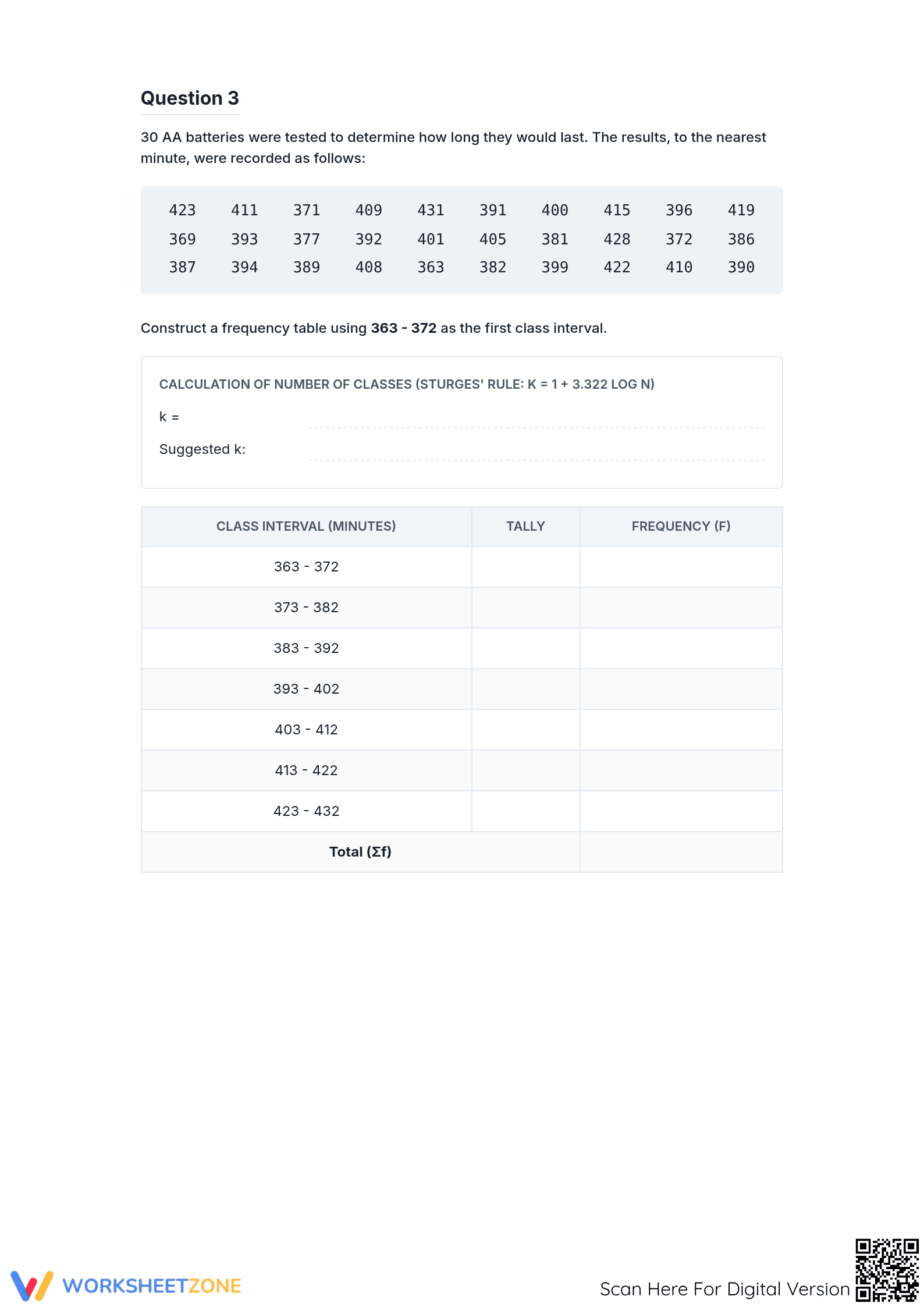
Spanning five detailed pages, this resource guides students through the entire lifecycle of data presentation. It includes clear definitions of statistical terminology, worked examples for both ungrouped and grouped data, and a detailed exploration of cumulative frequency distributions. The worksheet features structured tables for tallying, frequency calculation, and finding class boundaries, ensuring students have the organizational support needed to handle data sets of up to 40 individual values accurately.
Skill Progression
- Guided Practice: Students begin by following a step-by-step example that transforms 20 raw marks into an ungrouped frequency table, focusing on the basic tally method.
- Supported Practice: The middle pages provide a scaffolded approach to grouping continuous data, defining class limits and mid-points for a 40-item data set with pre-set intervals.
- Independent Practice: The final section challenges students to independently construct discrete frequency tables, grouped distributions for student weights, and cumulative frequency charts from scratch.
This gradual-release model ensures students build confidence in data handling before tackling the more complex requirements of cumulative frequency analysis.
Standards Alignment
This worksheet is strictly aligned to `CCSS.MATH.CONTENT.HSS.ID.A.1`, which requires students to represent data with plots on the real number line, including dot plots, histograms, and box plots. By focusing on the foundational table construction required to build these plots, the resource also supports `HSS.ID.A.2` by teaching students to summarize data distributions. Both standard codes can be copied directly into lesson plans, IEP goals, or district curriculum mapping tools.
How to Use It
This resource is best used during the first two days of a statistics unit, immediately after students have learned about data types but before they begin drawing histograms. It serves as an excellent formative assessment tool; teachers should observe students during the "class boundary" calculation on page 2 to identify misconceptions regarding continuous vs. discrete data. Expect students to spend approximately 15 minutes per practice page, including the cumulative frequency extension.
Who It's For
Designed for Grade 10 Math, Algebra 2, or introductory Statistics students, this worksheet is ideal for learners who require a clear, logical progression when handling abstract data. The structured tables provide necessary support for students with executive functioning challenges, while the cumulative frequency section offers a natural extension for advanced learners. It pairs perfectly with any standard high school statistics textbook or introductory data analysis lesson.
Educational research highlighted in the RAND AIRS 2024 report emphasizes that structural competency in data organization serves as a critical bridge between basic arithmetic and advanced statistical inference. This Grade 10 statistics worksheet targets CCSS.MATH.CONTENT.HSS.ID.A.1, requiring students to transform raw data sets into organized frequency distributions and cumulative frequency tables. Learners develop a conceptual understanding of data density and variability—skills foundational for interpreting histograms and box plots in higher-level mathematics. Studies by Fisher & Frey (2014) suggest that providing structured scaffolds for data grouping significantly reduces cognitive load during the initial phases of statistical analysis. This ensures students can accurately represent real-world data while building the stamina needed for complex data modeling. The inclusion of cumulative frequency exercises further aligns with NAEP standards for data analysis and probability at the secondary level.


