


























Views
Downloads

Preschool Color Sorting Printable | Pre-K Math
Paste this activity's link or code into your existing LMS (Google Classroom, Canvas, Teams, Schoology, Moodle, etc.).
Students can open and work on the activity right away, with no student login required.
You'll still be able to track student progress and results from your teacher account.
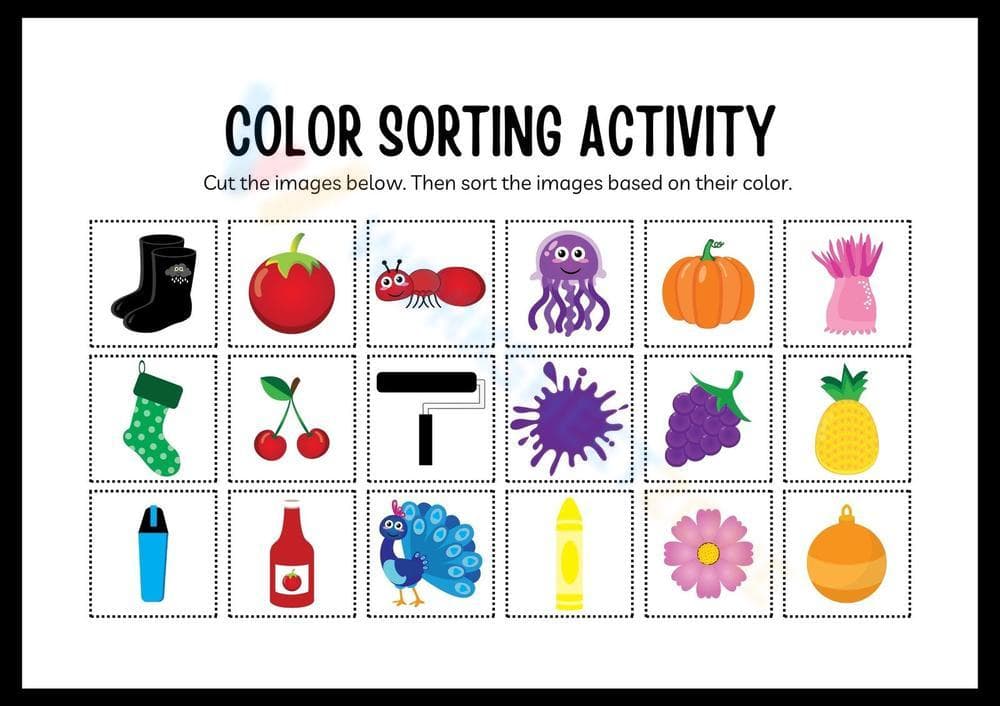
This preschool color sorting activity helps early learners classify objects by visual attributes while building essential fine motor skills. Students cut out eighteen distinct, colorful images and group them by color, reinforcing foundational math concepts and visual discrimination in a highly engaging, hands-on format.
At a Glance
- Grade: Pre-K · Subject: Math
- Standard:
CCSS.MATH.CONTENT.K.MD.B.3— Classify objects into given categories- Skill Focus: Color identification and sorting
- Format: 1 page · 18 problems · No answer key · PDF
- Best For: Independent centers
- Time: 15–20 minutes
This single-page printable features eighteen vibrant illustrations, including everyday objects, animals, and foods like tomatoes, octopuses, and pineapples. The layout is designed with clear, dashed cutting lines around each image to support scissor skills. Children will snip out each square and physically manipulate the pieces to group them into matching color families, such as red, blue, purple, and green.
This resource is designed for immediate classroom implementation with minimal teacher setup.
- Print (1 minute): Generate the single-page PDF for each student or center group.
- Distribute (1 minute): Hand out the sheets along with child-safe scissors and glue sticks.
- Review (3 minutes): Quickly check student groupings before they glue the pieces down to ensure accurate color categorization.
Total teacher prep time is under two minutes, making this an excellent option for emergency sub plans, morning work, or spontaneous math center rotations.
This activity aligns with CCSS.MATH.CONTENT.K.MD.B.3: Classify objects into given categories; count the numbers of objects in each category and sort the categories by count. While targeted at preschoolers, it provides the exact foundational practice needed for kindergarten readiness. Both standard codes can be copied directly into lesson plans, IEP goals, or district curriculum mapping tools.
Deploy this sorting game during morning math centers to establish independent work habits. It works exceptionally well after a whole-group read-aloud about colors or a direct instruction lesson on visual attributes. As a formative assessment tip, observe students while they cut and sort; note whether they can identify the primary color of multi-colored objects or if they struggle with scissor grip. The entire task typically takes 15 to 20 minutes to complete.
This resource is ideal for preschool, pre-K, and early kindergarten students developing basic classification skills. It also serves as a valuable intervention tool for occupational therapy sessions focusing on fine motor coordination and bilateral hand use. Pair this worksheet with physical sorting manipulatives, like colored counting bears or linking cubes, to bridge the gap between concrete objects and 2D representations.
Early childhood cognitive development relies heavily on the ability to recognize patterns and group items by shared attributes. Practicing these skills with CCSS.MATH.CONTENT.K.MD.B.3 helps students classify objects into given categories, forming the basis for later data analysis and algebraic thinking. According to Fisher & Frey (2014), integrating physical movement—such as cutting and pasting—with cognitive tasks significantly increases student retention and engagement in early learning environments. This color sorting matching game provides that exact dual-benefit, requiring children to utilize fine motor coordination while simultaneously processing visual information to categorize eighteen distinct items. By physically manipulating the pieces, young learners build stronger neural pathways associated with logical reasoning. This foundational practice ensures students are adequately prepared for more complex mathematical concepts as they transition into formal kindergarten settings, making it a critical component of early childhood curriculum design.


