


























Students will learn to write with precise diction and to demonstrate with action, dialogue, and imagery. At the end of this lesson, students are going to:
- learn the definition of precise.
- practice making imprecise words precise.
- compose using clear and concise language.
- study the differences between telling and showing.
- change "telling" sentences to "showing" paragraphs.
- How do students expand and improve their vocabulary?
- What makes writing clear and effective?
- What methods and tools do I employ to decipher unfamiliar vocabulary?
- What methods and tools does the student employ to decipher unfamiliar vocabulary?
- What will appeal to the audience the most?
- Who is the target audience?
- Why acquire new vocabulary?
- Why do authors write?
- What is the objective?
- What effects do language conventions and grammar have on written and spoken communication?
- Imagery: Descriptive or figurative language in a literary work.
- Literary Devices: Tools used by the author to enliven and provide a voice to the writing (e.g., dialogue, alliteration).
- Style: How an author writes; an author’s use of language; its effects and appropriateness to the author’s intent and theme.
- Tone: The attitude of the author toward the audience and characters (e.g., serious or humorous).
- Voice: The fluency, rhythm, and liveliness in writing that make it unique to the writer.
- Richard Peck. (2002). A Year Down Yonder. Puffin.
- Francisco X. (2011). Marcelo in the Real World. Stork, Scholastic Paperbacks.
- one dictionary
- copies of the Precise Language Activity handout (LW-7-3-1_Precise Language Activity) for each student
- copies of the Precise Language Assignment handout (LW-7-3-1_Precise Language Assignment) for each student
- a copy of a “telling” passage and a related “showing” passage OR
+ Carl Hiaasen.(2005). Flush. New York: Alfred A. Knopf.
+ Pam Muñoz Ryan. (2000). Esperanza Rising. New York: Scholastic.
- copies of Show; Don’t Tell! Strategies (LW-7-3-1_Show; Don't Tell Strategies) for each student
- copies of Show; Don’t Tell Assignment (LW-7-3-1_Show; Don't Tell Assignment) for each student
- During the precise language exercise and assignment, assess students' ability to substitute specific words or phrases for ambiguous ones. Whether or not students require additional practice using precise language will be revealed by their performance on these assignments.
- Assess students based on their ability to use descriptive language in place of explicit language. Give your thoughts on the class assignment and the Show; Don't Tell exercise. If students need more practice showing rather than telling, it will be evident from how well they complete the assignment.
Explicit instruction, modeling, scaffolding, and active engagement
W: Students gain an understanding of the distinction between precise and vague diction as well as experience and practice writing by demonstrating rather than by telling through the examination of effective writing.
H: The task for the class is to identify precise language and talk about how effective it is. Next, the students compare and contrast passages that are "telling" versus "showing."
E: In a group exercise, students investigate writing with precise language. Shared with the class are the finest (or funniest) sentences. Next, using action, dialogue, and imagery in their writing, students investigate demonstrating rather than telling.
R: Students consider what the word precise means. Before finishing individual assignments, they consider how well they used precise language in whole-class and small-group activities. Students share their paragraphs in small groups and consider how effective their passages were.
E: Students demonstrate their understanding through worksheets that ask them to examine the use of dialogue, action, and imagery as well as to translate vague language into precise language.
T: On the precise language assignment and the Show; Don't Tell assignment, students add their own precise words and elaborative details. They are creating their own distinct voices by doing this.
O: Each student writes and revises a full-length narrative using precise language, dialogue, action, and imagery that culminates in Lesson 3.
Main question: Why is precise language so important?
Part 1
"We'll be reading and talking about narrative writing in this unit. Literary elements like characters, setting, plot, and theme are developed in narrative writing through the use of literary devices like dialogue and sensory detail. This type of writing frequently establishes a deep emotional bond with its audience and paints readers with vivid pictures. Let's start by listening to a couple of authors share some narrative writing. Take note of how language is used vividly."
Start the class by reading a few passages from a book with a compelling story and colorful language, like Francisco X. Stork's Marcelo in the Real World or Richard Peck's A Year Down Yonder. For the benefit of the class, project the text. Highlight how the author creates atmosphere and mood with carefully chosen words. "Dictation refers to word choice. The carefully chosen language is necessary for an engaging story." Describe how a story is more than a collection of incidents. The author selects particular words to achieve particular goals. Give instances of how diction is used to create characters and images. When they hear the words, ask the students to describe their feelings. "What thoughts or feelings do you have after reading the writing? What types of vivid language are employed?"
Spend a few minutes talking with the students about the writing and the authors. Assist them in identifying vivid details, character details, strong details, etc. For visual learners, highlight examples of each in various colors. Assisting students in identifying the various components of the writing will help them to replicate this style independently.
Describe it precisely in your own words, students. Once a few answers have been shared, ask a student to look up precise in the dictionary and then present the definition to the class. Ask a fellow student to search the thesaurus for it and then share the synonyms. Mention that exact is a synonym for precise. Describe how exact words have great power because they enable readers to visualize, taste, smell, see, hear, and touch the author's intended experiences.
Part 2
For the class, enumerate the following terms: As an illustration, let's use the word "walk" to describe movement. However, numerous other precise words can describe different walking motions, like "strode," "shuffle," and "stroll." Employ the terms in phrases like "The student shuffled to the lectern to make a speech" or "The student strode to the lectern to make a speech," and inquire with the students about how a single word choice can elicit a distinct tone. "How do you think about the student in the first sentence versus the second?" Come up with terms as a class that are more exact and potent than these:
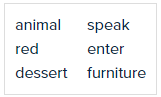
Have students use some of the exact words to create sentences. After reading both versions of the sentence and adding both nonspecific and more precise words, compare the words and their effects in the sentence. Discuss how the word choice affects the impression that the reader gets. Students will learn from this how word choice matters when it comes to tone. Inform students that later in the unit, when they create their own stories, they will be using precise language. While students are working on the exercise, it might be beneficial to go around the room and ask them questions about what is exact. They will learn how to become more specific by just taking the time to concentrate and choose the appropriate words as they focus and hone their language.
Lead the LW-7-3-1_Precise Language Activity exercise in precise language. Students should complete the precise-language note cards in pairs. Students must substitute precise nouns or verbs for ambiguous terms. After finishing, have students transfer their words to the fill-in-the-blank worksheet by matching the letter in the upper left corner of each card to the letter in the parentheses. Seek volunteers to present the class with the most absurd or humorous sentences they have ever heard.
Let students complete the LW-7-3-1_Precise Language Assignment on precise language. Utilize this to gauge how well pupils understand precise writing. Once more, going around the classroom to help students who struggle with the concept can be beneficial. Ask students to volunteer to share their answers when they're done, then have them all add to their worksheets. This exchange of additional ideas can improve everyone's writing vocabulary.
Part 3
"You have studied sentences to create precise language, and you have heard some examples of vivid narrative writing. We'll talk about how exact language can be used to tell or show now. I have two passages to read. The passages discuss the same events, but they are presented in various ways. As I read, please close your eyes. Try to visualize what I read in your mind." Give the class two passages to read. An excerpt from a book or short story that serves as a "showing" should come first. A "telling" version of the first passage should be found in the second. Inquire of the students what actions the first passage's author took that the second passage's author did not. Encourage your students to reply using words like action, detail, imagery, and exaggeration. Suggested passages:
1. Passage one: Take the first three paragraphs of Carl Hiaasen's Flush, chapter six.
Passage two: When Abbey was a baby, she had a bad habit of biting. None of us liked it. She would bite our arms, and one time she even bit a marble.
1. Passage one: Take the first twelve sentences from Pam Muñoz Ryan's Esperanza Rising chapter "Los Higos."
Passage two: It was windy that night. Esperanza had a nightmare about a bear. When the bear was about to suffocate her, Esperanza awoke. Even though she was awake, Esperanza was frightened. Then someone said her name.
1. Passage one: a well-developed passage from a story or novel that students are familiar with.
Passage two is a condensed/"telling" version of the first.
Use the Show, Don't Tell! and Strategies handout (LW-7-3-1_Show; Don't Tell Strategies) to teach students the distinction between telling and demonstrating. "Authors discover that there is a genuine distinction between narrating and illustrating a story. Telling is the act of simply explaining action as it occurs in a narrative using simple language. In contrast, writing that illustrates uses precise language, thoughts, feelings, and sensory details to bring the same events to life." Go over the tactics and discuss them with the students.
"Now let's go back to the instances I perused." Project or show a copy of the texts for the class. "Where does the author use action to show in the first passage?" Aloud, read the text to the class and highlight any relevant passages. "Where does the author use dialogue to show something?" (Highlight.) "Where does the author use imagery to show something?" (Highlight.) Ask students to go over the second passage again, noting where on a class copy they should highlight. Allow students to identify these areas on their own for the third passage, write them down, and turn them in. Check for comprehension.
Part 4
Give the assignment (LW-7-3-1_Show; Don't Tell Assignment) to the students. Inform the students that to respond to sentences that tell, they will practice utilizing various showing techniques. Assign students to groups to share their written work. Before gathering the students' written work, invite volunteers to present their "showing" paragraphs to the class. Remind the students that the "show, don't tell" approach will be employed in their narrative essay writing. "As we go around the room sharing our writing with our groups, pay attention to the various ways we can show. Some of you will use a lot of dialogue, some of you will use a lot of sensory detail, and some of you may use precise words most of the time. You have a ton of options; that's the point. Learning how to "paint a picture" for your audience is one of the pleasures of writing a narrative." Select three instances to draw attention to and show the class.
Extension:
Ask students to look through the book or books they are reading right now for instances of precise language.
Provide each student with an anonymous list of imprecise sentences that were compiled from their earlier essays. Request that students rewrite the ambiguous sentences using clearer language.
Give the class a reading of Josephine Nobisso's picture book Show, Don't Tell!: Secrets of Writing.

Precise Diction (LW-7-3-1)
Students will learn to write with precise diction and to demonstrate with action, dialogue, and imagery. At the end of this lesson, students are going to:
- learn the definition of precise.
- practice making imprecise words precise.
- compose using clear and concise language.
- study the differences between telling and showing.
- change "telling" sentences to "showing" paragraphs.


