


























Views
Downloads


Essential Algebraic Expressions Worksheet | Grades 6-8
Paste this activity's link or code into your existing LMS (Google Classroom, Canvas, Teams, Schoology, Moodle, etc.).
Students can open and work on the activity right away, with no student login required.
You'll still be able to track student progress and results from your teacher account.
This comprehensive algebraic expressions worksheet provides middle school students with rigorous practice in translating verbal phrases into mathematical language. By bridging the gap between descriptive English and abstract variables, learners develop the essential fluency required for higher-order algebra. Students will transform scenarios into expressions and evaluate situational variables.
At a Glance
- Grade: 6-8 · Subject: Algebra
- Standard:
CCSS.MATH.CONTENT.6.EE.A.2— Write, read, and evaluate expressions where letters stand for numbers- Skill Focus: Translating words to algebraic expressions
- Format: 4 pages · 13 problems · Answer key included · PDF
- Best For: Middle school algebra introduction or review
- Time: 30–45 minutes
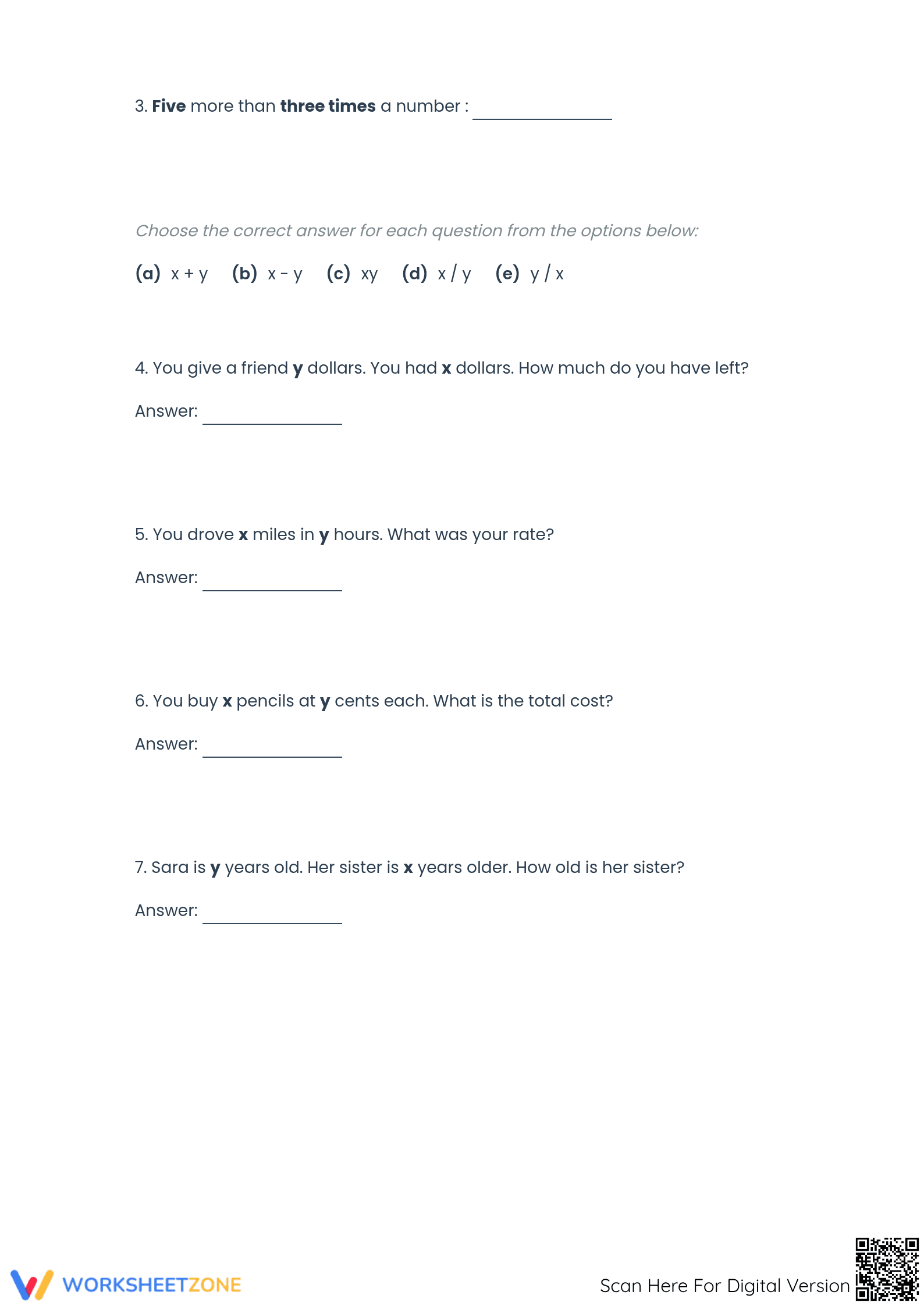
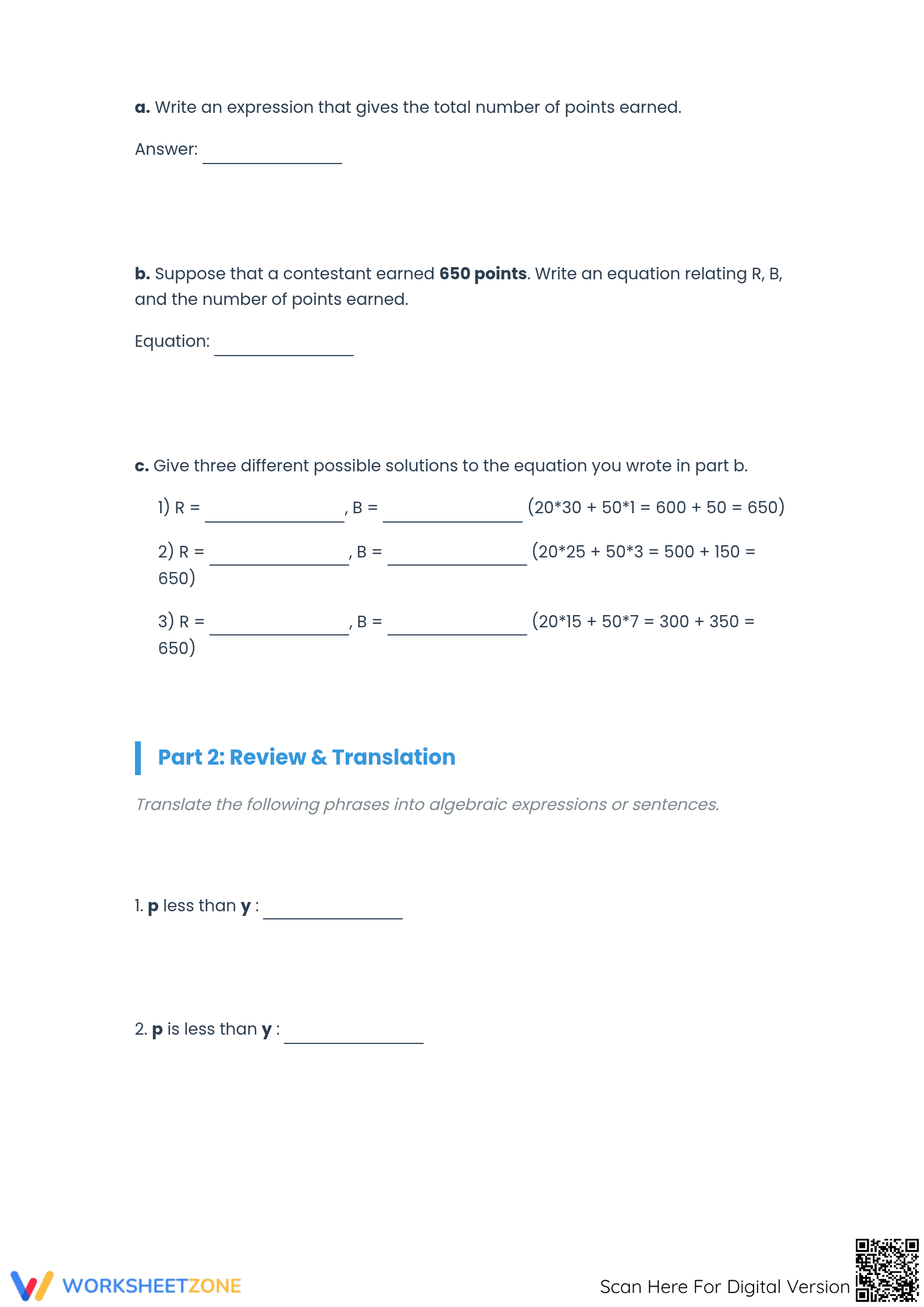
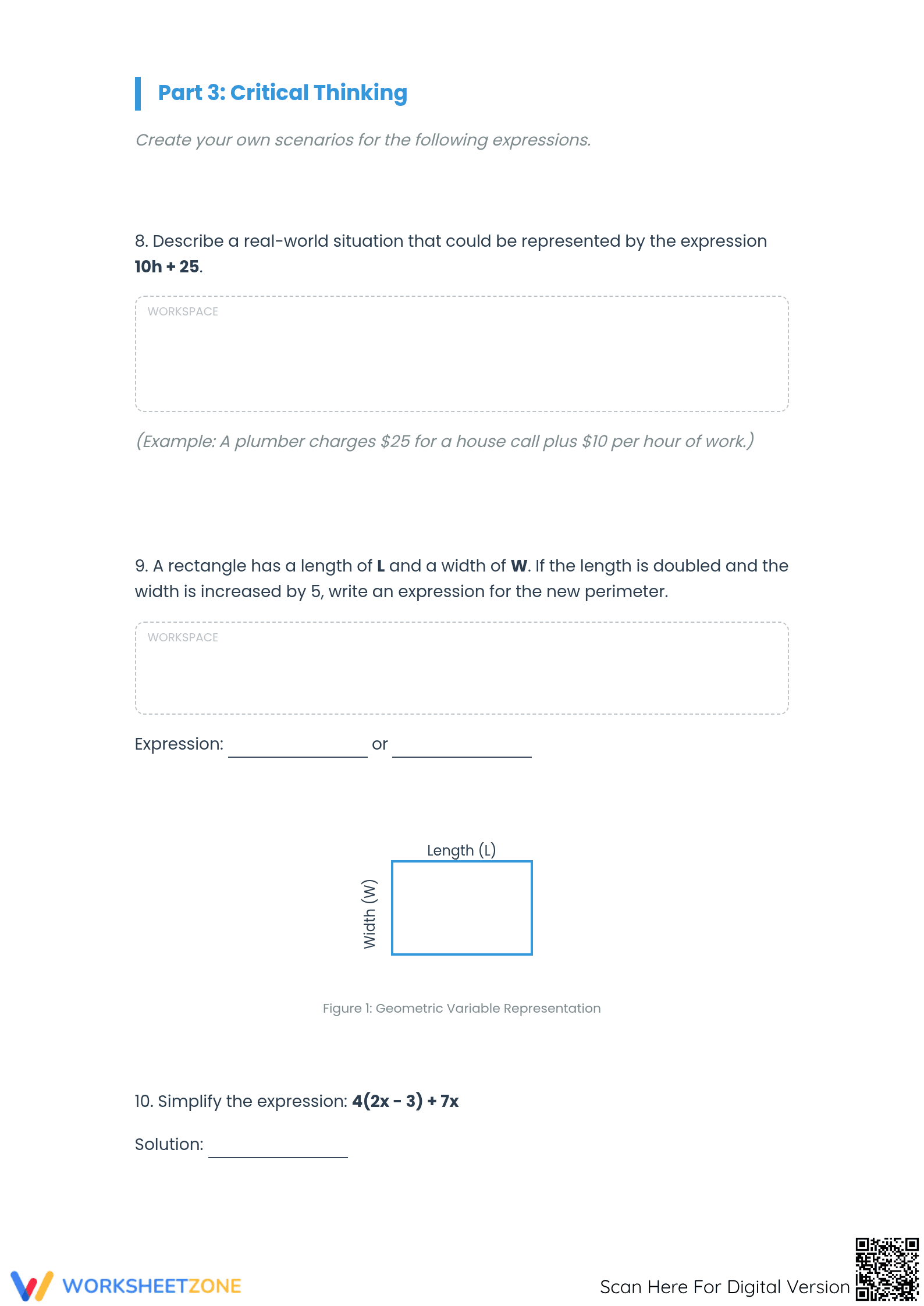
This resource features a structured layout including 13 multi-part problems. Section one focuses on direct translation of phrases like "less than" and "times a number." Section two introduces word problems involving money and distance. The final page challenges students with critical thinking tasks, including creating scenarios for given expressions and calculating perimeters. A full answer key is included.
The worksheet follows a strategic gradual-release model.
- Guided Practice: Students begin with direct verbal-to-variable translation, identifying operational keywords like "more than" or "product."
- Supported Practice: Learners apply skills to word problems where relationships between variables are defined by narrative context.
- Independent Practice: Final tasks require students to generate their own scenarios to match expressions and simplify algebraic terms independently.
This sequence ensures students move from basic phrase matching to conceptual mastery of variable relationships.
The primary focus is CCSS.MATH.CONTENT.6.EE.A.2, writing and evaluating expressions with letters for numbers. It also supports CCSS.MATH.CONTENT.7.EE.B.4 by using variables to represent quantities and construct simple equations. Both standard codes can be copied directly into lesson plans, IEP goals, or district curriculum mapping tools.
This resource is best utilized during the independent practice phase of an algebra unit. For a formative assessment, observe students during the translation of "p less than y" to catch common operational reversals. The worksheet requires 30 to 45 minutes for completion, making it an ideal choice for seatwork or a comprehensive homework assignment.
This practice set is designed for Grade 6 through Grade 8 students. It is effective for learners who struggle with word-to-math translation or those needing extra scaffolding before multi-step equation solving. Pair this worksheet with a coordinate plane activity or a direct instruction lesson on combining like terms.
The CCSS.MATH.CONTENT.6.EE.A.2 standard requires students to translate word phrases into mathematical language, a foundational bridge to higher-order algebra and functions. This worksheet targets that transition by moving students through three distinct phases of cognitive demand: simple one-variable translation, multi-variable situational modeling, and abstract simplification of terms. Research from Fisher & Frey (2014) emphasizes that gradual release models—moving from guided phrase matching to independent scenario creation—significantly improve long-term retention of variable-based logic. By grounding abstract symbols in concrete examples, such as monetary transactions and geometric perimeter calculations, students develop a more robust mental model for how variables operate as placeholders for unknown quantities. This specific practice set provides the necessary scaffolding to move middle school learners beyond rote memorization and toward the conceptual flexibility required for complex equation solving and function analysis in high school curricula. Use this resource to build reliable fluency in mathematical literacy.


