


























Views
Downloads

Printable Powers and Roots Worksheet | Essential Algebra
Paste this activity's link or code into your existing LMS (Google Classroom, Canvas, Teams, Schoology, Moodle, etc.).
Students can open and work on the activity right away, with no student login required.
You'll still be able to track student progress and results from your teacher account.
This comprehensive powers and roots worksheet enables middle and high school students to master exponential notation and radical evaluation. Learners transition from conceptual understanding of negative bases to high-level estimation of irrational roots. This resource ensures students build the computational fluency required for advanced algebraic functions and real-world mathematical modeling.
At a Glance
- Grade: 8–12 · Subject: Mathematics
- Standard:
CCSS.MATH.CONTENT.8.EE.A.2— Use square root and cube root symbols to represent solutions to equations.- Skill Focus: Powers, roots, and negative bases
- Format: 2 pages · 32 problems · Answer key included · PDF
- Best For: Algebra skill reinforcement and assessment
- Time: 20–30 minutes
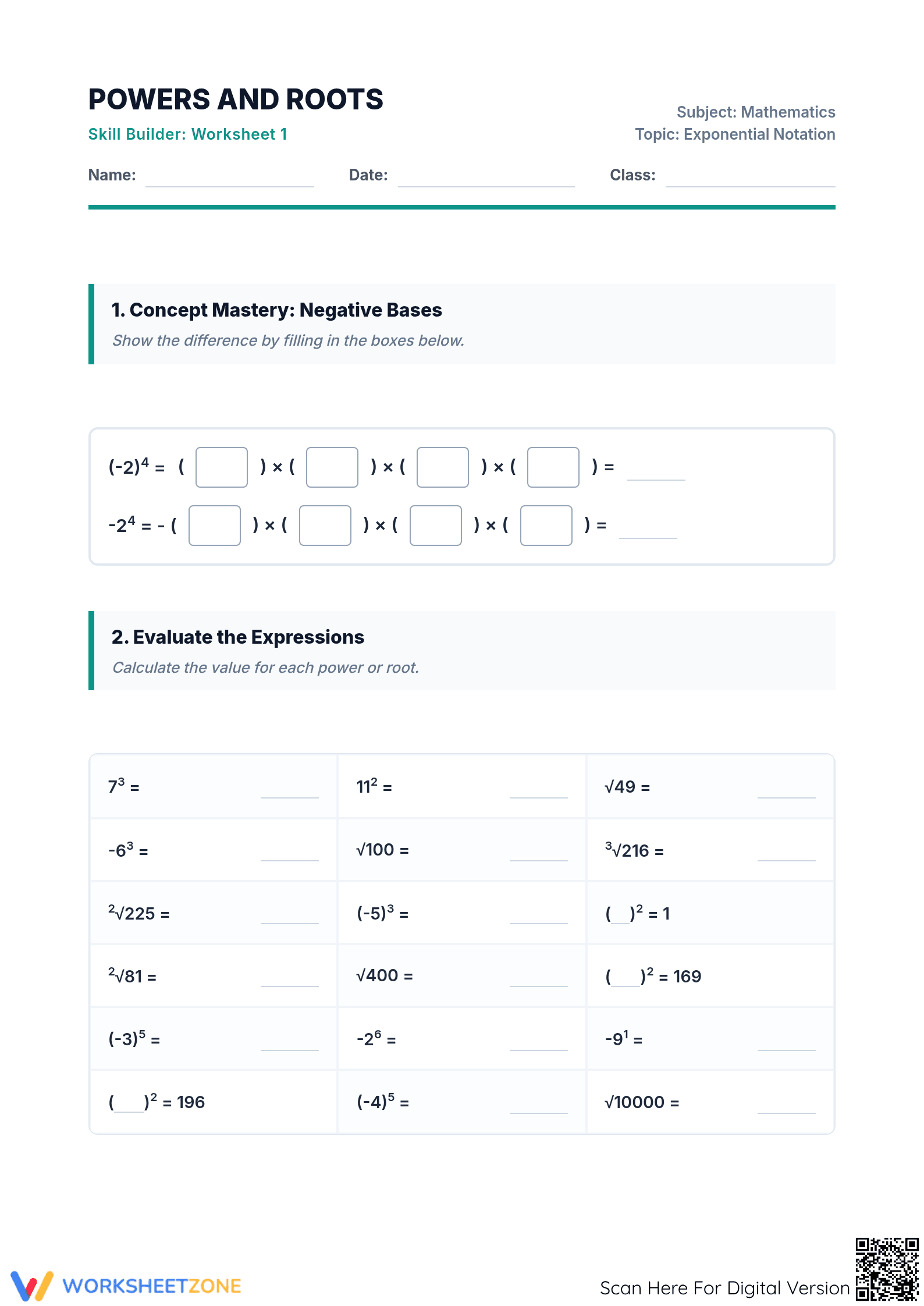
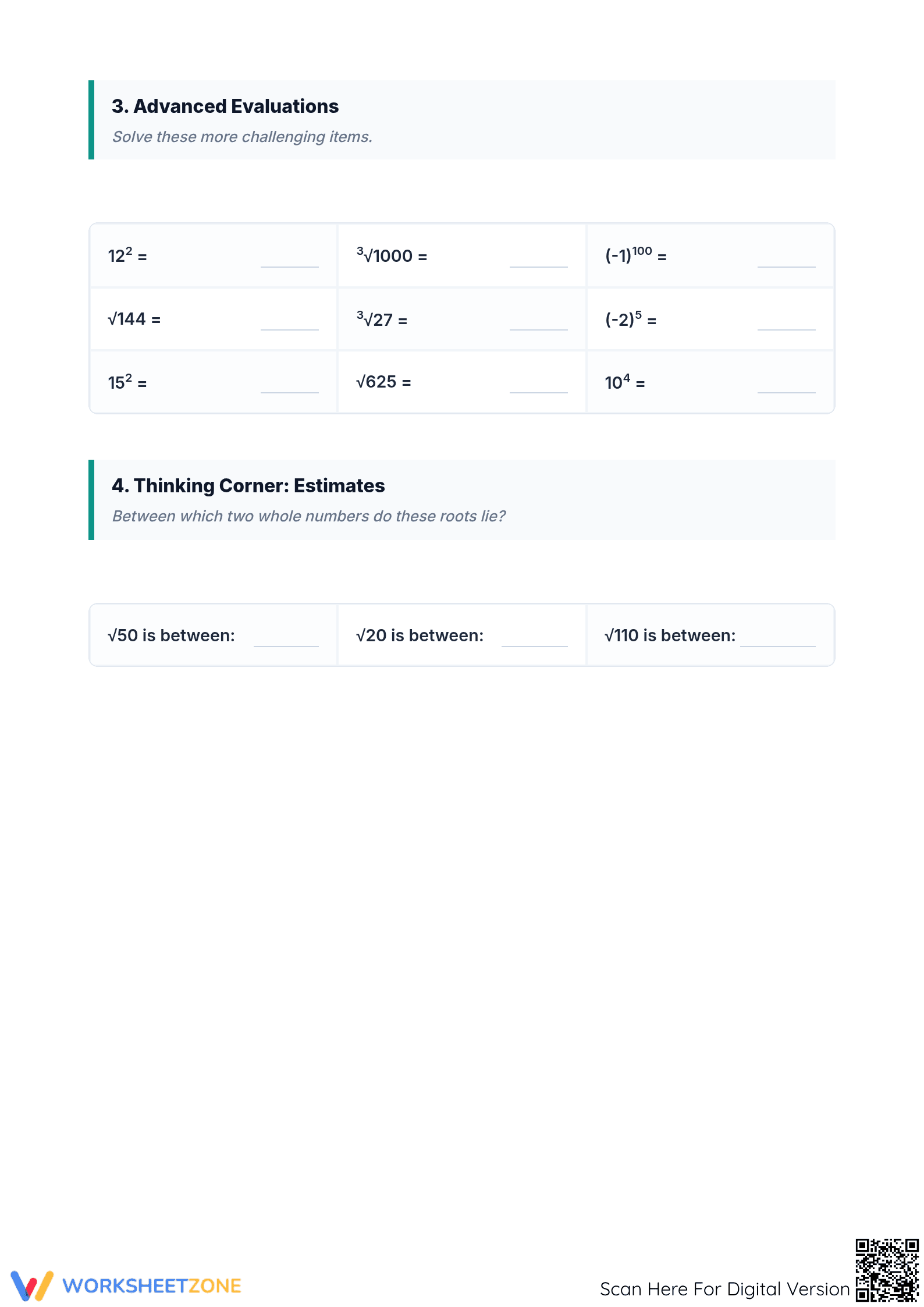
This two-page PDF features 32 tasks organized into four quadrants. It begins with expanded notation boxes to clarify the impact of parentheses on negative bases, followed by 18 evaluation problems covering square, cube, and higher-order roots. Page two includes advanced evaluations with larger exponents and a "Thinking Corner" for estimating non-perfect square roots between whole numbers.
Skill Progression
- Guided Practice: 2 conceptual problems use visual boxes to scaffold the difference between $(-2)^4$ and $-2^4$, preventing common notation errors.
- Supported Practice: 18 calculation tasks reinforce the relationship between exponents and radicals through perfect squares and cubes.
- Independent Practice: 12 advanced items challenge students to evaluate high-value powers and estimate irrational roots without a calculator.
Students follow a gradual-release model moving from procedural expanded notation to abstract mental estimation of irrational values.
Standards Alignment
The primary focus is CCSS.MATH.CONTENT.8.EE.A.2, evaluating square and cube roots of perfect values. It also addresses CCSS.MATH.CONTENT.8.EE.A.1 through integer exponent properties and the behavior of negative bases. Both standard codes can be copied directly into lesson plans, IEP goals, or district curriculum mapping tools.
How to Use It
Assign this for targeted practice following instruction on exponent properties. It is an excellent formative assessment; check Section 1 early to ensure students correctly handle negative bases. Expect completion in 25 minutes, making it ideal for a main lesson block or structured homework assignment to verify student mastery.
Who It's For
This resource is for Grade 8 Pre-Algebra and High School Algebra students. It scaffolds for struggling learners via expanded notation while extending for advanced students with root estimation. Pair this worksheet with a square root anchor chart or a "Powers" reference table to support computational fluency.
According to NAEP data, students often struggle with the conceptual distinction between negative bases with and without parentheses. This worksheet addresses this gap through the expanded notation methodology championed by Fisher & Frey (2014). By requiring students to show repeated multiplication for negative integers, the resource builds a durable mental model of how exponents interact with sign values. The inclusion of root estimation tasks aligns with RAND AIRS 2024 recommendations for developing number sense alongside procedural fluency. Evaluating √50 as a value between 7 and 8 reinforces the connection between geometry and algebra, preparing students for the demands of quadratic equations and irrational number systems found in high school curricula. This approach ensures that students do not merely memorize rules but understand the underlying arithmetic logic required for success in STEM-related college and career pathways.


