


























Views
Downloads
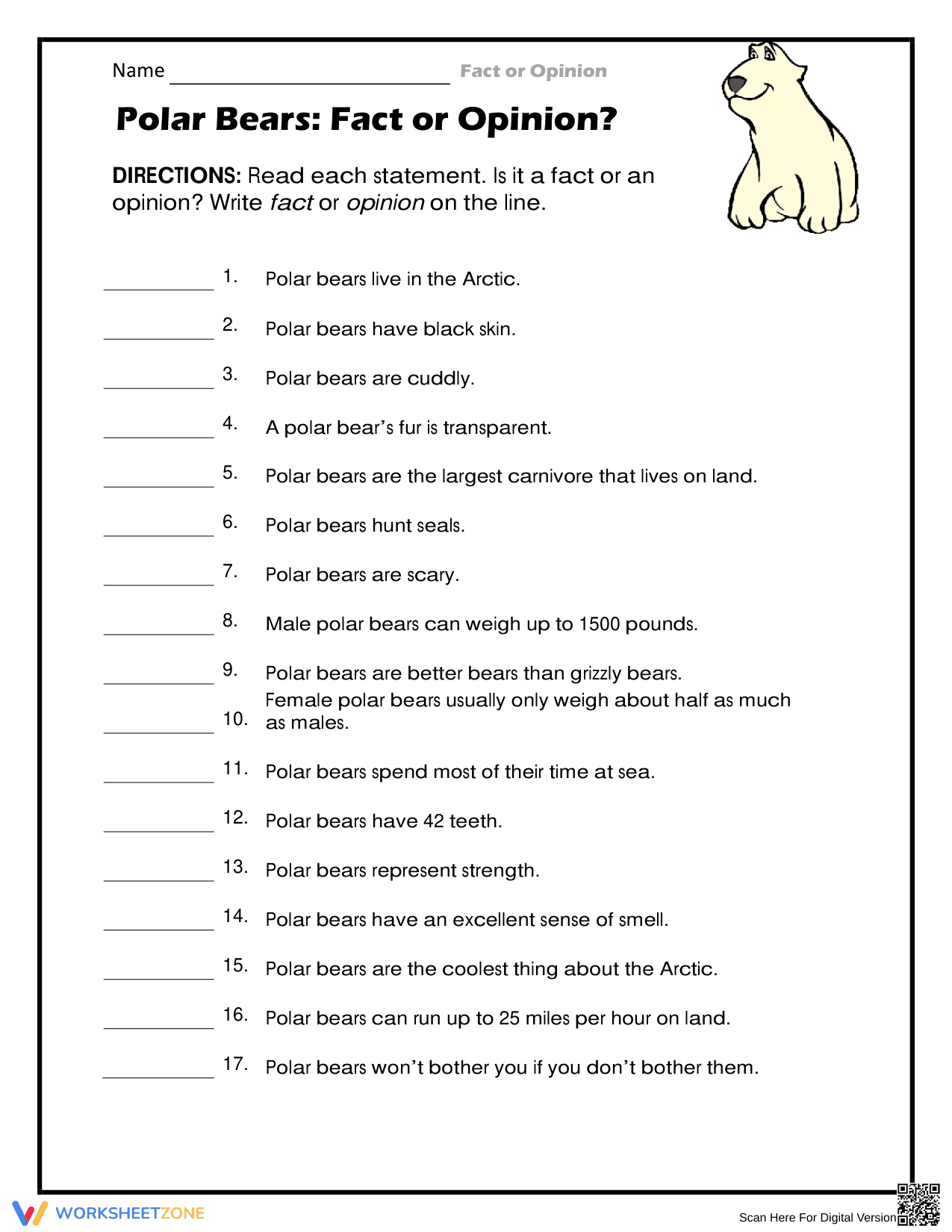

Grade 3 Polar Bears Fact or Opinion Worksheet | Printable
Paste this activity's link or code into your existing LMS (Google Classroom, Canvas, Teams, Schoology, Moodle, etc.).
Students can open and work on the activity right away, with no student login required.
You'll still be able to track student progress and results from your teacher account.
This Grade 3 polar bears worksheet focuses on the critical literacy skill of distinguishing between facts and opinions. Students analyze 17 different statements about Arctic wildlife to determine which can be proven with evidence and which express a personal belief. This essential practice builds a foundation for reading comprehension, research, and persuasive writing.
At a Glance
- Grade: 3 · Subject: English Language Arts
- Standard:
CCSS.ELA-LITERACY.RI.3.6— Distinguish their own point of view from that of the author- Skill Focus: Fact vs. Opinion Identification
- Format: 1 page · 17 problems · Answer key included · PDF
- Best For: Independent practice or morning work
- Time: 15–20 minutes
Inside this resource, you will find a cleanly designed single-page worksheet featuring 17 unique statements centered on polar bear biology, habitat, and human perception. The layout is optimized for clarity, with dedicated lines for students to write "fact" or "opinion" next to each item. The worksheet includes a charming illustration of a polar bear to engage young learners and comes with a full answer key for rapid grading or self-correction.
The zero-prep workflow for this resource is designed for maximum teacher efficiency. First, print the single-page PDF in seconds. Second, distribute the copies to your students; no scissors, glue, or additional materials are required. Third, review the results using the provided answer key in under two minutes. This streamlined process makes it an ideal choice for substitute lesson plans, emergency filler activities, or transition periods.
This worksheet is aligned with `CCSS.ELA-LITERACY.RI.3.6`, which requires students to distinguish their own point of view from that of the author of a text. By identifying which statements about polar bears are objective facts and which are subjective opinions, students develop the analytical skills necessary for critical reading. This standard code can be copied directly into lesson plans, IEP goals, or district curriculum mapping tools.
Use this worksheet as a formative assessment after a direct instruction lesson on the differences between facts and opinions. As students work, circulate through the room and observe whether they struggle with statements that use adjectives, which is a key indicator of their mastery level. Alternatively, assign it as a post-reading activity after a science unit on Arctic animals to reinforce content-area vocabulary and informational text skills. Completion typically takes 15 to 20 minutes.
This resource is designed for Grade 3 students but is also appropriate for Grade 2 learners requiring enrichment or Grade 4 students needing a quick review of core concepts. It is particularly effective for English Language Learners (ELLs) because the sentences are structured simply while still introducing specific academic vocabulary. Pair this worksheet with a non-fiction passage about polar bears or a digital slideshow on Arctic ecosystems for a comprehensive literacy experience.
Mastering the distinction between fact and opinion is a prerequisite for advanced informational literacy and media navigation. According to the RAND AIRS 2024 report, students who receive targeted practice in identifying subjective versus objective language show significant gains in their ability to evaluate the credibility of sources. This worksheet provides exactly that targeted practice through 17 specific tasks aligned to CCSS.ELA-LITERACY.RI.3.6. By focusing on a high-interest topic like polar bears, the resource reduces cognitive load, allowing students to focus on the linguistic cues that signal an opinion. This foundational skill supports long-term success in both ELA and science curricula, where students must eventually differentiate between empirical observations and hypotheses. Educators can use these results to identify gaps in logical reasoning, ensuring that learners are prepared for the complex argumentative writing tasks that define secondary educational standards.


