


























Views
Downloads
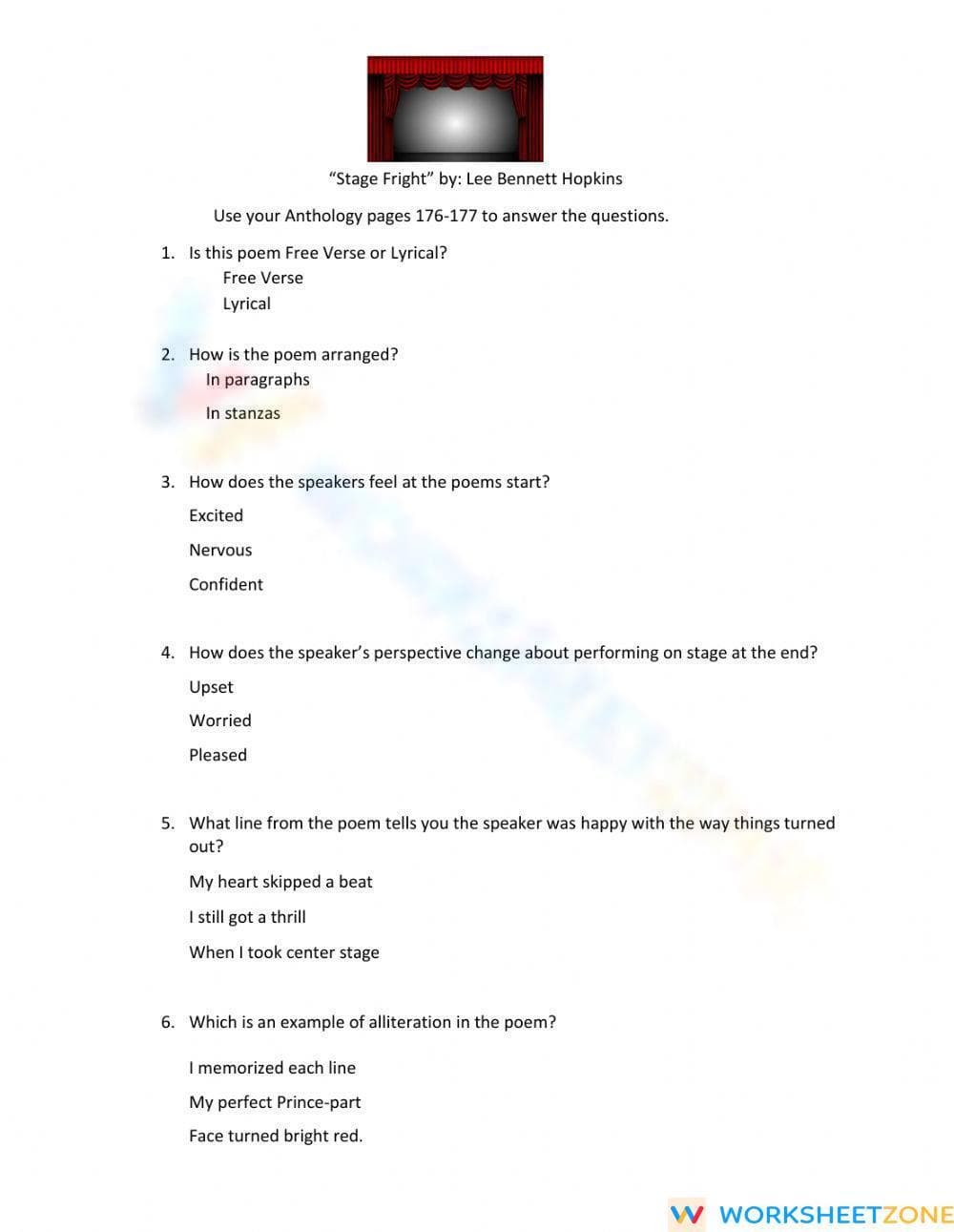


Essential Poetry Analysis Worksheet | Grade 5-6 ELA
Paste this activity's link or code into your existing LMS (Google Classroom, Canvas, Teams, Schoology, Moodle, etc.).
Students can open and work on the activity right away, with no student login required.
You'll still be able to track student progress and results from your teacher account.
This Grade 5 and 6 poetry analysis worksheet empowers students to master the nuances of literary structure and figurative language. By examining three distinct poems—"Stage Fright," "Catching Quiet," and "Foul Shot"—learners develop the skills to identify stanza arrangements, alliteration, and thematic development. This resource ensures students cite textual evidence to support interpretations.
At a Glance
- Grade: 5-6 · Subject: ELA Literature
- Standard:
CCSS.ELA-LITERACY.RL.5.5— Explain how stanzas fit together to provide the overall structure of a poem- Skill Focus: Poetry Analysis & Text Evidence
- Format: 3 pages · 13 problems · Answer key included · PDF
- Best For: Reading comprehension practice and literary analysis
- Time: 25–35 minutes
What's Inside
This comprehensive 3-page PDF features 13 structured multiple-choice and short-answer questions designed for use with a classroom anthology. Each page focuses on a different poem, challenging students to distinguish between free verse and lyrical forms, identify alliteration, and track speaker perspective shifts. The clean layout includes clear headings and supporting graphics that maintain engagement without visual clutter.
Skill Progression
- Guided Practice (Questions 1-3): Students identify basic structural elements like stanzas and poem types using direct visual cues from the text.
- Supported Practice (Questions 4-8): Learners analyze speaker perspectives and identify figurative language examples like alliteration within specific lines of the provided poems.
- Independent Practice (Questions 9-13): Students perform comparative analysis and thematic evaluation, determining how specific word choices support a central message.
This progression follows the gradual-release model, moving from concrete structural identification to abstract thematic interpretation.
Standards Alignment
The primary alignment is `CCSS.ELA-LITERACY.RL.5.5`, requiring students to explain how stanzas provide the structure of a poem. It also supports `CCSS.ELA-LITERACY.RL.5.4` by asking students to determine meanings of phrases, including alliteration. Both standard codes can be copied directly into lesson plans or curriculum mapping tools.
How to Use It
This worksheet is ideal during the "We Do" phase of a poetry unit. Teachers can distribute the pages as a formative assessment to gauge understanding of alliteration and poem types. A helpful observation tip is to watch how students navigate between questions and the text to find evidence. Completion typically takes 30 minutes.
Who It's For
Designed for Grade 5-6, this resource is effective for learners who benefit from multiple-choice options to scaffold analysis. It supports English Language Learners (ELL) with clear definitions for terms like "stanza." This worksheet pairs naturally with a poetry anchor chart or a short video lesson on narrative and free verse poetry.
The analysis of poetic structure is a cornerstone of the middle-grade ELA curriculum, directly addressing `CCSS.ELA-LITERACY.RL.5.5`. Research from Fisher & Frey (2014) on the gradual release of responsibility shows that structured practice moving from concrete structural elements to complex thematic analysis is essential for developing deep reading habits. This worksheet facilitates that transition by providing 13 targeted tasks that require students to cite evidence and explain how poetic arrangement contributes to a speaker's perspective. Recent ScienceDirect TpT Analysis (2024) indicates that zero-prep resources focused on specific standards significantly reduce teacher burnout while maintaining high instructional rigor. By integrating multiple poems like "Stage Fright" and "Foul Shot," this resource ensures students encounter diverse styles, reinforcing their ability to generalize structural concepts. This dual focus prepares students for advanced literary analysis in secondary education.


