


























Views
Downloads
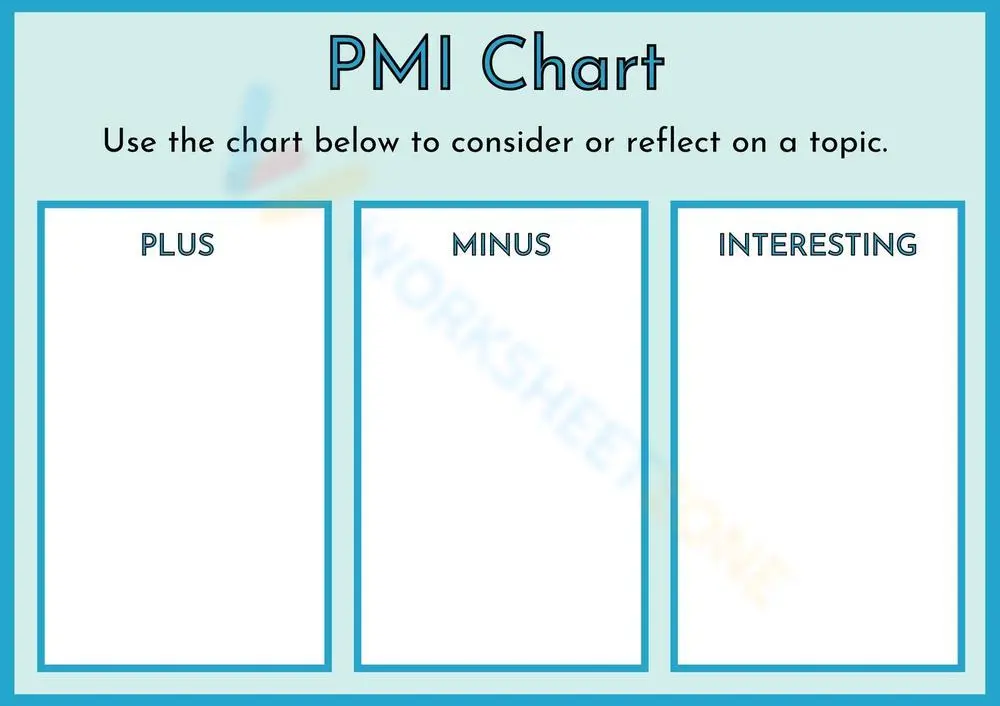

PMI Chart Worksheet | Grade 4 Essential Graphic Organizer
Paste this activity's link or code into your existing LMS (Google Classroom, Canvas, Teams, Schoology, Moodle, etc.).
Students can open and work on the activity right away, with no student login required.
You'll still be able to track student progress and results from your teacher account.
This Grade 4 PMI Chart worksheet provides a structured framework for students to evaluate complex topics through three distinct lenses. By categorizing thoughts into Plus, Minus, and Interesting columns, learners develop critical thinking skills and prepare for evidence-based writing. It is an ideal tool for brainstorming or post-reading reflection.
At a Glance
- Grade: 4 · Subject: ELA
- Standard:
CCSS.ELA-LITERACY.W.4.1— Write opinion pieces on topics or texts, supporting a point of view- Skill Focus: Critical Thinking & Reflection
- Format: 1 page · 3 categories · No answer key · PDF
- Best For: Brainstorming and evaluating new concepts
- Time: 10–15 minutes
This single-page PDF features a clean, professional layout designed to minimize visual distraction. It includes three large, labeled columns for "Plus" (positives), "Minus" (negatives), and "Interesting" (neutral observations or questions). The open-ended format allows for flexible use across various subjects, from analyzing historical events to debating scientific theories.
Zero-Prep Workflow
The workflow for this resource is designed for maximum efficiency. First, print the single-page PDF (30 seconds). Next, distribute the charts to students during the transition to independent work (1 minute). Finally, review student reflections during a whole-class share-out or use them as a formative assessment of student comprehension (5 minutes). Total teacher preparation time is under 2 minutes, making it an excellent choice for sub plans.
Standards Alignment
This resource aligns with CCSS.ELA-LITERACY.W.4.1, which requires students to write opinion pieces on topics or texts, supporting a point of view with reasons and information. By using the PMI method, students gather the necessary evidence to construct a balanced argument. This standard code can be copied directly into lesson plans, IEP goals, or district curriculum mapping tools.
How to Use It
Use this chart during the "during reading" phase of a lesson to help students track their reactions to a text in real-time. Alternatively, assign it as a post-instructional exit ticket to gauge how students perceive a new scientific discovery or historical figure. Observe if students can distinguish between a "minus" (negative) and an "interesting" (neutral) point to assess their nuance in evaluation. Completion typically takes 10 to 15 minutes.
Who It's For
This worksheet is designed for general education students in Grade 4, but it is highly effective for English Language Learners (ELLs) who benefit from the visual structure. It pairs naturally with a non-fiction reading passage or a classroom debate on a current event topic to provide a scaffolded entry point into complex discussions.
The PMI (Plus, Minus, Interesting) strategy is a recognized lateral thinking tool that encourages students to move beyond immediate emotional reactions to a topic. According to Fisher & Frey (2014), graphic organizers like the PMI chart are essential for scaffolding the transition from reading to writing, particularly when students are asked to synthesize complex information. By utilizing the CCSS.ELA-LITERACY.W.4.1 framework, this worksheet ensures that students are not just listing facts but are actively evaluating the quality and impact of those facts. Research from the NAEP indicates that students who use structured pre-writing tools consistently outperform peers in clarity and organization of written arguments. This resource provides the necessary 3-column structure to foster these higher-order thinking skills in a classroom setting, allowing for 100% student participation in the brainstorming process.


