




























Views
Downloads
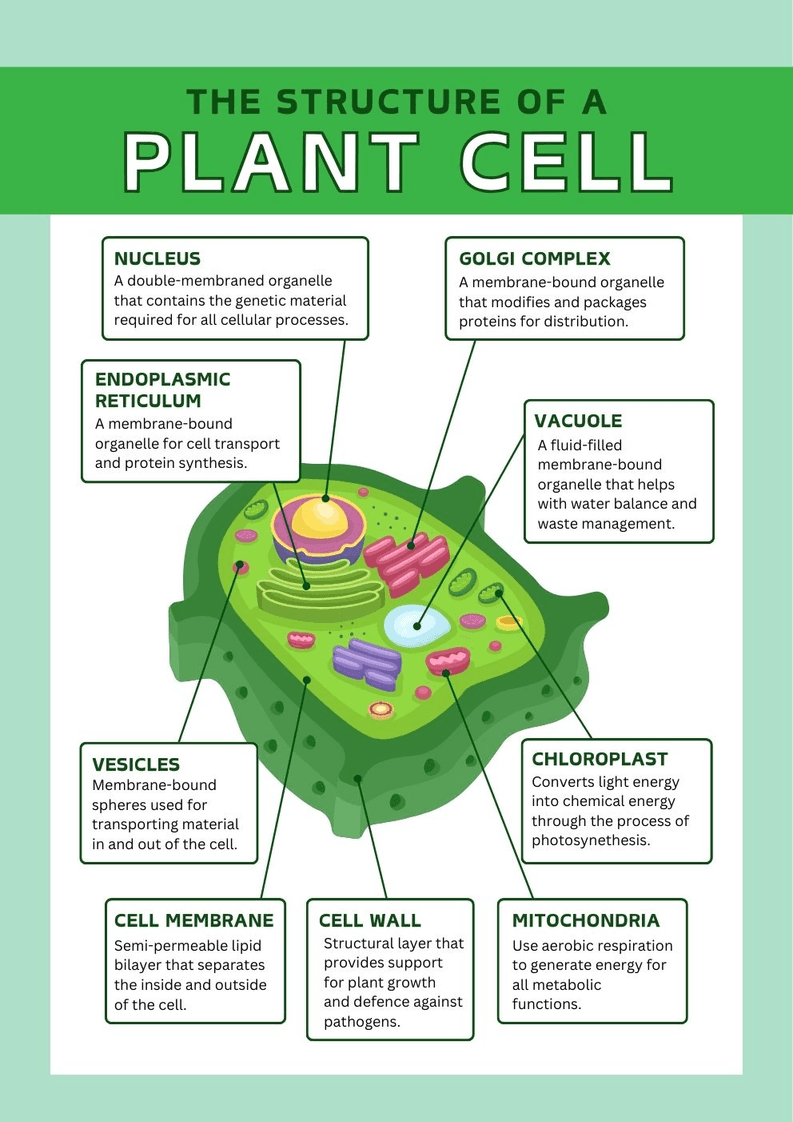

Essential Plant Cell Structure Guide | Grade 7 Science

Paste this activity's link or code into your existing LMS (Google Classroom, Canvas, Teams, Schoology, Moodle, etc.).
Students can open and work on the activity right away, with no student login required.
You'll still be able to track student progress and results from your teacher account.
This Grade 7 science resource provides a clear visual model of plant cell anatomy to help students identify organelles and understand their specific biological roles. By connecting visual structures to functional definitions, students build a foundational mental map of cellular biology necessary for mastering complex life science concepts and comparative anatomy.
At a Glance
- Grade: 7 · Subject: Science
- Standard:
MS-LS1-2— Develop and use a model to describe the function of a cell- Skill Focus: Organelle identification and function
- Format: 1 page · 0 problems · Reference Guide · PDF
- Best For: Interactive notebooks and visual reference
- Time: 10–15 minutes
This single-page PDF serves as a comprehensive visual anchor for middle school biology. It features a high-resolution cross-section of a plant cell with nine distinct callouts. Each callout identifies a major organelle—including the nucleus, chloroplast, and mitochondria—and provides a concise, one-sentence definition of its primary function within the cellular system. The layout is designed to be clean and readable, making it an ideal addition to a student science journal or a classroom poster.
The zero-prep workflow for this resource is designed for maximum efficiency. First, print the color PDF (30 seconds). Second, distribute the guide as a physical handout or upload it to your LMS for digital access (1 minute). Third, review the nine organelle functions during a brief whole-class check for understanding (5 minutes). Total teacher preparation time is under 2 minutes, making this an excellent choice for emergency sub plans or quick review sessions.
This resource aligns directly with MS-LS1-2: "Develop and use a model to describe the function of a cell as a whole and ways parts of cells contribute to the function." It specifically supports the evidence statement requiring students to identify the relationship between the structure and function of cell components. Both standard codes can be copied directly into lesson plans, IEP goals, or district curriculum mapping tools to ensure compliance with NGSS frameworks.
Use this guide during the "Explore" phase of a 5E lesson cycle to provide students with the vocabulary needed to describe cellular processes. It also serves as an excellent formative assessment tool; ask students to cover the text and identify organelles based on shape alone. Expected completion for a labeling activity using this guide is 15 minutes. It can also be used as a scaffold for students who are struggling to memorize the complex terminology of the Golgi complex or endoplasmic reticulum.
This guide is designed for Grade 7 life science students, including English Language Learners who benefit from the strong visual-to-text correlation. It pairs naturally with a microscope lab or a cell-part analogy project where students compare the cell to a factory or city. The clear labeling ensures that all students, regardless of reading level, can access the core scientific content.
According to the RAND AIRS 2024 report on science literacy, visual models are critical for middle schoolers to transition from concrete observations to abstract biological systems. This plant cell guide addresses the MS-LS1-2 standard by providing a structured model that reduces cognitive load while introducing technical vocabulary like "semi-permeable lipid bilayer" and "aerobic respiration." Research from Fisher & Frey (2014) emphasizes that high-quality visual anchors facilitate the gradual release of responsibility, allowing students to move from teacher-led identification to independent analysis of cellular functions. By providing clear, concise definitions alongside anatomical placement, this resource ensures that students develop the precise scientific language required for high-school biology readiness. The inclusion of the cell wall and chloroplast specifically differentiates this model from animal cell studies, reinforcing the unique characteristics of autotrophic organisms in the 7th-grade curriculum.


