


























Views
Downloads

Photosynthesis Word Search | Grade 7 Essential Science
Paste this activity's link or code into your existing LMS (Google Classroom, Canvas, Teams, Schoology, Moodle, etc.).
Students can open and work on the activity right away, with no student login required.
You'll still be able to track student progress and results from your teacher account.
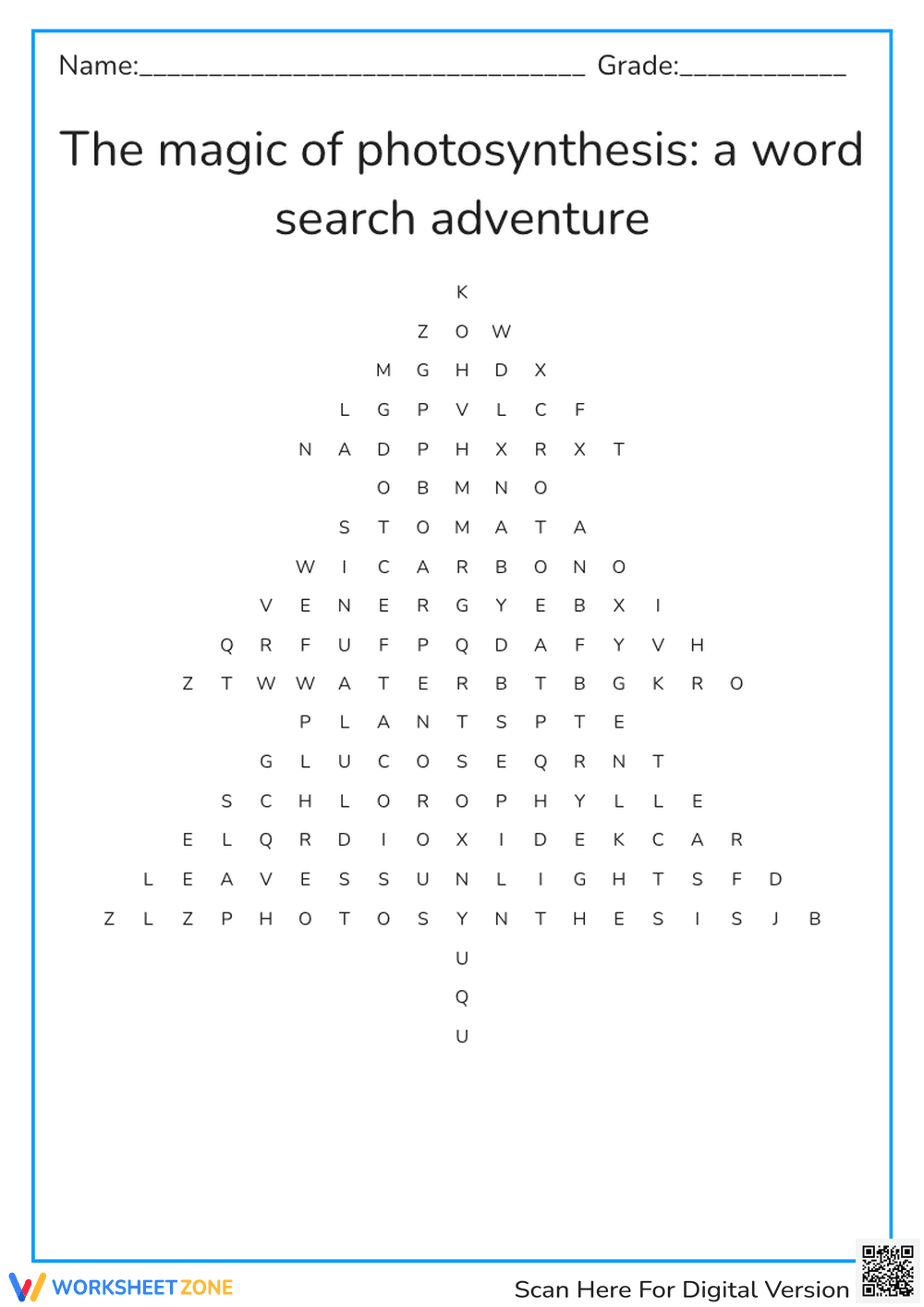
This Grade 7 photosynthesis worksheet provides a focused vocabulary activity to help students internalize the complex terminology of plant energy production. By identifying key terms within a structured grid, learners reinforce their recognition of the chemical components and biological structures essential for life on Earth before moving toward complex chemical equations.
At a Glance
- Grade: 7 · Subject: Science
- Standard:
MS-LS1-6— Construct a scientific explanation for the role of photosynthesis in cycling matter- Skill Focus: Photosynthesis Vocabulary
- Format: 2 pages · 14 terms · Answer key included · PDF
- Best For: Vocabulary reinforcement and early finishers
- Time: 15–20 minutes
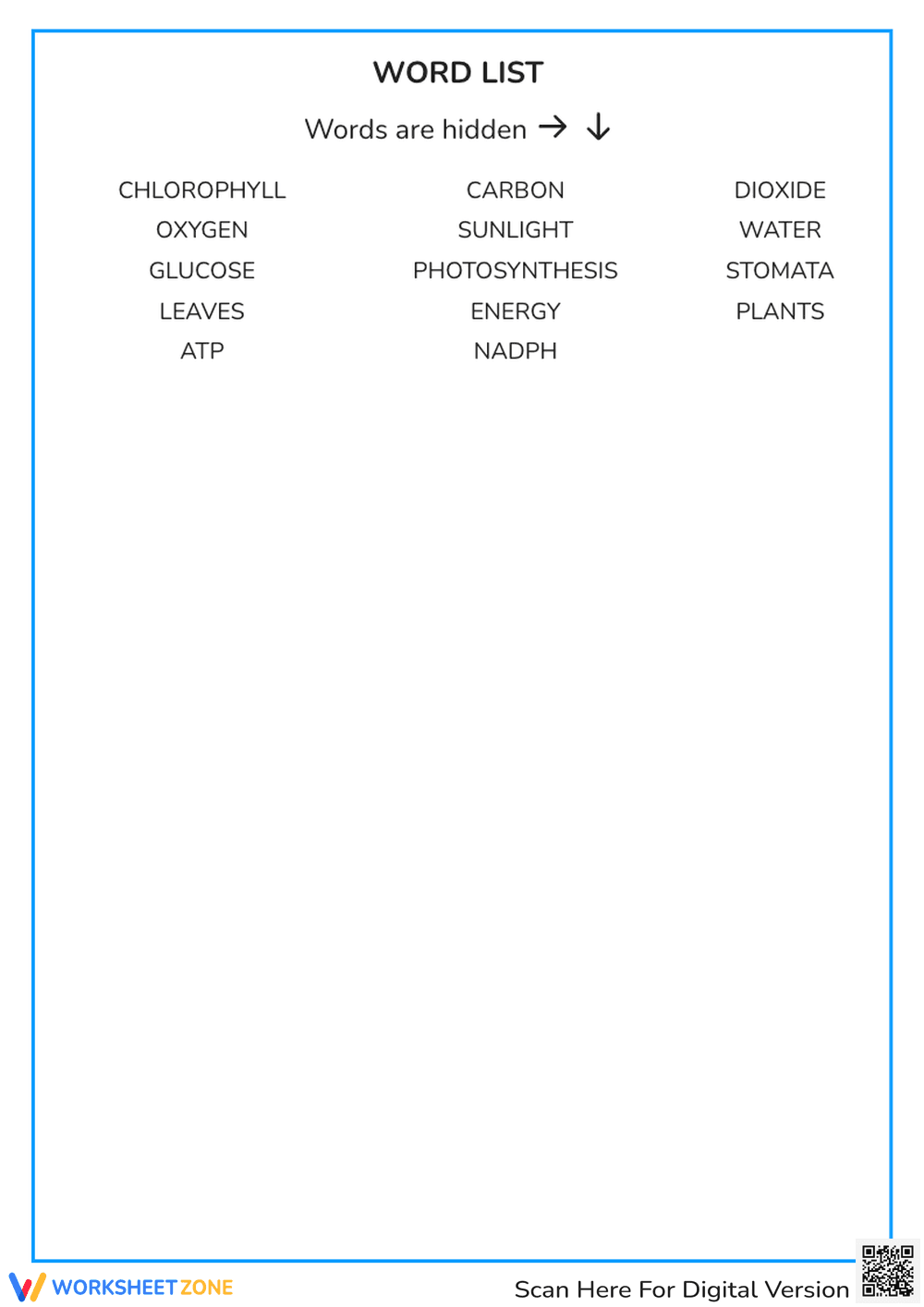
What's Inside: This two-page PDF features a unique tree-shaped word search grid containing 14 high-utility science terms. The word list includes foundational concepts like Chlorophyll and Glucose alongside advanced Grade 7 requirements such as ATP and NADPH. The layout is clean and professional, ensuring students can focus entirely on term identification without visual clutter or unnecessary distractions.
Zero-Prep Workflow
- Print: Generate copies for your entire class in less than 1 minute using the standard PDF format.
- Distribute: Hand out the sheets as a bell-ringer or transition activity to settle the class instantly.
- Review: Spend 1 minute at the end of the session defining the found terms to check for conceptual understanding.
This resource is specifically designed for emergency sub plans or low-prep instructional days where student engagement must remain high.
Standards Alignment
This resource aligns with `MS-LS1-6`. Students must construct a scientific explanation based on evidence for the role of photosynthesis in the cycling of matter and flow of energy into and out of organisms. This worksheet supports the vocabulary acquisition necessary to build those explanations. Both standard codes can be copied directly into lesson plans, IEP goals, or district curriculum mapping tools.
How to Use It
Use this as a "Do Now" activity at the start of a unit on bioenergetics to gauge prior knowledge of plant systems. Alternatively, assign it as a quiet-time task for students who complete their lab work early. It serves as an excellent formative assessment tool; as students find words, ask them to explain the role of that specific component, such as the function of the stomata or the source of sunlight energy.
Who It's For
This is designed for Grade 7 science classrooms but is suitable for any middle school life science curriculum. It provides excellent support for English Language Learners (ELL) by providing visual word recognition practice. It pairs naturally with a direct instruction lesson on the Calvin cycle or a leaf-dissection lab where these structures are observed in real-time.
According to the RAND AIRS 2024 report on instructional materials, vocabulary reinforcement through gamified recognition tasks significantly improves long-term retention of scientific nomenclature in middle school learners. This worksheet targets `MS-LS1-6` by focusing on the specific chemical inputs and outputs of the photosynthetic process, such as carbon dioxide and oxygen. Research by Fisher & Frey (2014) suggests that word-level familiarity is a prerequisite for the complex constructing explanations practice required by NGSS frameworks. By providing 14 targeted terms in a low-stakes format, this resource reduces cognitive load during the initial stages of the energy flow unit. This allows students to transition more effectively from simple identification to the higher-order analysis of how matter cycles through ecosystems. The inclusion of advanced terms like NADPH ensures the content remains rigorous for the seventh-grade level while remaining accessible to all learners.


