


























Views
Downloads

Grade 6-10 Area and Perimeter — Printable No-Prep Worksheet
Paste this activity's link or code into your existing LMS (Google Classroom, Canvas, Teams, Schoology, Moodle, etc.).
Students can open and work on the activity right away, with no student login required.
You'll still be able to track student progress and results from your teacher account.
This comprehensive geometry resource empowers students to master the calculation of perimeter and area for squares and rectangles. By progressing from basic formula application to complex real-world scenarios, learners build a deep conceptual understanding of 2D measurements. This printable packet ensures students can confidently solve for missing dimensions and apply geometry to practical life situations.
At a Glance
- Grade: 6-10 · Subject: Math
- Standard:
CCSS.MATH.CONTENT.6.G.A.1— Solve real-world and mathematical problems involving the area of special quadrilaterals- Skill Focus: Perimeter and Area of Squares and Rectangles
- Format: 4 pages · 14 problems · Answer key included · PDF
- Best For: Independent practice and formative assessment
- Time: 30–45 minutes
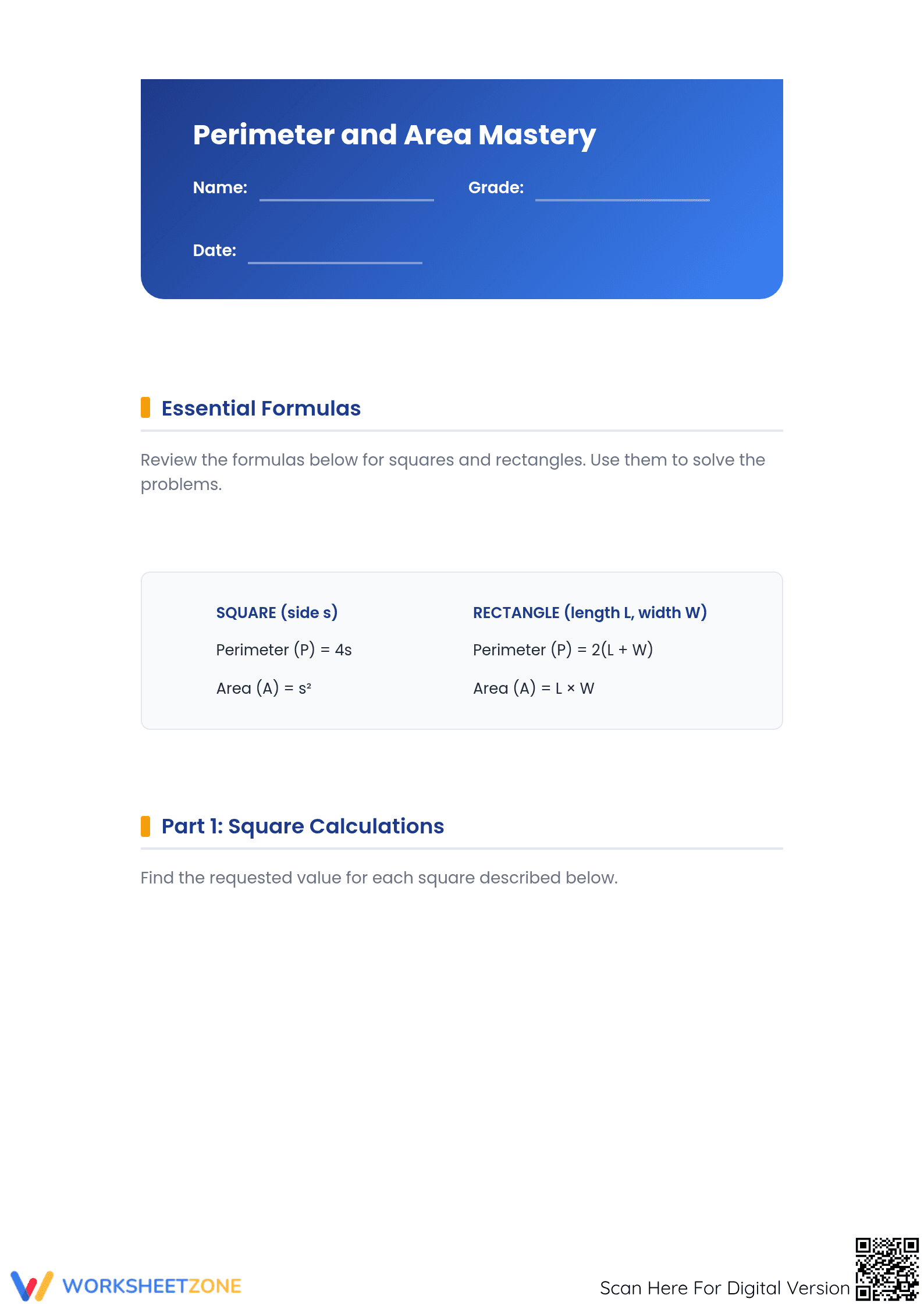
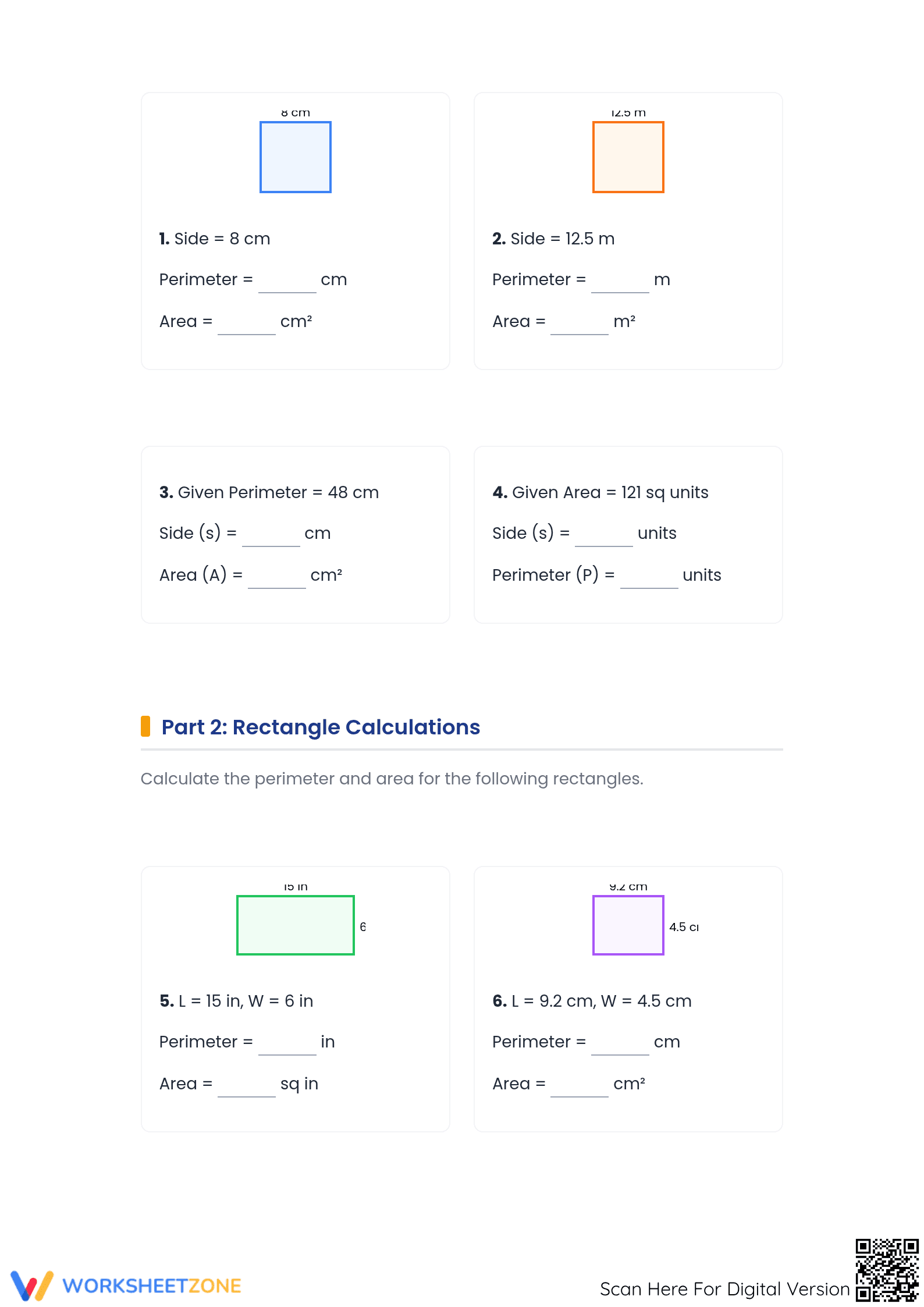
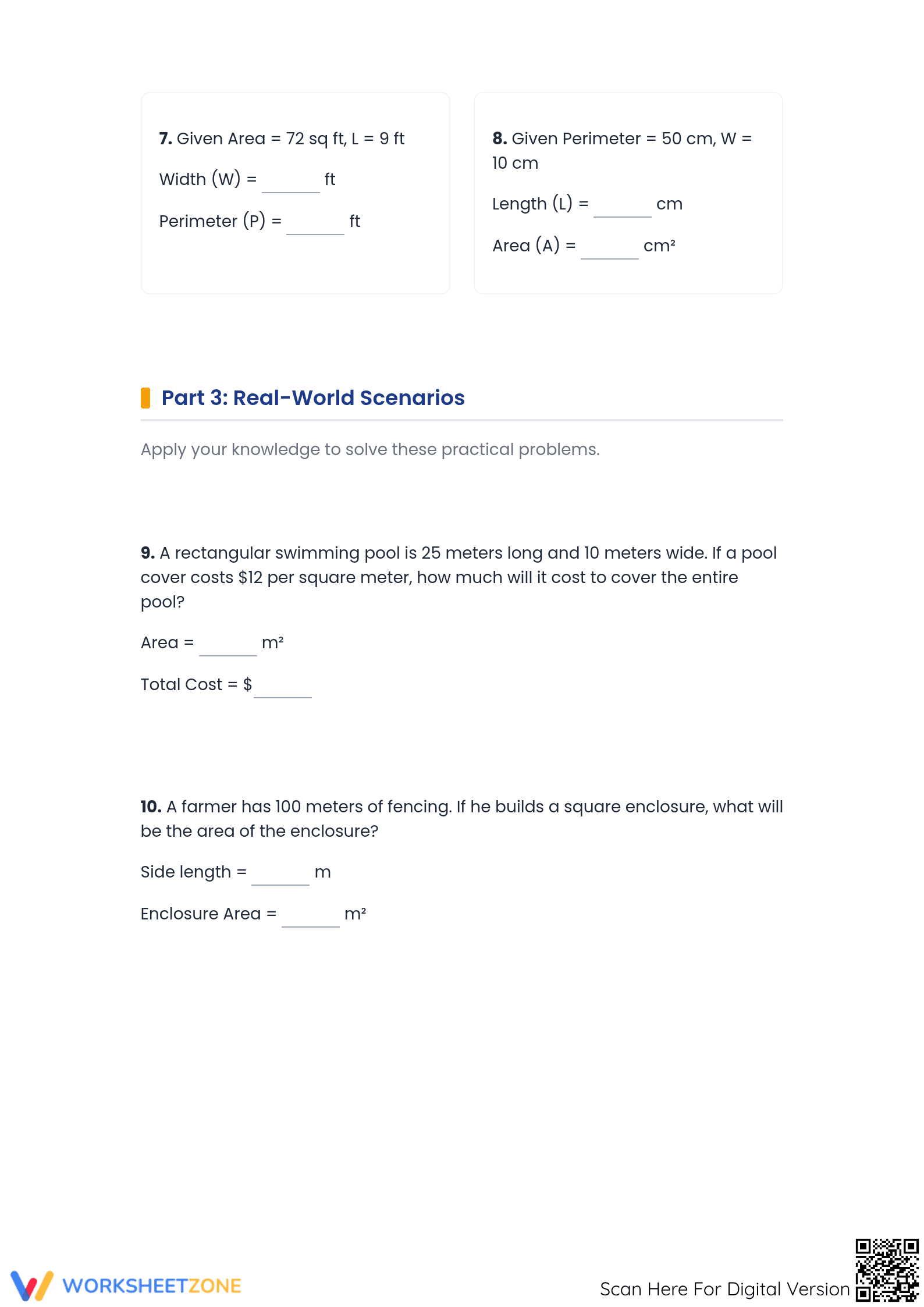
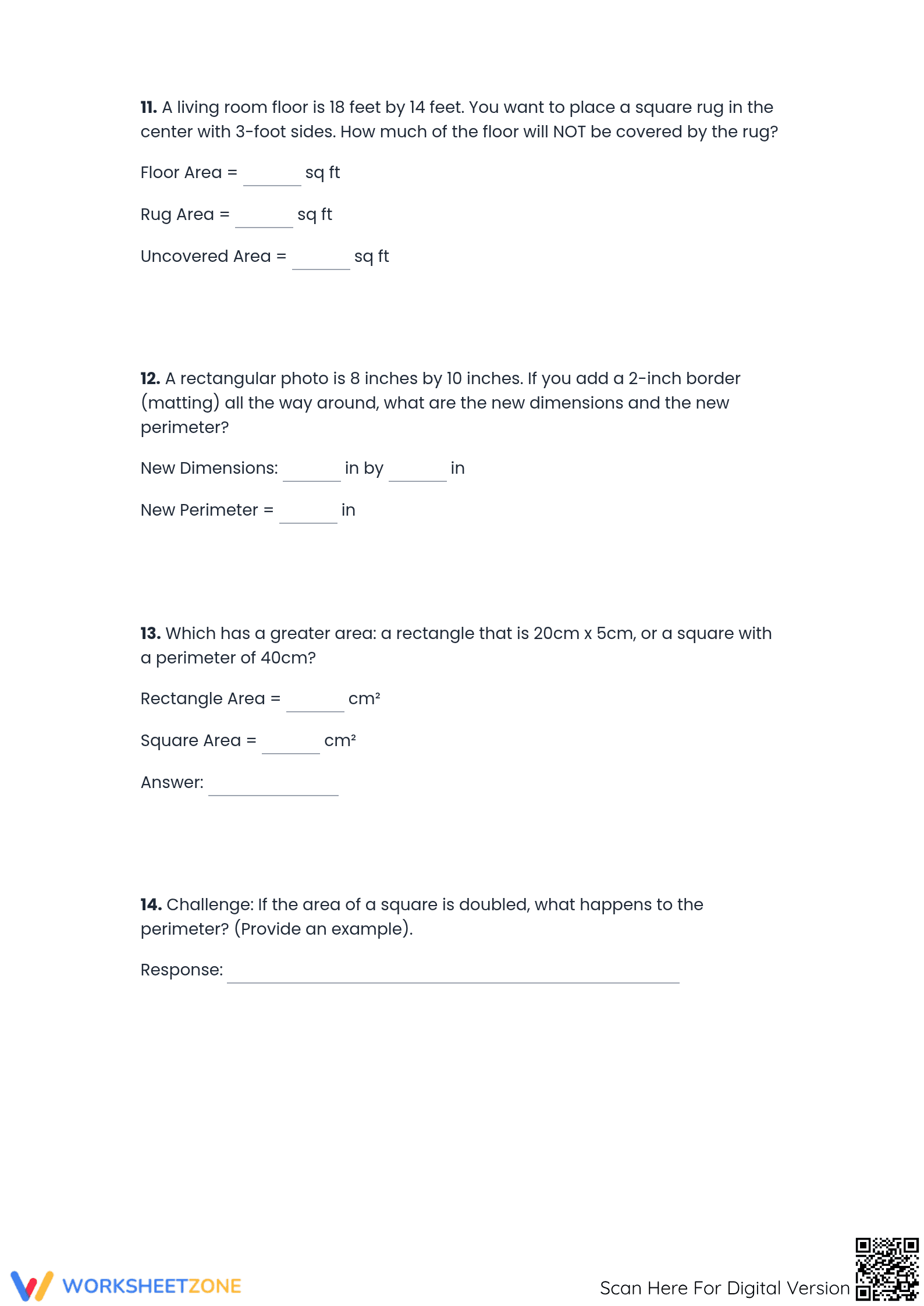
This 4-page PDF packet contains 14 structured problems designed to facilitate mathematical fluency. The first page features a dedicated Essential Formulas reference section, providing students with immediate support for both square and rectangle calculations. The worksheet is divided into three logical parts: basic square and rectangle calculations, finding missing dimensions when area or perimeter is given, and multi-step real-world application scenarios. A full answer key is included for rapid grading.
Teachers can implement this resource in under two minutes with a simple three-step process. First, print the 4-page packet or select specific pages for targeted practice (30 seconds). Second, distribute the worksheets to students during independent work time or as a sub-plan activity (1 minute). Finally, use the included answer key to provide immediate feedback or allow students to self-correct their work (30 seconds). The clear layout makes it suitable for substitute teacher packets.
The primary focus is CCSS.MATH.CONTENT.6.G.A.1, which requires students to find the area of right triangles, other triangles, special quadrilaterals, and polygons by composing into rectangles or decomposing into triangles. This worksheet directly supports this by grounding students in the foundational area properties of quadrilaterals. Both standard codes can be copied directly into lesson plans, IEP goals, or district curriculum mapping tools to ensure instructional alignment.
Use this worksheet as a summative assessment following a unit on 2D geometry or as a rigorous independent practice session during class. For a formative check, observe students during Part 3 (Real-World Scenarios) to see if they can correctly translate word problems into geometric equations. Expected completion time is approximately 40 minutes, depending on the students prior knowledge of formulas and their ability to handle multi-step algebraic solving.
This resource is designed for middle and high school students in grades 6 through 10 who are developing or refining their geometric measurement skills. It is particularly effective for students requiring extra practice with multi-step word problems or those preparing for standardized testing. It pairs naturally with a lesson on unit conversions or a project involving architectural floor plans and interior design calculations.
Calculating perimeter and area of quadrilaterals is a fundamental competency in middle school mathematics that serves as a gateway to higher-level spatial reasoning and algebra. According to research by Fisher & Frey (2014), the gradual release of responsibility—moving from the explicit formula support provided on page one to the independent application in the real-world scenarios of page four—is critical for ensuring long-term retention of mathematical concepts. This worksheet leverages this pedagogical model by providing 14 distinct tasks that bridge the gap between abstract calculation and concrete problem-solving. By requiring students to solve for missing variables (Standard CCSS.MATH.CONTENT.6.G.A.1), the resource forces a higher cognitive load than simple rote calculation. This alignment ensures that students are not merely following a procedure but are engaging in the type of rigorous mathematical thinking necessary for success in secondary mathematics and vocational applications alike.


