


























Views
Downloads

Perfect Square Roots Worksheet | Grade 8 Complete
Paste this activity's link or code into your existing LMS (Google Classroom, Canvas, Teams, Schoology, Moodle, etc.).
Students can open and work on the activity right away, with no student login required.
You'll still be able to track student progress and results from your teacher account.
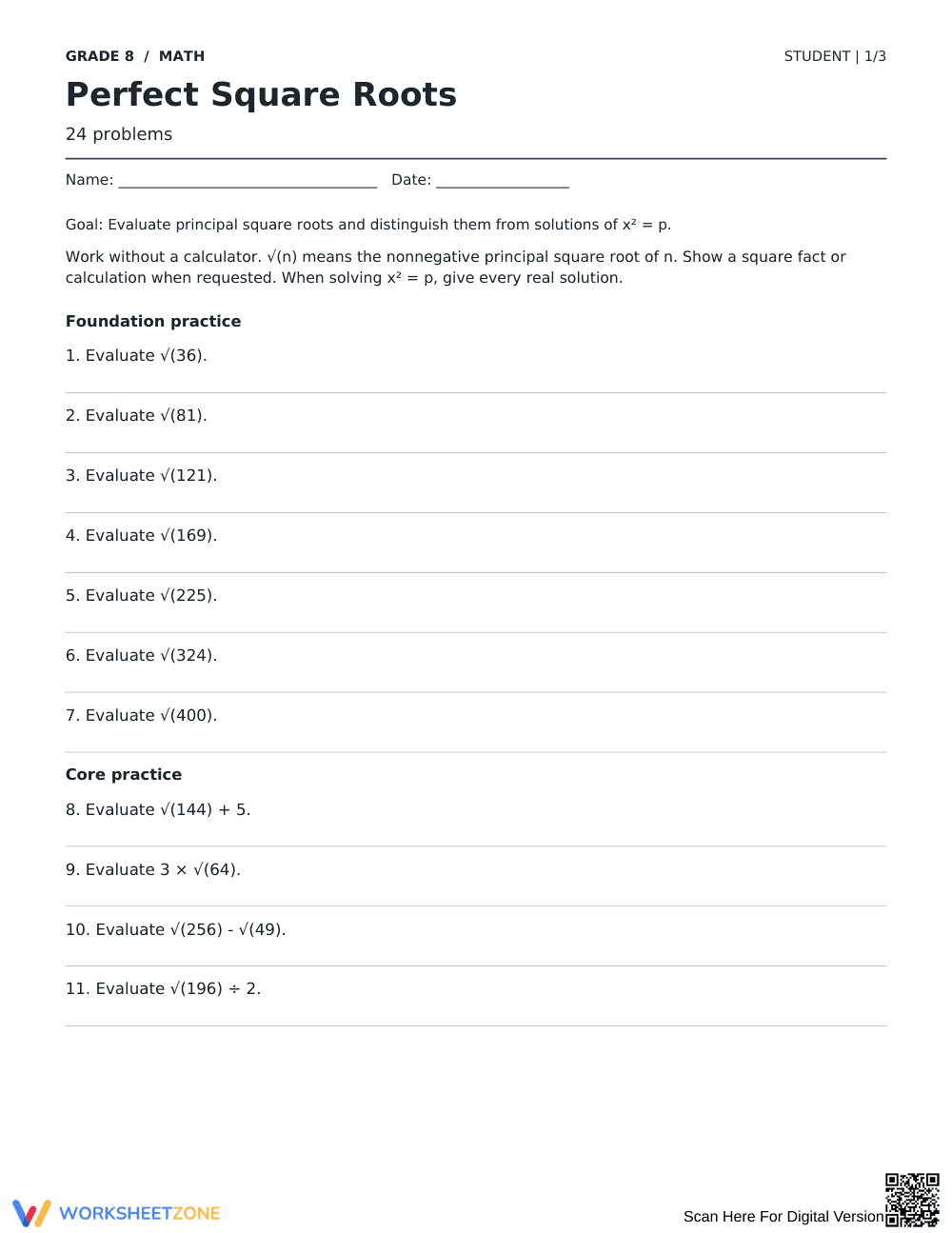
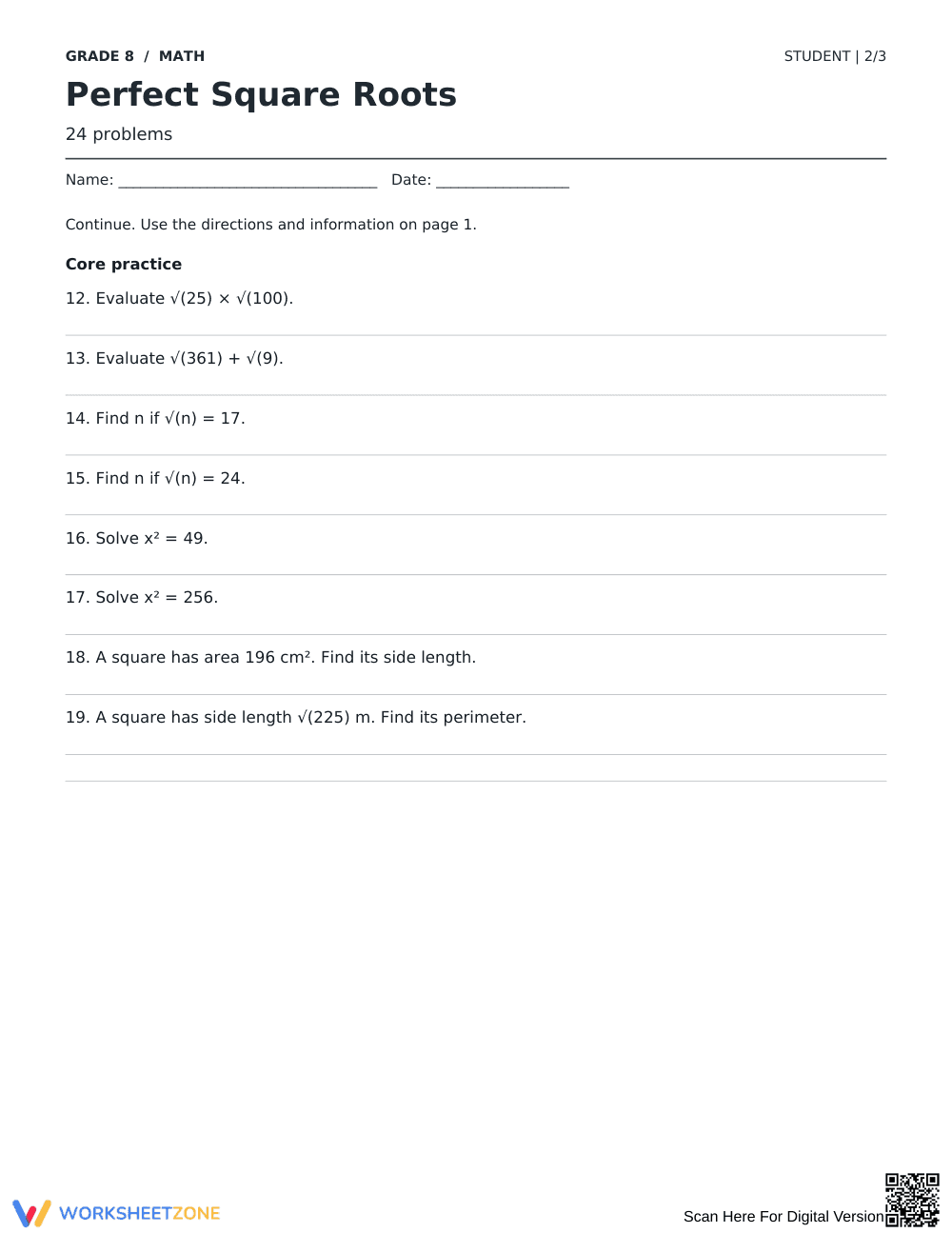
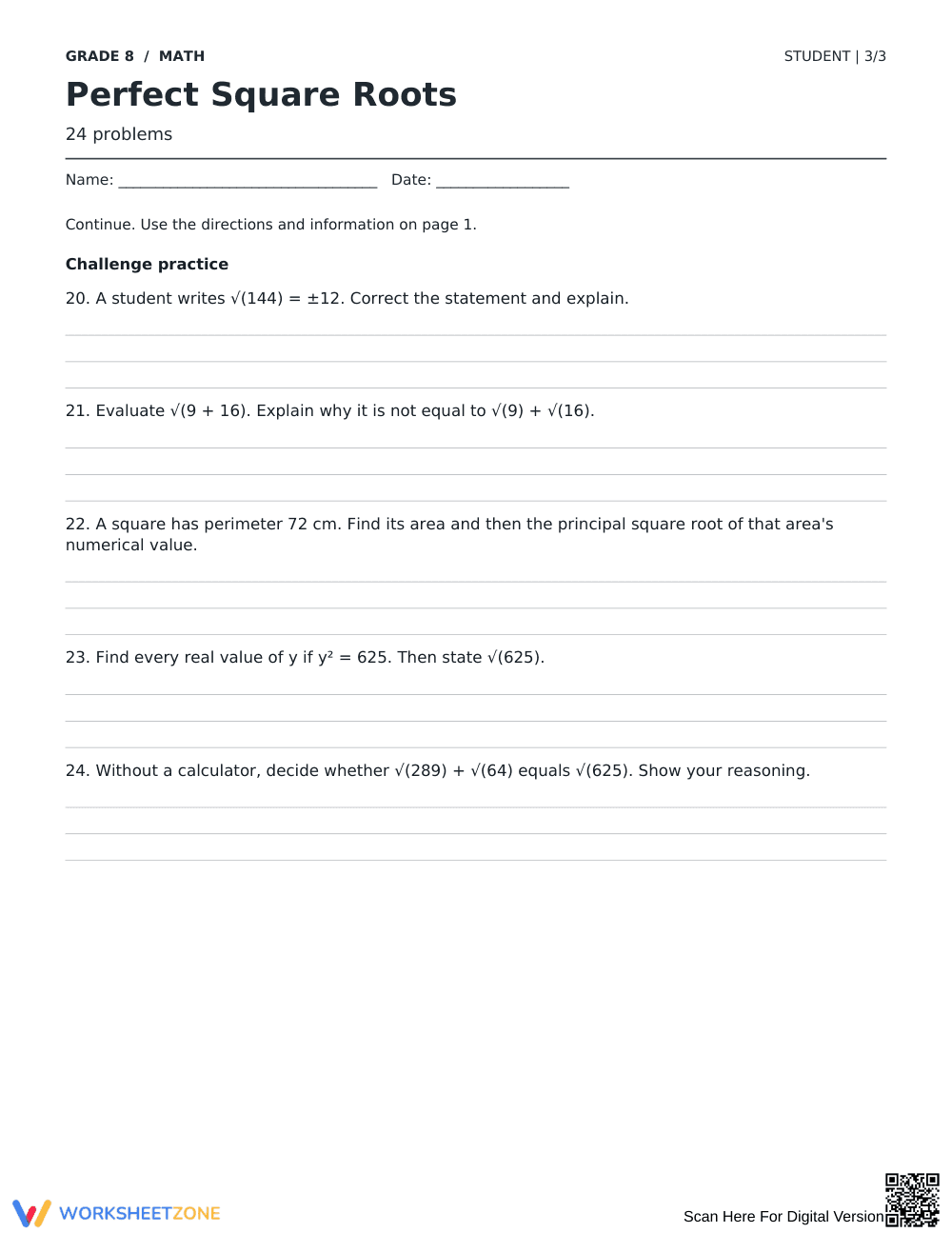
This Grade 8 math worksheet helps students evaluate principal square roots of perfect squares and solve quadratic equations of the form x² = p. Through 24 scaffolded tasks, learners solidify radical notation, distinguish principal roots from dual solutions, and solve geometric applications.
At a Glance
- Grade: 8 · Subject: Math
- Standard:
CCSS.MATH.CONTENT.8.EE.A.2— Evaluate square roots of small perfect squares and solve x² = p- Skill Focus: Principal square roots and quadratic equations
- Format: 3 pages · 24 problems · Answer key included · PDF
- Best For: Independent practice and radical review
- Time: 30–40 minutes
What's Inside
This 3-page printable set delivers 24 structured math problems divided into three clear tiers. It includes single-term radical evaluations, multi-operation arithmetic expressions, algebraic equations, geometric perimeter and area word problems, and error-analysis prompts. A complete 2-page answer key provides step-by-step solutions and point breakdown notes.
Skill Progression
- Guided practice (Problems 1–7): Students establish foundational fluency by evaluating basic principal square roots of perfect squares from 36 up to 400 without a calculator.
- Supported practice (Problems 8–19): Learners combine radical expressions with arithmetic operations, determine unknown radicands, solve equations like x² = 49, and calculate area and perimeter for geometric squares.
- Independent practice (Problems 20–24): Students tackle challenge tasks requiring written mathematical explanations, error correction regarding positive versus negative roots, and non-distributive radical properties.
This structured progression reflects the gradual-release model, guiding students smoothly from foundational recall to deep conceptual mastery.
Standards Alignment
Primary Standard: `CCSS.MATH.CONTENT.8.EE.A.2` — Use square root and cube root symbols to represent solutions to equations of the form x² = p and x³ = p, where p is a positive rational number. Evaluate square roots of small perfect squares and cube roots of small perfect cubes. Both standard codes can be copied directly into lesson plans, IEP goals, or district curriculum mapping tools.
How to Use It
Deploy this activity immediately after direct instruction on square root notation, or assign it as a targeted mid-unit review. During classwork, observe whether students include both positive and negative roots when solving equations versus identifying only the nonnegative principal root under radical signs. Expected completion time is 30 to 40 minutes.
Who It's For
Designed for general Grade 8 mathematics, Pre-Algebra, or early Algebra 1 classrooms. It offers accessible entry points for intervention while challenging advanced learners with conceptual proofs. Pair this printable with an anchor chart on perfect squares from 1 to 400.
Rigorous mathematical development requires structured opportunities to connect abstract radical notation with concrete operational meaning. According to EdReports 2024, standards-aligned practice that effectively balances procedural fluency with conceptual explanation substantially improves middle school algebraic readiness and long-term retention. This 24-problem printable worksheet directly targets standard CCSS.MATH.CONTENT.8.EE.A.2 by prompting eighth-grade students to evaluate principal square roots of small perfect squares, manipulate arithmetic expressions containing radicals, and correctly interpret dual algebraic solutions when solving quadratic equations. By scaffolding tasks from foundational single-term evaluations to complex geometric perimeter problems and analytical error-analysis prompts, learners systematically develop the critical mathematical reasoning skills needed for advanced secondary coursework. Incorporating deliberate practice with non-distributive radical rules ensures students build robust conceptual foundations, preventing common misconceptions regarding positive versus negative roots while fostering lasting confidence and precision in daily mathematical communication.


