


























Views
Downloads
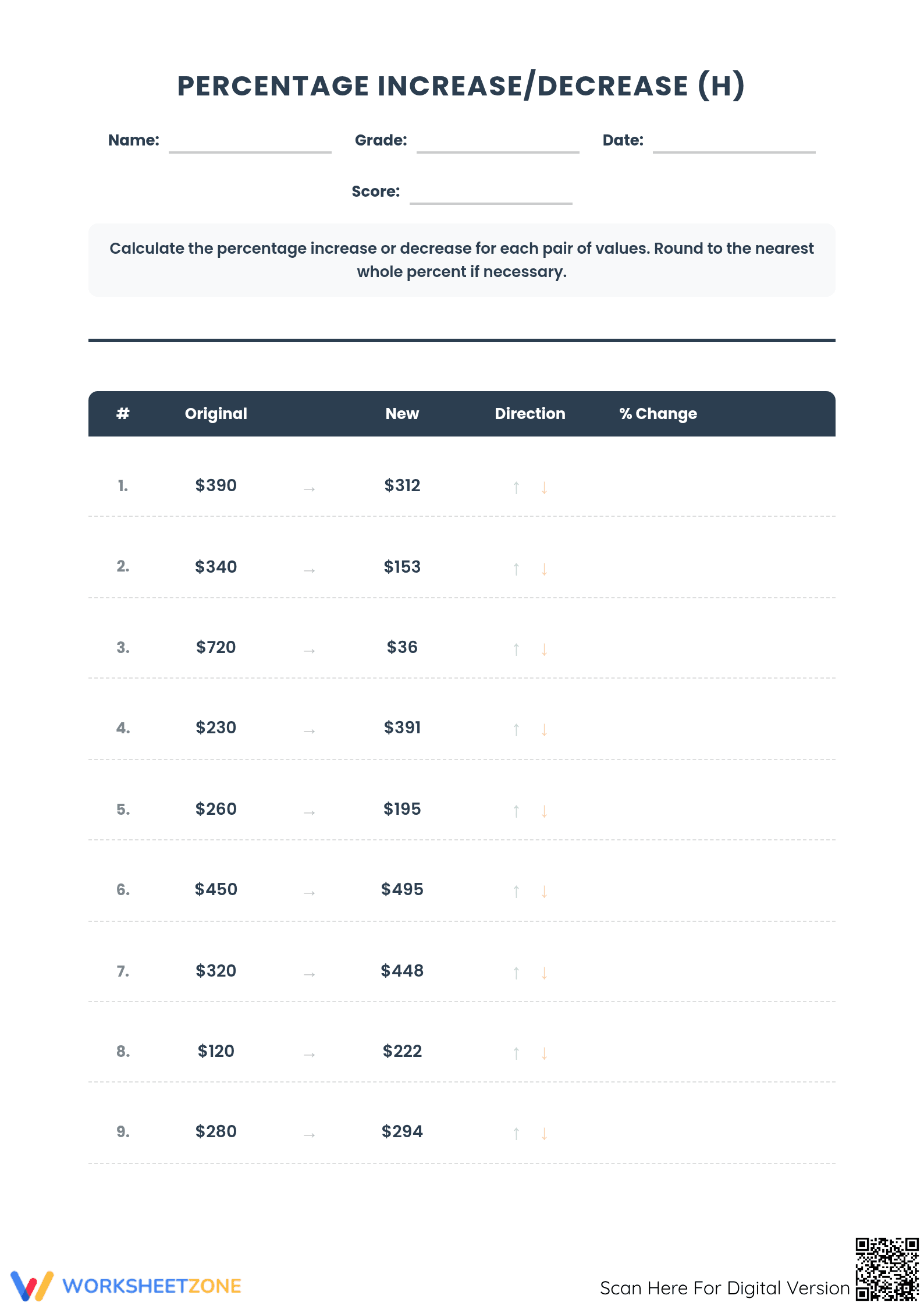
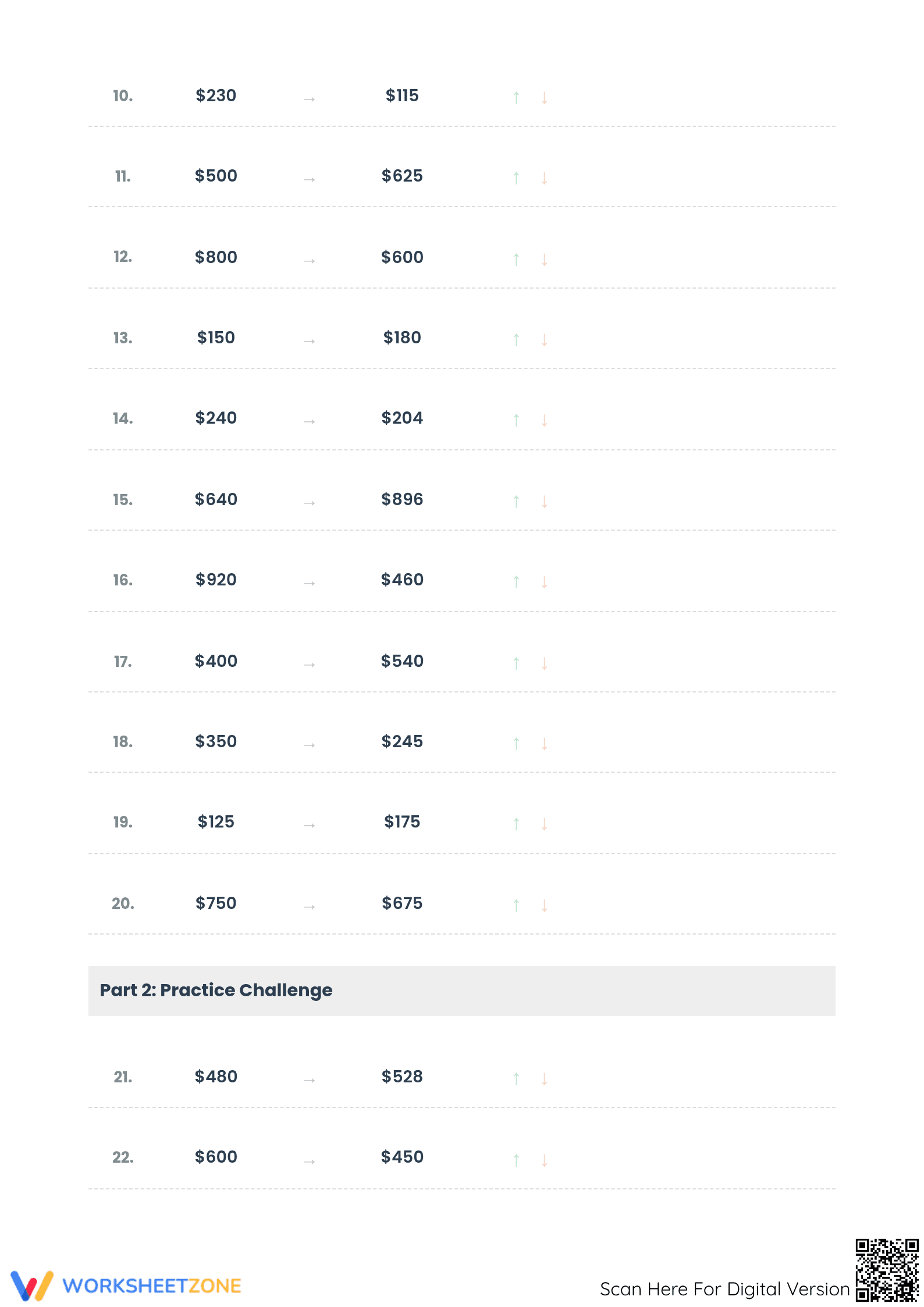
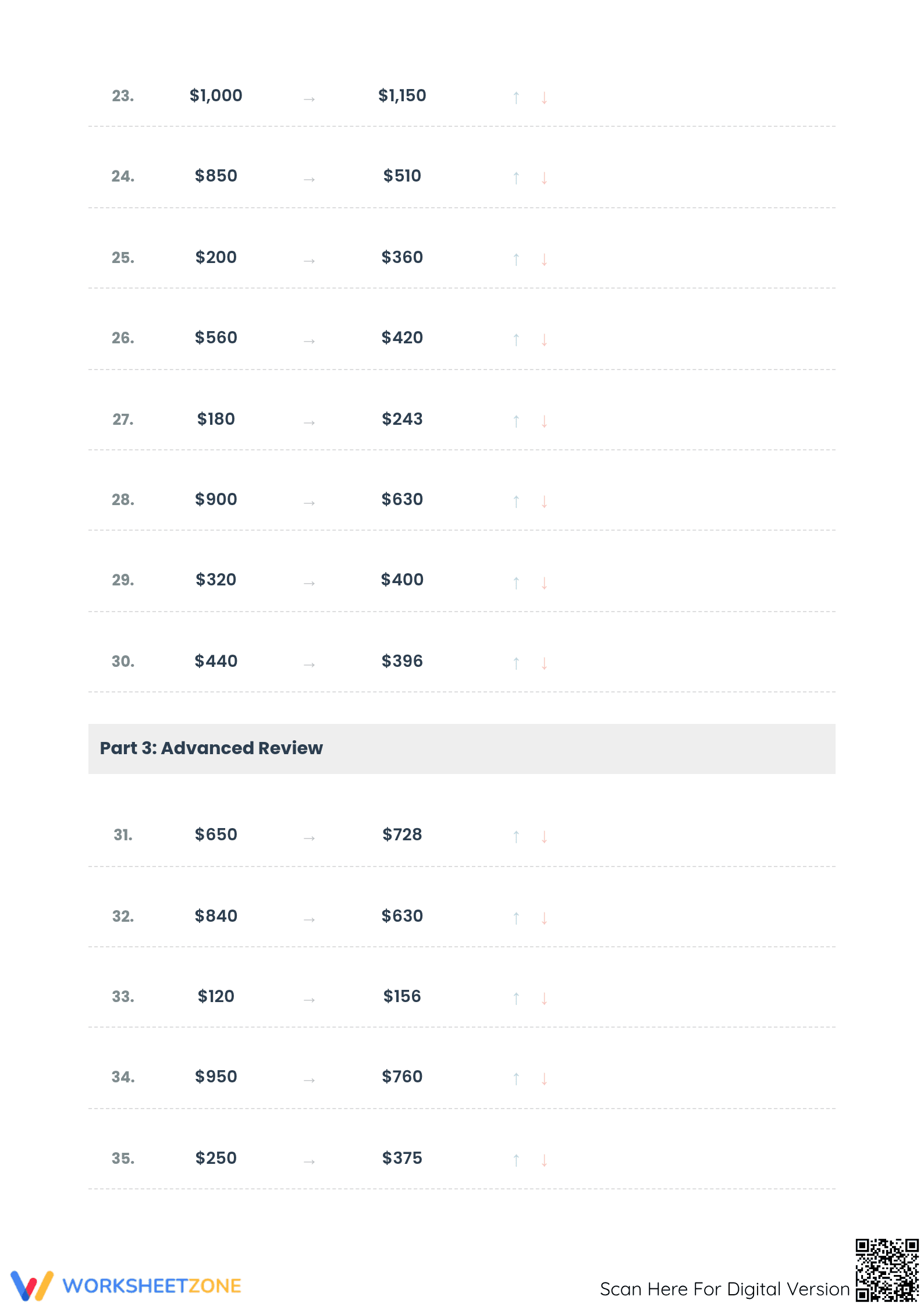
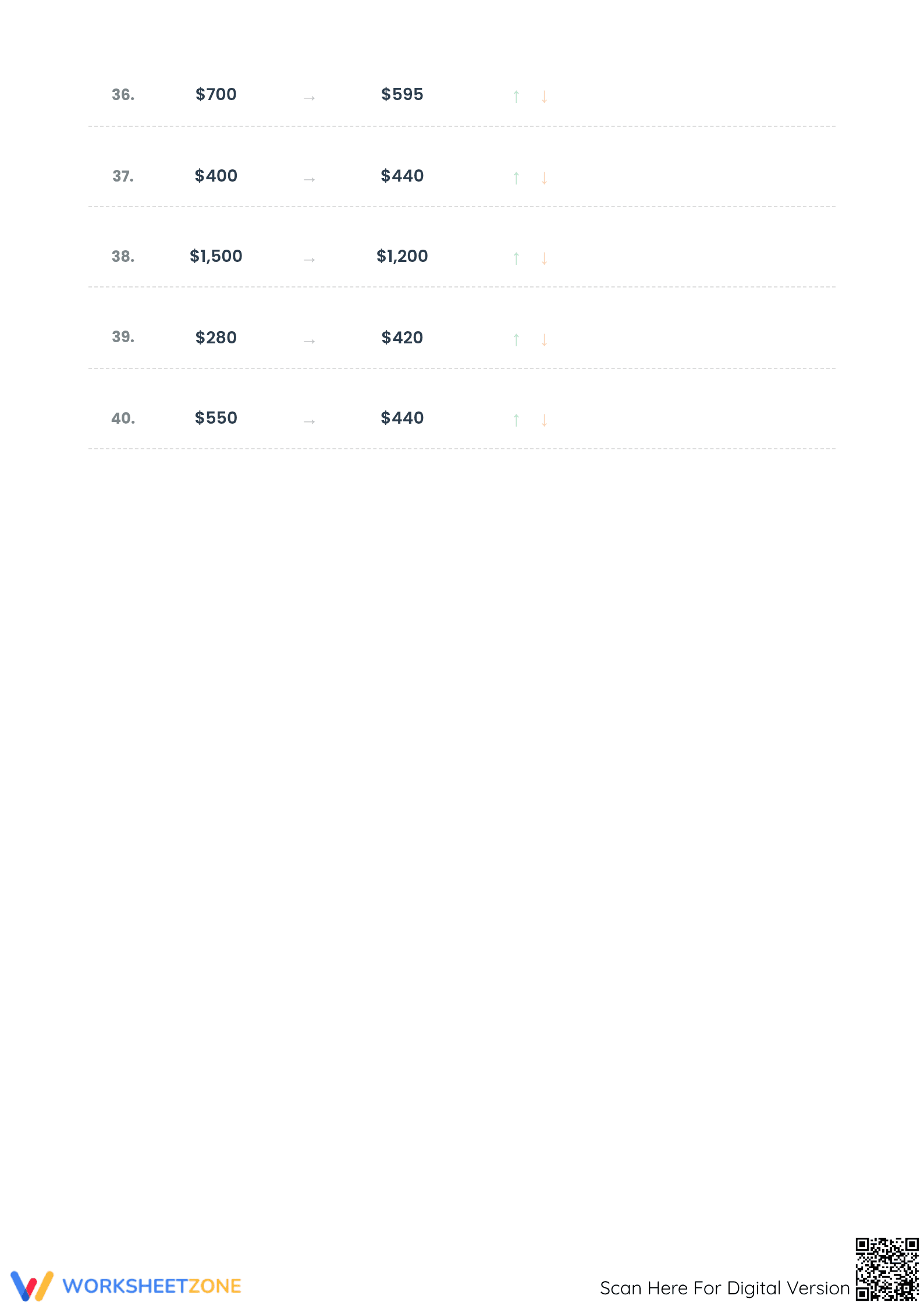

Essential Percent Change Worksheet | Grade 7 Math
Paste this activity's link or code into your existing LMS (Google Classroom, Canvas, Teams, Schoology, Moodle, etc.).
Students can open and work on the activity right away, with no student login required.
You'll still be able to track student progress and results from your teacher account.
Calculating percentage change is a fundamental middle school math skill that bridges basic arithmetic and real-world financial literacy. This comprehensive worksheet provides students with targeted practice in determining both percent increase and percent decrease across forty diverse problems. By working through these sets, learners develop the procedural fluency necessary to navigate complex proportional relationships with confidence.
At a Glance
- Grade: 7 · Subject: Math
- Standard:
7.RP.A.3— Use proportional relationships to solve multistep ratio and percent problems like percent change.- Skill Focus: Calculating Percent Increase and Decrease
- Format: 4 pages · 40 problems · Answer key included · PDF
- Best For: Middle school math independent practice sessions.
- Time: 30–45 minutes
This robust four-page PDF includes a structured table layout designed to minimize cognitive load while maximizing calculation accuracy. The resource features forty distinct problems categorized into three distinct parts, including a practice challenge and an advanced review section. Each problem provides an original and a new value, requiring students to identify the direction of change and calculate the final percentage.
- Guided Practice: The first twenty problems provide a repetitive structure that allows students to internalize the percentage change formula using varied numerical pairs.
- Supported Practice: Part two introduces a practice challenge where values are less intuitive, requiring more precise division and careful attention to the direction of change.
- Independent Practice: The advanced review section presents ten complex problems that simulate real-world scenarios, forcing students to apply their rounding skills to the nearest whole percent.
This resource utilizes the gradual-release model to move students from basic calculation to higher-order mastery through a structured sequence that supports long-term retention.
This worksheet is strictly aligned with 7.RP.A.3, focusing on using proportional relationships to solve multistep percent problems. Students must identify the difference between values and compare it to the original amount. This standard code can be copied directly into lesson plans, IEP goals, or district curriculum mapping tools to ensure instructional coherence.
Use this worksheet as a summative assessment following a unit on ratios and proportions or as a high-quality homework assignment. During the instructional block, teachers can observe students working on the first five problems to identify common misconceptions, such as using the new value as the denominator instead of the original amount. The expected completion time is forty minutes.
This resource is ideal for seventh-grade students mastering Ratios and Proportional Relationships, though it serves as excellent remediation for eighth-graders. It pairs naturally with a lesson on markups and markdowns or a direct instruction session using a percentage change anchor chart. Students requiring differentiation can focus on the first page before attempting the advanced review.
Research by Fisher & Frey (2014) emphasizes that scaffolded practice is essential for internalizing mathematical algorithms like the percentage change formula. This Grade 7 Math resource provides the necessary repetition to move students from surface-level understanding to deep procedural mastery of 7.RP.A.3. By requiring students to identify the direction of change before calculating the magnitude, the worksheet enforces a conceptual check that prevents common errors in multistep ratio problems. The inclusion of forty tasks ensures that learners encounter a wide range of numeric scenarios, from significant decreases to marginal increases. This high-repetition approach is supported by the ScienceDirect TpT Analysis, which indicates that worksheets with structured data tables lead to higher student engagement and lower error rates in middle school mathematics. Educators can rely on this printable as a research-backed tool for building fluency in essential proportional reasoning skills required for high school success.


