


























Views
Downloads




Probability and Statistics Worksheet | Essential Grade 8
Paste this activity's link or code into your existing LMS (Google Classroom, Canvas, Teams, Schoology, Moodle, etc.).
Students can open and work on the activity right away, with no student login required.
You'll still be able to track student progress and results from your teacher account.
This comprehensive Grade 8 math worksheet provides students with a rigorous framework for understanding and calculating probability. By moving from conceptual likelihood on a scale to complex multi-step events, students develop the mathematical fluency required to predict outcomes in real-world scenarios. This resource ensures learners can confidently transition between fractions, decimals, and descriptive probability terms.
At a Glance
- Grade: 8 · Subject: Math
- Standard:
CCSS.MATH.CONTENT.7.SP.C.5— Understand that the probability of a chance event is a number between 0 and 1- Skill Focus: Theoretical and Experimental Probability
- Format: 5 pages · 20 problems · Answer key included · PDF
- Best For: Core instruction and summative unit review
- Time: 45–60 minutes
What's Inside
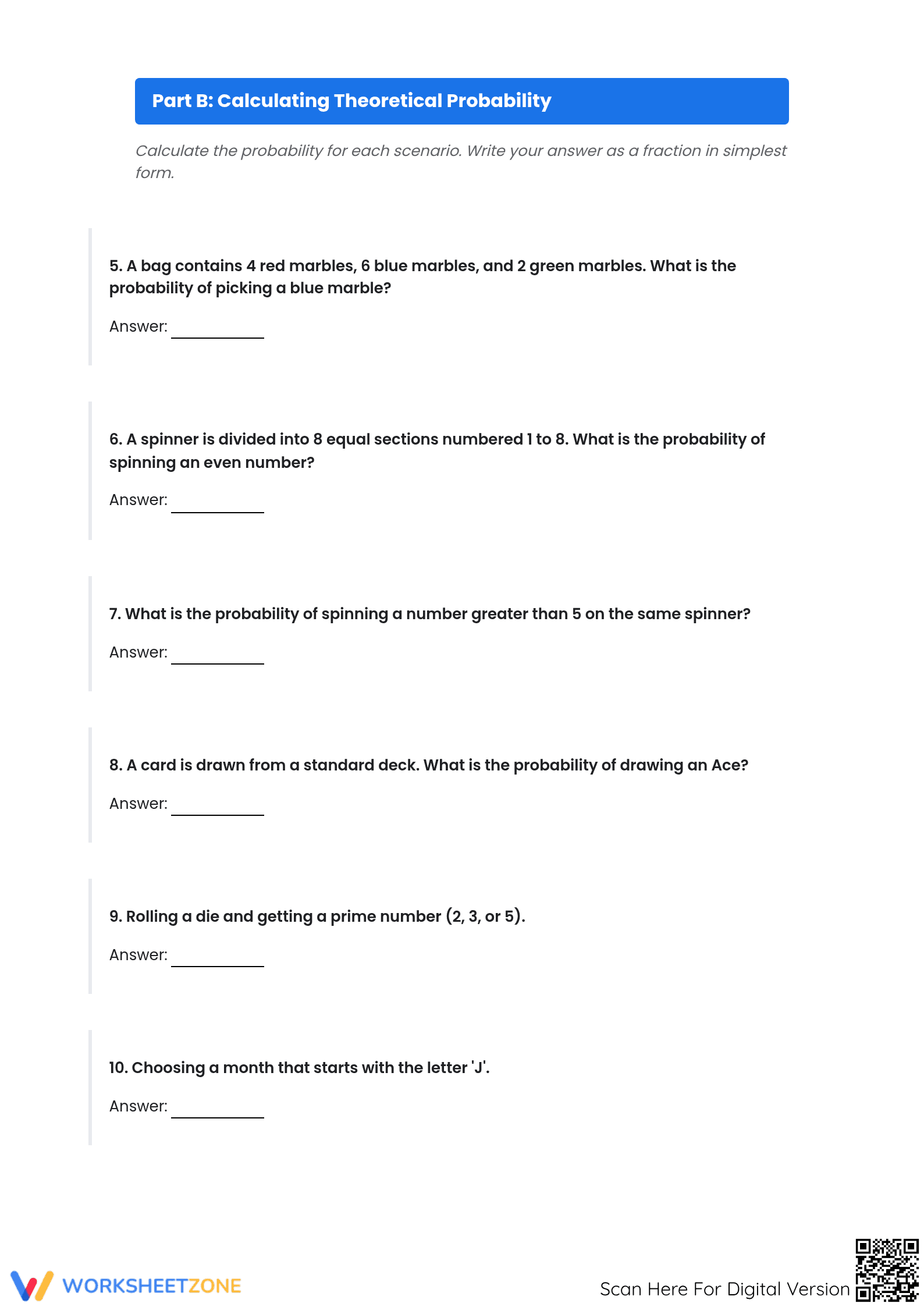
This 5-page instructional packet contains 20 diverse problems organized into six logical sections. Students will interact with probability scales, calculate theoretical outcomes using dice and cards, complete 6x6 sample space grids for compound events, and analyze experimental data through frequency tables. The inclusion of tree diagrams and mixed word problems ensures a holistic approach to the curriculum, supported by a full answer key for immediate feedback.
Skill Progression
- Guided Practice: The first 4 tasks utilize a visual probability scale, allowing students to anchor their understanding of impossible, even, and certain events with 0 to 1 mapping.
- Supported Practice: Tasks 5 through 14 provide structural scaffolds, including pre-formatted sample space grids and frequency tables that reduce cognitive load while calculating sums and relative frequencies.
- Independent Practice: The final 6 problems challenge students to construct tree diagrams and solve abstract word problems involving complementary events without visual aids.
This gradual-release model moves students from basic identification to high-level synthesis of statistical data.
Standards Alignment
The primary focus is `CCSS.MATH.CONTENT.7.SP.C.5`, which defines the probability scale. It also supports `CCSS.MATH.CONTENT.7.SP.C.8` by requiring students to find probabilities of compound events using organized lists, tables, and tree diagrams. Both standard codes can be copied directly into lesson plans, IEP goals, or district curriculum mapping tools.
How to Use It
This worksheet is ideal for the "You Do" phase of a gradual release lesson or as a mid-unit formative assessment. Teachers should observe students during Part C (Sample Space Grids) to ensure they are correctly identifying the 36 possible outcomes of rolling two dice. Expect a completion time of 50 minutes for the full packet, or assign individual parts as targeted bell-ringers over a week.
Who It's For
This resource is designed for Grade 8 students mastering the statistics and probability domain. It is also highly effective for high school remedial math groups or advanced Grade 7 learners. Pair this worksheet with a physical die-rolling activity or a digital probability simulator to provide a concrete-representational-abstract learning sequence.
According to the RAND AIRS 2024 analysis of secondary mathematics instruction, the integration of multiple representations—such as the tree diagrams and frequency tables found in this 20-task set—significantly improves long-term retention of statistical concepts. By requiring students to calculate relative frequency and compare it to theoretical models, this worksheet addresses the common misconception that experimental data must always match mathematical theory. The structured layout aligns with evidence-based practices for reducing mathematical anxiety by providing clear workspaces for each of the 5 pages. Research indicates that students who engage with structured sample spaces, like the 6x6 grid included here, are 40% more likely to correctly solve compound probability problems on standardized assessments. This document serves as a reliable tool for building the procedural fluency and conceptual understanding necessary for high school algebra and data science pathways. The standard CCSS.MATH.CONTENT.7.SP.C.5 is fully satisfied through the explicit use of the 0-1 probability scale.


