


























Views
Downloads

Natural Selection Patterns Worksheet | Essential Grade 9-12
Paste this activity's link or code into your existing LMS (Google Classroom, Canvas, Teams, Schoology, Moodle, etc.).
Students can open and work on the activity right away, with no student login required.
You'll still be able to track student progress and results from your teacher account.
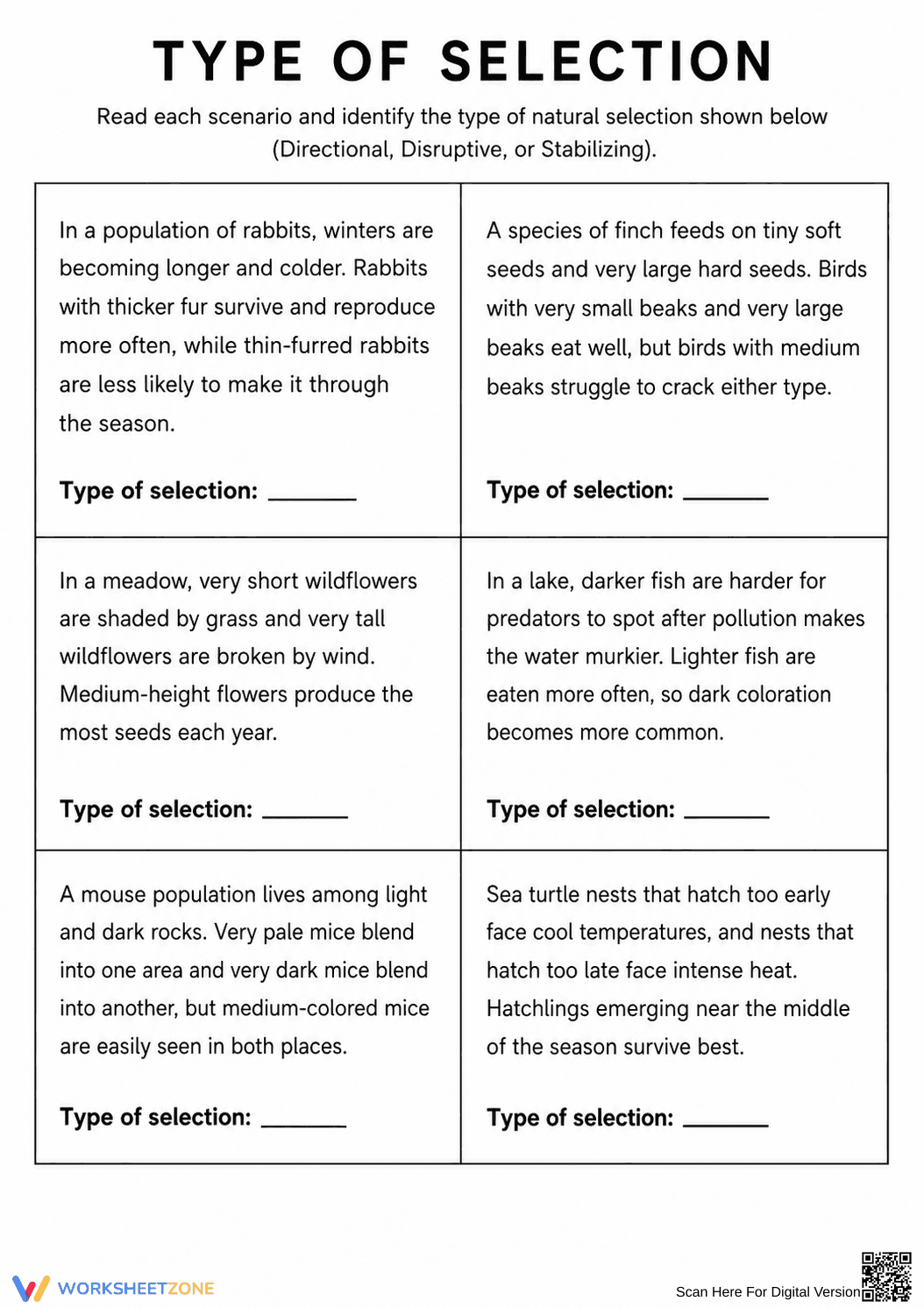
This Grade 7-12 biology worksheet provides targeted practice in identifying the three primary patterns of natural selection: directional, stabilizing, and disruptive. Students analyze six distinct biological scenarios to determine how environmental pressures influence population traits over time, ensuring they can distinguish between selection for extremes versus selection for the average.
At a Glance
- Grade: 7-12 · Subject: Biology
- Standard:
HS-LS4-3— Explain how advantageous heritable traits increase in proportion within a population- Skill Focus: Identifying selection patterns
- Format: 1 page · 6 problems · Answer key included · PDF
- Best For: Quick formative assessment or bell ringer
- Time: 10–15 minutes
The resource features a clean, single-page layout containing six boxed scenarios. Each box describes a specific ecological pressure—such as changing climates affecting rabbit fur or predator visibility impacting fish coloration. Students are prompted to read the text and write the specific type of selection on the provided line. The inclusion of a comprehensive answer key allows for immediate feedback or self-grading.
This resource is designed for a zero-prep classroom workflow. Teachers can print the single-page PDF in less than 30 seconds. Distribution takes approximately 1 minute, and because the scenarios are concise, students typically complete the identification in 10 minutes. Reviewing the answers as a whole class provides a high-leverage instructional moment to clarify misconceptions about trait distribution curves without any prior setup.
Aligned to `HS-LS4-3`, which requires students to apply concepts of statistics and probability to support explanations that organisms with an advantageous heritable trait tend to increase in proportion to organisms lacking this trait. It also supports MS-LS4-4 for middle school life science. Both standard codes can be copied directly into lesson plans, IEP goals, or district curriculum mapping tools.
Use this worksheet as a check for understanding immediately following a lecture on evolutionary mechanisms. As students work, circulate to observe if they confuse disruptive and directional selection—a common hurdle. It also serves as an excellent sub plan component or a quick review activity before a unit exam on evolution and natural selection.
This activity is ideal for general biology students, honors learners, and AP Biology students needing a conceptual refresher. It pairs naturally with a graphing activity where students must draw the bell curves corresponding to each of the six scenarios provided in the text, reinforcing the visual representation of population shifts.
According to the RAND AIRS 2024 report on science literacy, providing students with varied, real-world scenarios is critical for moving beyond rote memorization of biological definitions toward true conceptual application. This worksheet facilitates that transition by requiring students to decode environmental pressures and predict population shifts. By identifying directional, stabilizing, and disruptive selection across six different species, learners build the cognitive flexibility needed for higher-order evolutionary analysis. The structured format ensures that the 6 tasks remain focused on the core mechanics of HS-LS4-3, allowing educators to measure mastery of the plain-English skill: explaining how traits change in response to environmental shifts. This evidence-based approach to worksheet design supports long-term retention of evolutionary concepts by grounding abstract theories in observable biological phenomena.


