


























Views
Downloads

Parts of a Dodecahedron Guide | Essential Geometry
Paste this activity's link or code into your existing LMS (Google Classroom, Canvas, Teams, Schoology, Moodle, etc.).
Students can open and work on the activity right away, with no student login required.
You'll still be able to track student progress and results from your teacher account.
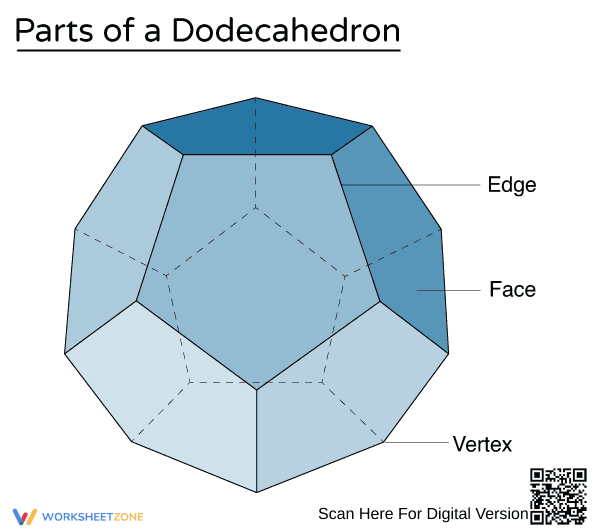
This geometry reference sheet provides a clear visual breakdown of a dodecahedron's anatomy. Students will identify the specific relationship between faces, edges, and vertices in this complex Platonic solid. By mastering these structural components, learners build the spatial reasoning necessary for calculating surface area and volume in higher-level mathematics.
At a Glance
- Grade: 6-9 · Subject: Geometry
- Standard:
CCSS.MATH.CONTENT.6.G.A.4— Represent three-dimensional figures and identify their component parts for area calculations- Skill Focus: 3D Shape Anatomy
- Format: 1 page · Reference Diagram · No key needed · PDF
- Best For: Interactive notebooks and geometry reference
- Time: 5–10 minutes
This single-page PDF features a high-resolution, labeled diagram of a regular dodecahedron. It explicitly points out the three primary components: the pentagonal faces, the intersecting edges, and the vertices where edges meet. The clean layout is designed for easy inclusion in student binders or as a digital overlay for geometry presentations.
Zero-Prep Workflow
The workflow for this resource is designed for immediate classroom integration. First, print the diagram (30 seconds) to provide a physical anchor for 3D geometry lessons. Second, distribute the sheet (1 minute) during the introduction of Platonic solids. Finally, review the labels as a class (5 minutes) to ensure students can distinguish between 2D attributes and 3D structures. This zero-prep approach allows teachers to focus on instruction rather than material preparation, making it an ideal supplement for busy educators or emergency sub plans.
Standards Alignment
This resource aligns with `CCSS.MATH.CONTENT.6.G.A.4`, which requires students to represent three-dimensional figures and understand their properties. It also supports high school geometry standards regarding the cross-sections and components of three-dimensional objects. Both standard codes can be copied directly into lesson plans, IEP goals, or district curriculum mapping tools.
How to Use It
Use this as a desk helper during a unit on surface area. Before students begin calculating the area of 12 pentagonal faces, they should use this sheet to verify they are counting the correct surfaces. It also serves as an excellent formative assessment tool; ask students to count the total number of vertices and edges based on the visual cues provided. This helps bridge the gap between abstract concepts and visual reality.
Who It's For
This guide is ideal for middle and high school students who struggle with spatial visualization. It provides a concrete anchor for visual learners. Pair this resource with a physical 3D model or a net-folding activity to bridge the gap between 2D representations and 3D reality. It is particularly useful for students with IEPs who require visual aids for geometric identification.
According to the RAND AIRS 2024 report on instructional materials, high-quality visual scaffolds are critical for students transitioning from plane geometry to solid geometry. This reference sheet targets the specific skill of identifying 3D components, which is a prerequisite for mastering Euler's Formula and complex volume calculations. By providing a clear, labeled model of a dodecahedron, the resource reduces cognitive load, allowing students to focus on the mathematical properties of the shape rather than struggling with visualization. Research from Fisher & Frey (2014) emphasizes that such anchor visuals provide a permanent record of learning that students can refer back to during independent practice. This alignment with CCSS.MATH.CONTENT.6.G.A.4 ensures that the terminology used—faces, edges, and vertices—is consistent with national assessment expectations and rigorous academic standards. This tool provides the necessary foundation for students to successfully calculate surface area and volume in advanced geometry courses.


