


























Using toy cars (chips) from paper parking lots, students add and subtract to investigate the relationship between addition and subtraction. Through this exercise, students can investigate various subtraction models, such as finding a missing addend, deducting, and comparing. Students are going to:
- recognize the different interpretations of whole number addition and subtraction.
- acknowledge that addition and subtraction have an inverse relationship.
- recognize how addition and subtraction affect whole numbers.
- understand the terms addition (sum, in all, total, how many more, and so on) and subtraction (difference, take away, what is left, how many more).
- What mathematical representations exist for relationships?
- What are some applications for expressions, equations, and inequalities in the quantification, modeling, solving, and/or analysis of mathematical situations?
- How can the study of mathematics aid in clear communication?
- How are relationships in mathematical contexts described by patterns?
- How can identifying regularity or repetition help with problem-solving efficiency?
- How are numbers represented, compared, quantified, and modeled using mathematics?
- Addend: A number that is added to an equation.
- Subtraction: To take one quantity away from another quantity (separation).
- number cubes (numbered 1–6), one for each pair of students
- ten-frame “parking lots,” one per student (M-1-3-1_Ten-Frames)
- twenty small cars (or counting chips or small squares of paper to represent cars) per pair of students
- paper and pencils (or whiteboards and markers), one of each per student
- Number Sentences sheet (M-1-3-1_Number Sentences)
- dry-erase markers and eraser
- See which methods students feel most comfortable using to get to ten by watching them play the Parking Cars game.
- Make a note of which students are prepared for extension activities and which ones would benefit from small-group guided practice as they model and record their answers to the story problems.
Explicit instruction, modeling, scaffolding, and active engagement
W: Explain to the class that you will be using a game in which cars fill a parking lot to explore addition and subtraction.
H: As part of the Parking Cars game, split the class into pairs. Assist with materials distribution and game rules clarification. While the students are playing, quiz them on how many turns it might take them to fill the parking lot and what number will enable them to do so.
E: Keep using the game's materials to create different scenarios of cars pulling into or out of the parking lot. Students determine whether to subtract or add when calculating the number of cars that are still in use.
R: Assign students to write comparable narrative problems for their peers to solve.
E: Have students who are writing the stories check to see if the number of sentences in their answers matches those of their classmates.
T: Permit students to use larger or smaller parking lots to continue playing the Parking Cars game. Students should describe the picture by writing one addition sentence and one subtraction sentence on the board, which should resemble the parking lot the students are using.
O: Students practice addition and subtraction techniques related to locating a missing addend in this lesson.
Students are supposed to consider how many ways they can add to ten in the first exercise of this lesson. While calculating the necessary numbers to roll in their ten-frame parking lot, they discover an addend that is missing. Before they tackle the story problems that call for multiple addition and subtraction strategies, this is a suitable warm-up. Students practice selecting operations to solve story problems involving cars entering and exiting parking lots in the second portion of the lesson.
"Where do you park when you go to the store with your parents? Yes, I meant the parking lot. Today, with the aid of several automobiles and a parking lot, we will investigate addition and subtraction. These (hold up the cars) will be the vehicles, and this ten-frame (hold up the ten-frames page) (M-1-3-1_Ten-Frames) will be the parking lot. How big of a parking lot is this? That's right—ten. Let's start with a game called Parking Cars."
"This game is going to be played in pairs. You will all have one parking lot and ten cars each. I'll give you a number cube to share. Roll the cube when it's your turn, then park that many cars in your lot. You forfeit your turn if the total of the numbers you roll exceeds the number of available spots in your parking lot. Thus, you forfeit your turn if you roll a 4 and have 2 empty spaces on your lot. Four is more than two. To park more cars, you have to roll a 1 or a 2 in your subsequent turn. Being the first person to load up your parking lot with ten cars is the goal. Each of you can roll the cube once to determine who gets to start the game. The person with the highest number is the first to go. You can start a new game after you finish the one I've given you, which will last roughly fifteen minutes. Go first in turns."
To demonstrate how to play the game, ask a volunteer to join you for a few rounds. Students should work in pairs, and each pair should receive two ten-frames (M-1-3-1_Ten-Frames), twenty cars or chips, and one number cube. Stroll around and watch the students. Observe which pupils can identify the missing addend (the number of spaces needed to complete ten) with ease.
Ask questions like these:
"If you have seven cars in your parking lot now, what numbers could you roll to fill the empty spaces?" (3, or 1 and 2, or 1 and 1 and 1)
"I notice that your parking lot is home to three automobiles. Could you fill it in with just one more turn?" (No, since I can only roll a six and I need seven more cars. So I require two more turns at the very least.)
"What is the minimum number of turns required for someone to fill their parking lot?" (Two, since the player could roll a 6 and then a 4, or a 5 and a 5).
Give students a heads-up when they have just a few minutes left to play a game instead of starting a new one. As you gather the students, explain to them, "We have been practicing addition and subtraction with cars. Does anyone still know the meaning of these words?" Ask a few students to respond. "Next, we will work with numerical stories. We build a number model in the process of solving a number story. Both numbers and symbols are used in a number model." Write the word "add" on the board, easel, or chart paper. Then, ask the students what sign or symbol represents adding (+). After "add," place the addition symbol. Use "subtract" (–) and "equals" (=) to repeat this procedure. Gather the number cubes and instruct the students to retain ten cars and one parking lot from the game. Assign each student a number sentence to write on a piece of paper with a pencil or a marker on a whiteboard. For the next task, they will be working on their own.
"I'll now tell you some stories, and you'll use the cars and the ten-frame parking lot to solve the problems. I'll give you an illustration." Solve a numerical story model. Make sure to simulate both building the number model and solving the problem with the cars. "It's your turn now. To determine whether to add or remove cars from your parking lot, pay close attention to each story as it is told. Collaborate with a partner and display your work using ten-frame parking lots and your cars (or chips). Write a numerical sentence outlining the addition or subtraction method you used to solve the problem." After each problem is completed, go over it with the entire group. In case students appear to be struggling with the problems, employ a think-aloud approach to guide them through the initial problems in a step-by-step manner.
Tell stories that necessitate a variety of solutions. Consider the basic addition:
"There are six cars in your parking lot. Three more vehicles arrive and are parked. What is the number of cars on your lot?" (3 + 6 = 9)
"Three cars are in your parking lot. Another six cars arrive and are parked. On your lot, how many cars are there?" (3 + 6 = 9)
"Three cars are in your parking lot. Two more enter and park. 4 more cars arrive and are parked after that. On your lot, how many cars are there?" (3 + 2 + 4 = 9)
Easy subtraction, also known as "take away":
"Your parking lot has eight vehicles. Five go out. How many are left?" (8 – 5 = 3)
"Your parking lot has nine vehicles. Six go out. How many are left?" (9 – 6 = 3)
Missing addends:
"There are 4 cars in your parking lot. How many more vehicles must park in your lot before it is full?" (10 - 4 = 6) is the inverse operation of (4 + 6 = 10).
"There are five cars in your parking lot. Nine cars were parked in your lot an hour ago. In your parking lot, how many cars are left?" (5+ 4 = 9 or 9 – 5 = 4) in reverse
Comparisons:
"In your parking lot, you have nine cars, and I have three. How many cars do you have left?" (Either 3 + 6 = 9 or 9 – 3 = 6; we both have 3 and the student has 6 more.)
"There are seven cars in your parking lot. There are nine cars on my lot. How many more vehicles are there in my parking lot?" (The sevens in the student's and teacher's lots line up. Next, the instructor has an additional 2; that is, 7 + 2 = 9; or 9 – 7 = 2.)
Multiple operations:
"There are six cars parked in your parking lot. Four cars leave. Five vehicles arrive. How many cars are parked there right now?" [(6–4) + 5 = 7]
"There are five cars in your parking lot. Three vehicles arrive and are parked. Four vehicles drive out. Now, how many cars are there in the lot?" [(5 + 3) – 4 = 4]
Watch the students as they work through problems and note their answers. They may be chosen to present their work using an overhead projector or another kind of projection technology.
Select a few students to write story problems for their peers to solve after they show that they understand the task. They can have very easy stories or very difficult ones. This is a suitable course of action.
As students narrate their own stories and hear from their peers about potential solutions, have them compare their answers to those of their peers. Have all of you written the same number of sentences? Have you written distinct numbers of sentences and received the same response?
Extension:
Expansion: Give each student a second ten-frame parking lot once they feel comfortable handling addition and subtraction stories involving ten cars. To solve problems involving more cars in two parking lots, students can work alone or in pairs.
Tell stories such as:
"Patrick has two spaces for parking. Six cars are in one, and nine cars are in the other. What is the total number of cars in the lots?" (9 + 6 = 15)
"Donny has 7 cars in one lot and 8 cars in the other. Does Donny have enough parking spots if five more cars need to park?" (Yes, because 7 + 8 = 15. He has twenty spaces (15 + 5 = 20).
"Maria's two parking lots are marked with 'Lot Full' signs. One lot contains five cars, while the other lot has two cars. Three cars are waiting for a spot. How many more cars can Maria allow to park after they do so before she has to post the "Lot Full" sign once more?" [20 – (5 + 2) = 13 and 13 + 3 = 16, so 16 + 4 = 20 allows for the parking of 4 more cars.]
Routine: Have students keep a math journal on their desks. Ask students to write answers to the problems you post on the board in their journals as soon as they arrive, as part of their morning routine. Draw a big ten-frame on the board and place dots in some of the spaces to further reinforce the addition and subtraction relationship. Give the students a copy of the drawing to copy into their journals, along with at least one addition and one subtraction sentence that could be used to describe the model. Draw this ten-frame as an example.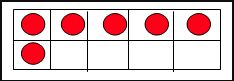
Inform the pupils that there are ten spots available in this parking lot. For cars, there are red dots. In the lot, there are six parked cars. They need to figure out how many more cars can fit in the lot. Next, they have to use the numbers from the problem—6, 10, and the number they figure out—to write an addition number sentence (4). Students might write either 4 + 6 = 10 or 6 + 4 = 10. After that, assign the students to use the numbers from the ten-frame to write a subtraction number sentence. Students might write either 10 – 6 = 4 or 10 – 4 = 6.
As an alternative, assign students to write a narrative problem based on the model, e.g., "Six cars were parked outside the store." There were four more cars in the empty spaces. "How many were there in total?" (Students are free to suggest imaginative alternative stories if they would rather not limit the story to cars and parking lots.)
Workstation or Small Group: Print copies of the Number Sentences activity sheet (M-1-3-1_Number Sentences) for the students before beginning this exercise. To create a self-checking exercise, print each page back-to-back and write the answers in the spaces on one side. To conserve paper, laminate the pages and include dry-erase markers.
Students will use the cars and ten-frames to help them solve number sentences as they work alone or in pairs. To solve for the missing number, students should select a number sentence, invent a car-related story that illustrates the issue, and solve it. Students should be instructed to fill in the blank with the missing number before turning the paper over to verify their response.

Parking Cars (M-1-3-1)
Using toy cars (chips) from paper parking lots, students add and subtract to investigate the relationship between addition and subtraction. Through this exercise, students can investigate various subtraction models, such as finding a missing addend, deducting, and comparing. Students are going to:
- recognize the different interpretations of whole number addition and subtraction.
- acknowledge that addition and subtraction have an inverse relationship.
- recognize how addition and subtraction affect whole numbers.
- understand the terms addition (sum, in all, total, how many more, and so on) and subtraction (difference, take away, what is left, how many more).


