


























Views
Downloads

Essential Laws of Exponents Worksheet | Algebra Grade 8-11
Paste this activity's link or code into your existing LMS (Google Classroom, Canvas, Teams, Schoology, Moodle, etc.).
Students can open and work on the activity right away, with no student login required.
You'll still be able to track student progress and results from your teacher account.
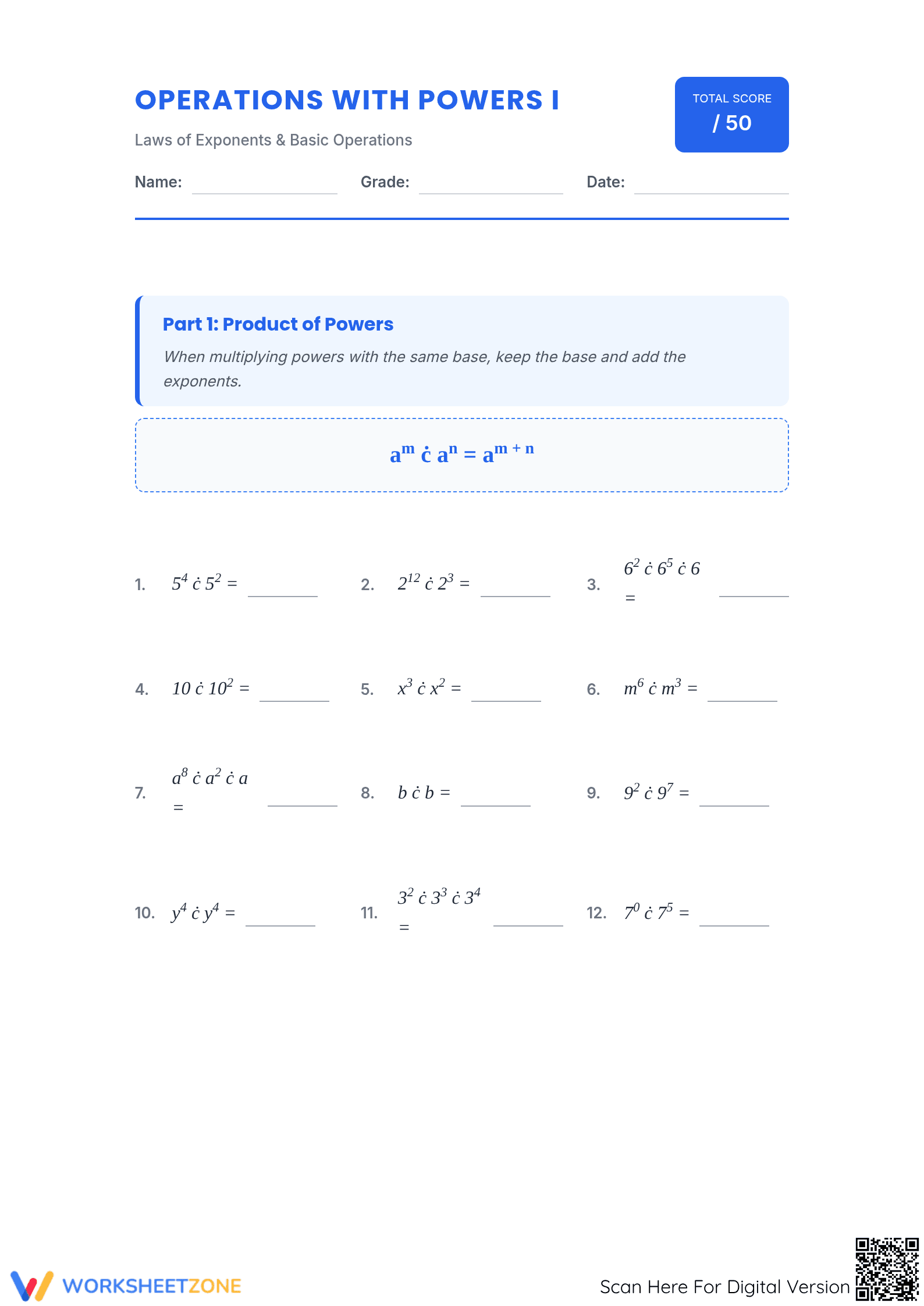
This comprehensive laws of exponents worksheet provides students with focused practice on essential algebraic operations. Students will master the product, quotient, and power of a power rules through structured repetition and mixed application. By simplifying complex numerical and algebraic expressions, learners build a strong foundation for advanced polynomial operations and exponential functions.
At a Glance
- Grade: 8 · Subject: Algebra
- Standard:
8.EE.A.1— Apply properties of integer exponents to generate equivalent numerical expressions- Skill Focus: Operations with powers and exponent rules
- Format: 3 pages · 45 problems · Answer key included · PDF
- Best For: Independent practice and formative assessment
- Time: 30–45 minutes
What's Inside
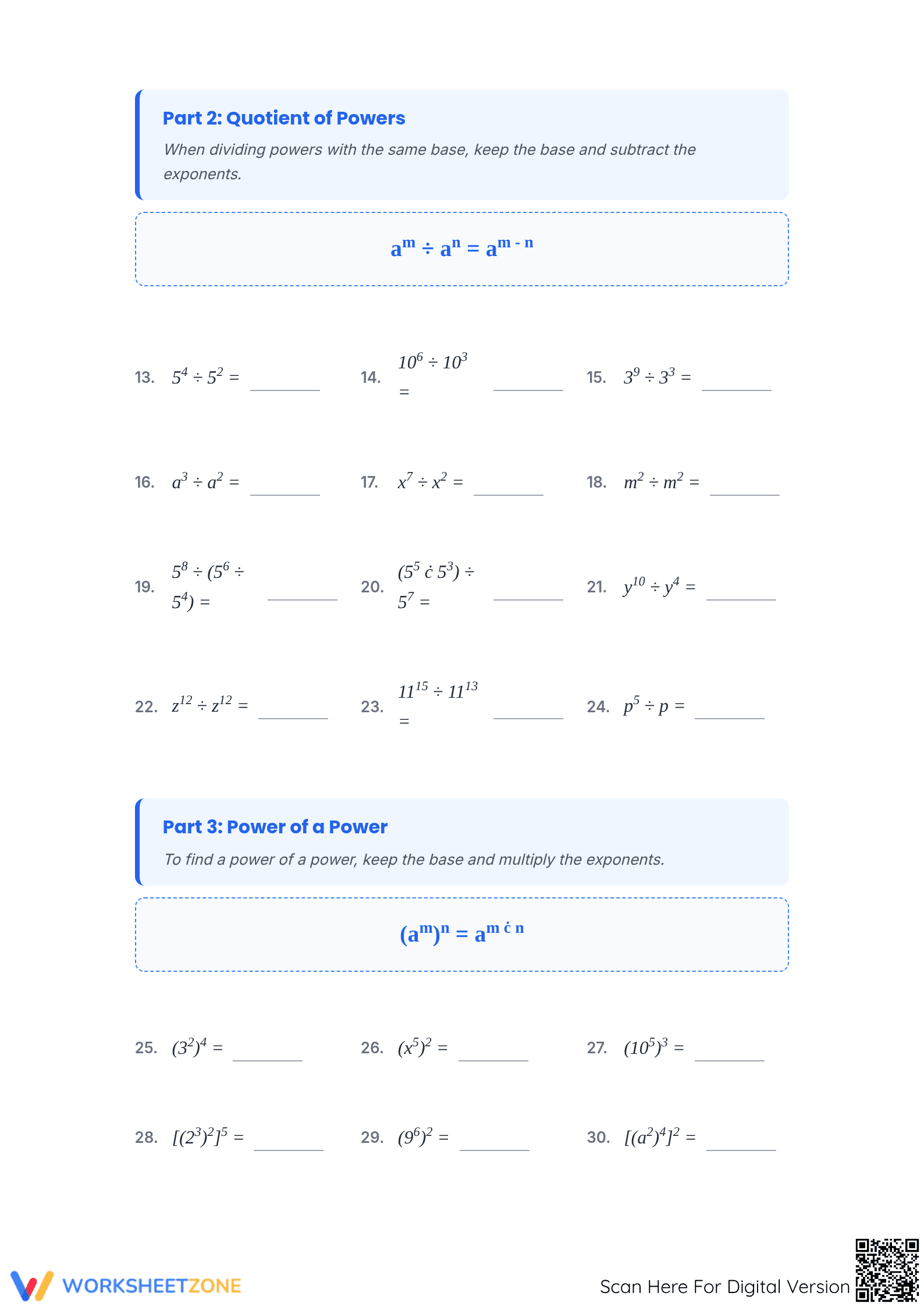
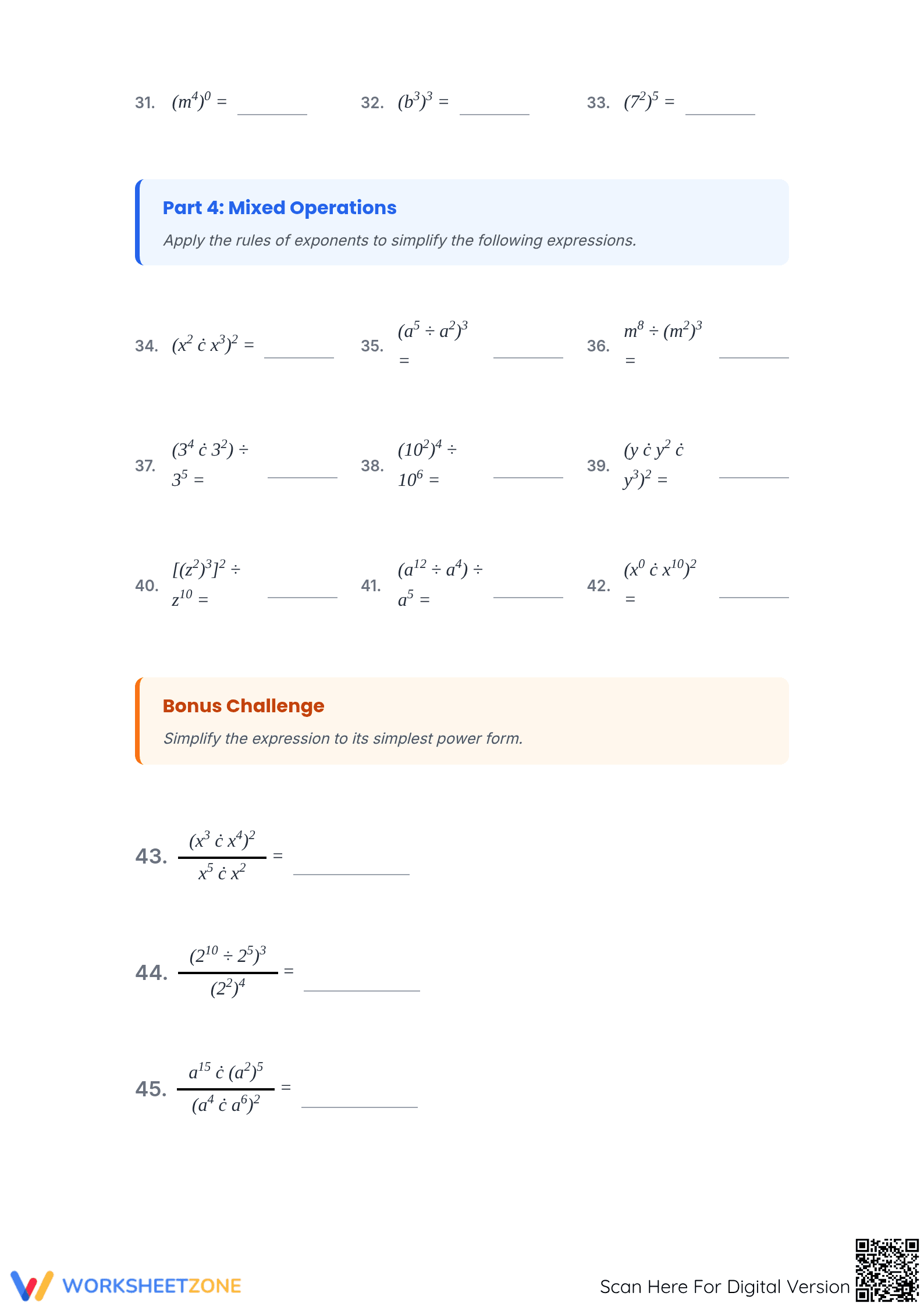
This three-page resource is divided into five distinct sections designed to scaffold student learning. It features 12 problems on the product of powers, 12 problems on the quotient of powers, 9 problems on the power of a power rule, and 9 mixed operation challenges. The final section includes 3 high-level bonus problems involving fractional expressions. A complete three-page answer key provides step-by-step solutions for immediate grading or self-review.
Skill Progression
- Guided practice: Each section begins with a rule box (e.g., a^m * a^n = a^(m+n)) and basic single-variable problems.
- Supported practice: Problems increase in complexity, incorporating multiple variables and numerical bases requiring mental math.
- Independent practice: The mixed operations section removes specific rule cues, forcing students to apply the correct property in multi-step simplifications.
This structured flow follows the "I Do, We Do, You Do" instructional strategy for mathematical fluency.
Standards Alignment
This resource is directly aligned to 8.EE.A.1: "Know and apply the properties of integer exponents to generate equivalent numerical expressions." It also supports high school algebra standards involving the simplification of rational expressions and polynomial multiplication. Both standard codes can be copied directly into lesson plans, IEP goals, or district curriculum mapping tools.
How to Use It
Use this as a practice tool during the "Independent Practice" phase of a lesson. It is ideal for a mid-unit assessment to check for misconceptions, such as adding bases instead of exponents. For formative observation, watch students during the mixed operations section to see if they correctly sequence operations when powers are nested. Completion time ranges from 30 to 45 minutes.
Who It's For
This resource is designed for Grade 8 Pre-Algebra and high school Algebra 1 students. It provides necessary scaffolding for learners who struggle with abstract notation while offering sufficient rigor for advanced students through the bonus challenges. It pairs naturally with a lesson on scientific notation or a guided notes passage on the history of mathematical symbols.
Effective mathematical instruction requires a balance of procedural fluency and conceptual understanding, a principle emphasized in the RAND AIRS 2024 report on secondary math outcomes. This worksheet provides 45 structured opportunities to apply the 8.EE.A.1 standard in increasingly complex scenarios. By isolating specific laws—product, quotient, and power of a power—before requiring mixed application, the resource prevents cognitive overload and allows students to encode each rule into long-term memory. Research from Fisher & Frey (2014) indicates that such scaffolding is critical for students to transition from guided instruction to independent mastery of abstract algebraic concepts. The inclusion of a comprehensive answer key further supports metacognitive development, as students can immediately verify their logic against the standardized 8.EE.A.1 criteria. This evidence-based approach ensures that learners are prepared for the rigorous demands of standardized testing and higher-level calculus progressions.


