


























Views
Downloads
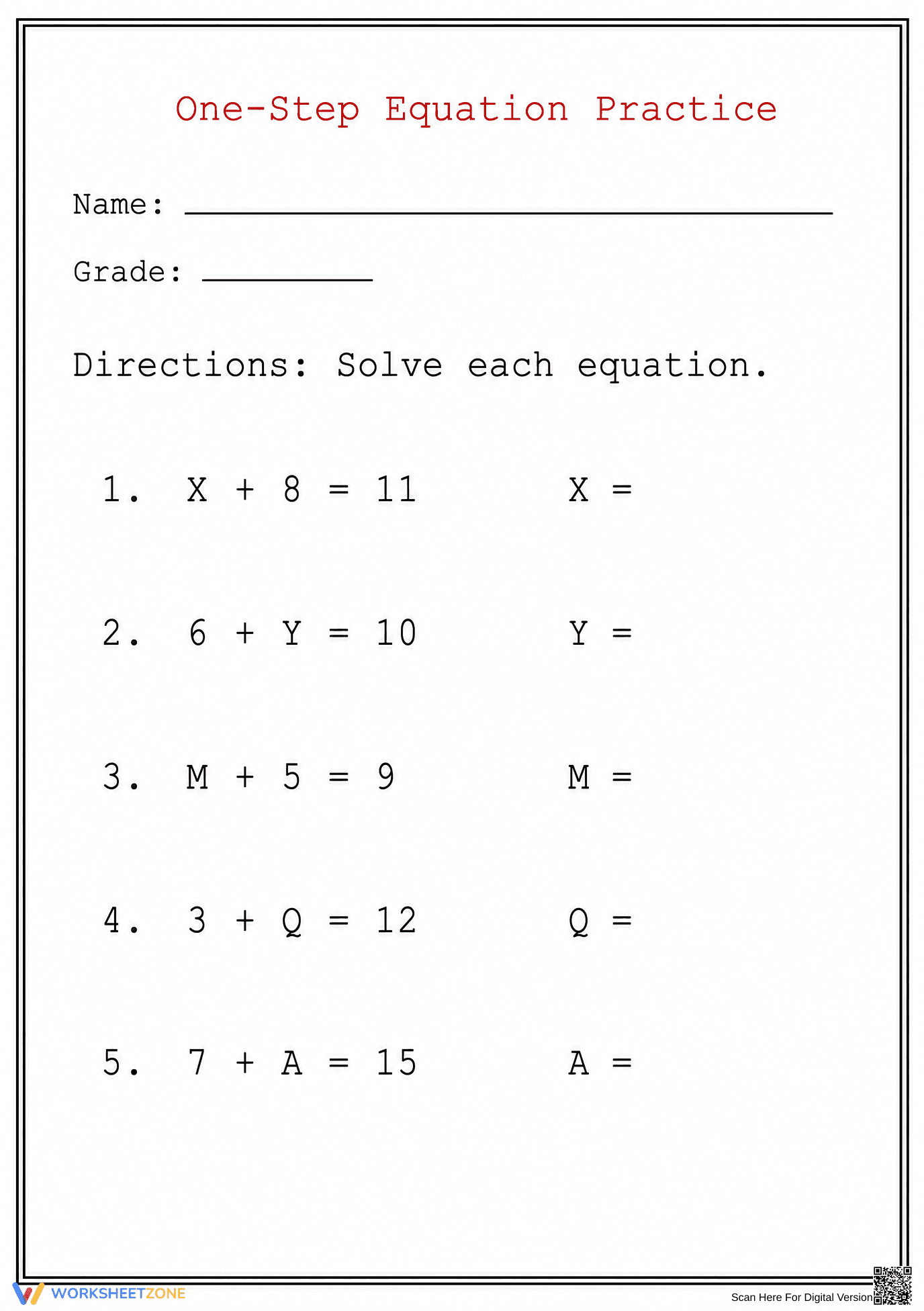

Essential One-Step Equation Practice | Grade 7 Math
Paste this activity's link or code into your existing LMS (Google Classroom, Canvas, Teams, Schoology, Moodle, etc.).
Students can open and work on the activity right away, with no student login required.
You'll still be able to track student progress and results from your teacher account.
This Grade 7 math worksheet provides targeted practice for solving one-step addition equations. Students isolate variables using inverse operations to find unknown values. By focusing on five problems, learners build the procedural fluency necessary for complex algebraic expressions.
At a Glance
- Grade: 7 · Subject: Math
- Standard:
CCSS.MATH.CONTENT.7.EE.B.4— Use variables to represent quantities and solve simple equations- Skill Focus: One-step addition equations
- Format: 1 page · 5 problems · Answer key included · PDF
- Best For: Quick formative assessment or bell ringer
- Time: 5–10 minutes
What's Inside
The worksheet features a distraction-free layout with five addition equations. Each problem requires solving for a different variable. The document includes fields for name and grade, plus concise directions. This single-page PDF is designed for immediate use.
Zero-Prep Workflow
- Print: Generate the single-page PDF in less than 30 seconds.
- Distribute: Hand out the sheets as students enter for a 5-minute warm-up.
- Review: Discuss the five solutions as a group to identify common misconceptions.
Total teacher prep time is under 2 minutes, making this an ideal resource for sub plans or busy mornings.
Standards Alignment
This resource aligns with CCSS.MATH.CONTENT.7.EE.B.4, which requires students to "Use variables to represent quantities in a real-world or mathematical problem, and construct simple equations and inequalities to solve problems by reasoning about the quantities." It specifically addresses the foundational skill of solving equations of the form x + p = q. Both standard codes can be copied directly into lesson plans, IEP goals, or district curriculum mapping tools.
How to Use It
Use this worksheet as a "Do Now" activity at the start of a lesson to gauge prior knowledge before introducing subtraction or multiplication equations. Alternatively, assign it as a quick exit ticket to verify that students can correctly isolate a variable after direct instruction. Observe if students are mentally calculating or showing the inverse operation of subtracting the constant from both sides.
Who It's For
This practice sheet is ideal for Grade 7 students beginning their algebra unit or older students requiring intervention to shore up basic computation skills. It serves as an excellent scaffolded resource for English Language Learners due to its minimal text and clear mathematical syntax. Pair this with a visual anchor chart demonstrating the balance scale model of equations.
According to the RAND AIRS 2024 report on mathematical fluency, frequent exposure to low-stakes, high-success tasks significantly reduces math anxiety and improves long-term retention of algebraic procedures. This worksheet facilitates that exposure by focusing on the specific skill of solving one-step addition equations under the CCSS.MATH.CONTENT.7.EE.B.4 standard. By isolating the variable through inverse operations, students develop the cognitive schemas required for higher-level mathematics. Mastering these foundational movements is a prerequisite for multi-step algebra. This resource provides the structured repetition needed to move from effortful calculation to automaticity, ensuring students are prepared for the rigorous demands of secondary mathematics. The clear formatting and limited problem set allow for immediate feedback, a critical component of effective formative assessment in middle school environments. By utilizing this targeted practice, educators can ensure that students possess the necessary fluency to tackle complex equations in later grades.


