


























Views
Downloads




Number 123 Counting Worksheet | Grade Preschool Ready
Paste this activity's link or code into your existing LMS (Google Classroom, Canvas, Teams, Schoology, Moodle, etc.).
Students can open and work on the activity right away, with no student login required.
You'll still be able to track student progress and results from your teacher account.
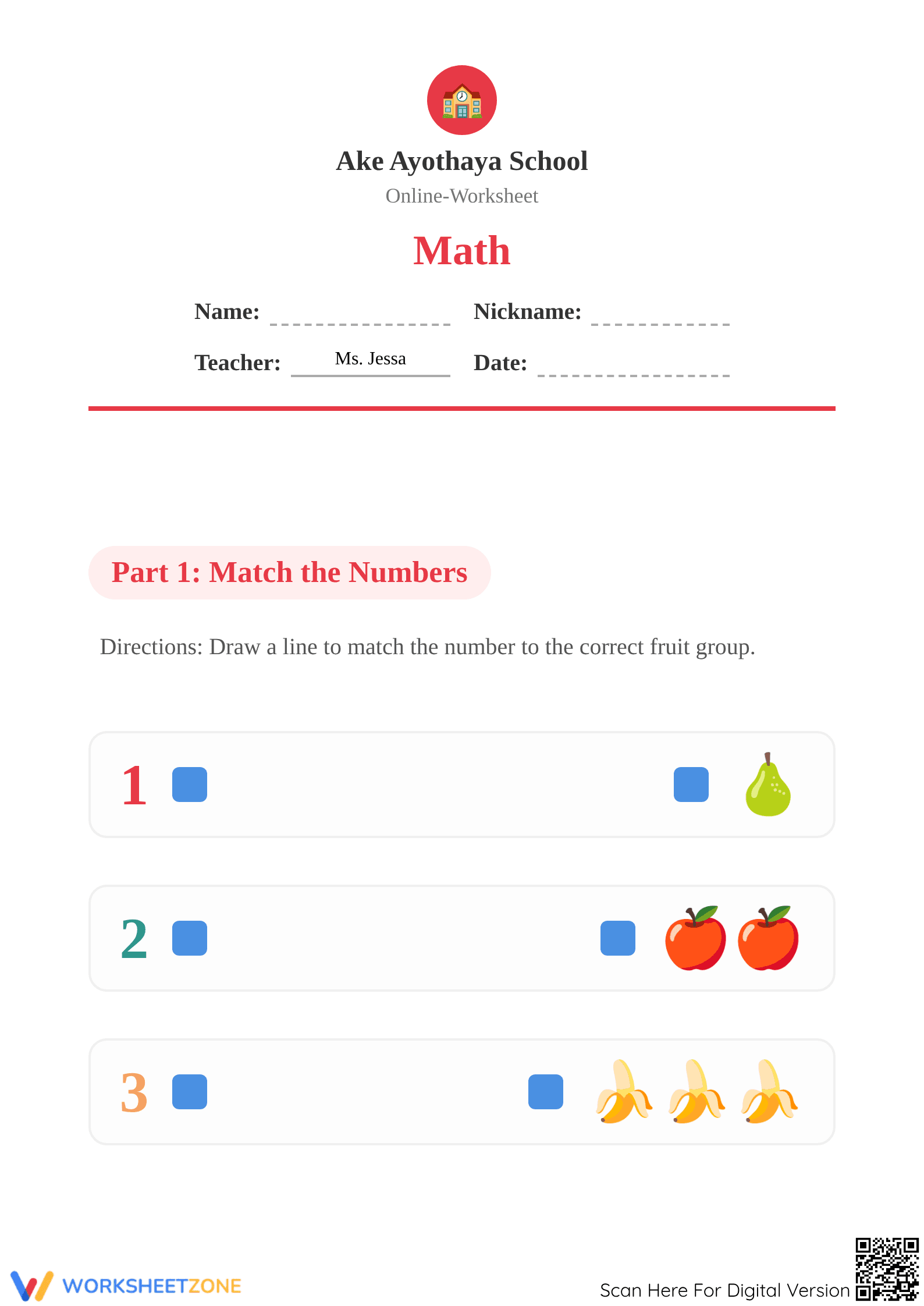
This Preschool counting worksheet provides a structured approach for early learners to master numbers 1, 2, and 3. By counting familiar objects like fruits and animals, students develop one-to-one correspondence and cardinality. This essential resource bridges the gap between seeing a group and identifying its numerical value through engaging visual tasks.
At a Glance
- Grade: Preschool · Subject: Math
- Standard:
CCSS.MATH.CONTENT.K.CC.B.4— Count objects to understand the relationship between numbers and quantities- Skill Focus: 1-to-1 Correspondence
- Format: 5 pages · 15 problems · Answer key included · PDF
- Best For: Early numeracy morning work centers
- Time: 15–20 minutes
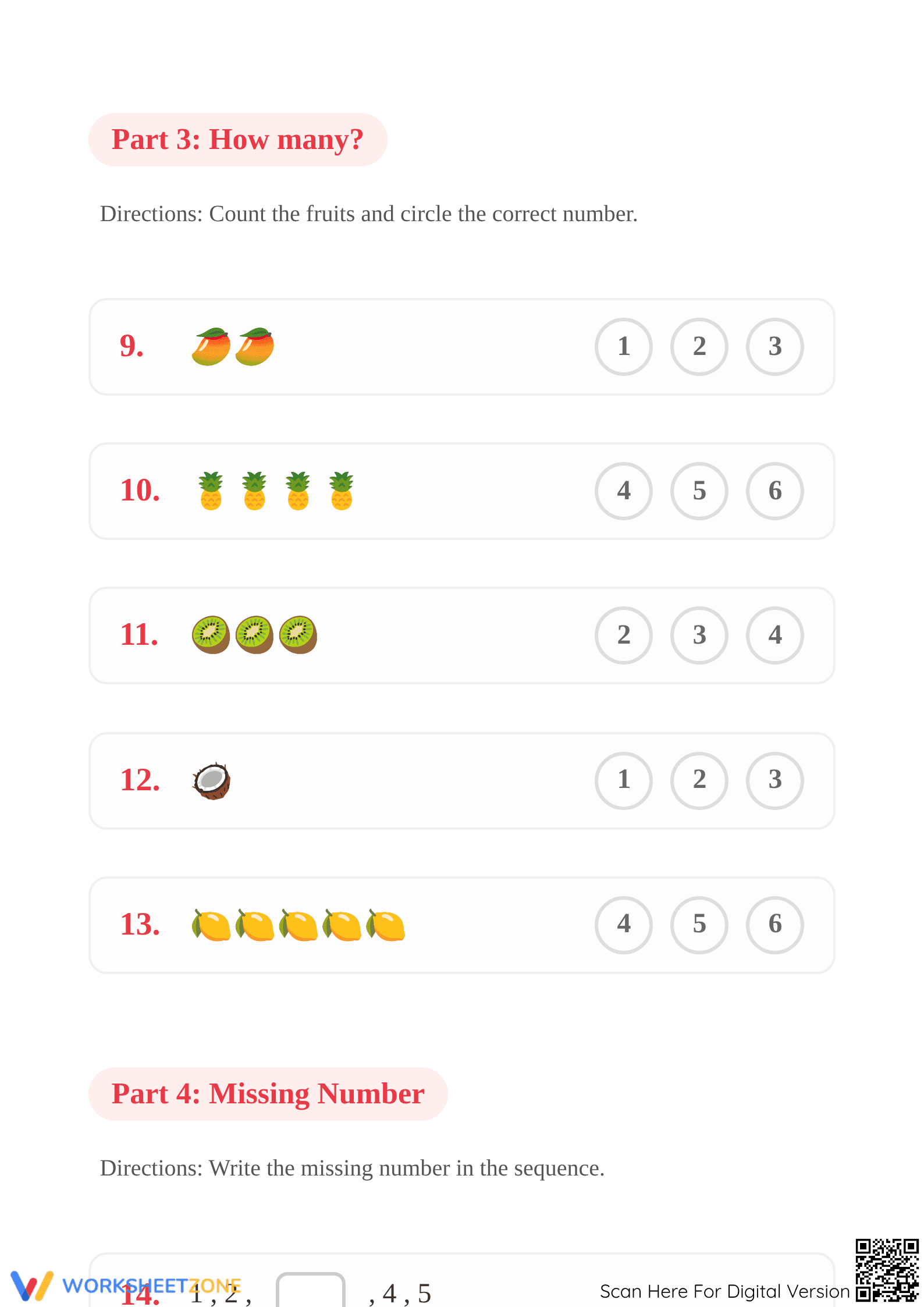
Inside this 5-page bundle, educators will find a series of "How many?" prompts featuring vibrant illustrations. Each page contains three distinct counting tasks designed to keep young minds focused. The format includes a clear workspace for students to circle or write their answers, accompanied by a comprehensive answer key for quick teacher verification or self-checking.
- Guided practice: The first page features large, easily distinguishable objects to help students establish the "touch and count" rhythm with teacher support.
- Supported practice: Middle pages introduce slightly more complex arrangements, encouraging students to track their count independently using visual cues.
- Independent practice: The final pages challenge learners to identify sets up to three without assistance, solidifying their grasp of basic cardinality across 15 total tasks.
This sequence follows the gradual-release model, moving from high-support "I Do" modeling to "You Do" independent mastery of early counting concepts.
Standards Alignment
The primary focus is CCSS.MATH.CONTENT.K.CC.B.4, which requires students to understand the relationship between numbers and quantities; connect counting to cardinality. This worksheet ensures that when counting objects, students say the number names in the standard order, pairing each object with one and only one number name. Both standard codes can be copied directly into lesson plans, IEP goals, or district curriculum mapping tools.
How to Use It
Use this resource during small-group math rotations after a direct instruction lesson on "Number of the Day." It serves as an excellent formative assessment tool; observe if students use their fingers to point at each object, which indicates developing 1-to-1 correspondence. Expect students to spend approximately 4 minutes per page, totaling 20 minutes for the entire set.
Who It's For
This packet is designed for Preschool and Nursery students, as well as Kindergarten learners needing intervention. It supports students with fine motor challenges through large target areas. Naturally pair this with a counting song or a physical manipulative set of blocks to reinforce tactile learning alongside these printable visuals.
Research from NAEP indicates that early exposure to cardinality and 1-to-1 correspondence is a primary predictor of later mathematical success in elementary school. This Grade Preschool worksheet directly addresses these foundational needs by providing 15 repetitions of object-to-number matching across 5 high-quality pages. According to NAEP, students who master these "number sense" basics before entering Kindergarten show significantly higher rates of proficiency in operations and algebraic thinking by the third grade. The structured visual layout of this document minimizes cognitive load, allowing students to focus entirely on the counting sequence and the concept of "how many." This printable resource serves as a vital component in a balanced early childhood math curriculum focused on meaningful numerical engagement. By using CCSS.MATH.CONTENT.K.CC.B.4, teachers can verify that students are successfully pairing each object with exactly one number name, a critical milestone in early cognitive development.


