


























Views
Downloads

Negative Exponents Worksheet | Grade 9 Essential
Paste this activity's link or code into your existing LMS (Google Classroom, Canvas, Teams, Schoology, Moodle, etc.).
Students can open and work on the activity right away, with no student login required.
You'll still be able to track student progress and results from your teacher account.
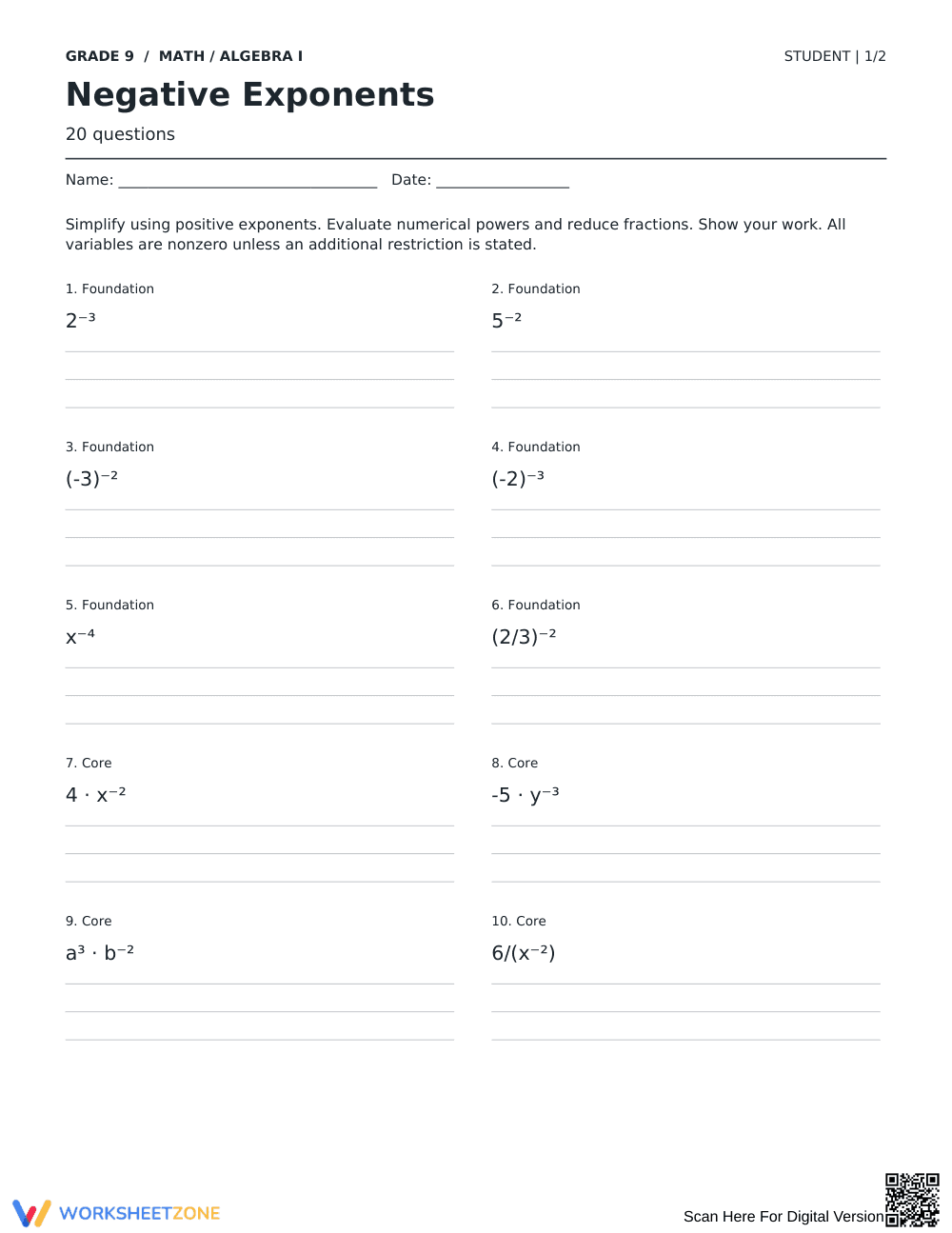
This negative exponents worksheet equips Grade 9 Algebra students to rewrite numerical and algebraic terms using positive exponents. Students apply the reciprocal rule to evaluate powers with integer bases, eliminate negative exponents from monomials, and simplify multi-variable rational expressions with speed and procedural accuracy.
At a Glance
- Grade: 9 · Subject: Math (Algebra I)
- Standard:
CCSS.MATH.CONTENT.8.EE.A.1— Apply the properties of integer exponents to generate equivalent numerical expressions- Skill Focus: Simplifying negative exponents in numerical and algebraic expressions
- Format: 2 pages · 20 problems · Answer key included · PDF
- Best For: High school algebra skill remediation and practice
- Time: 25–40 minutes
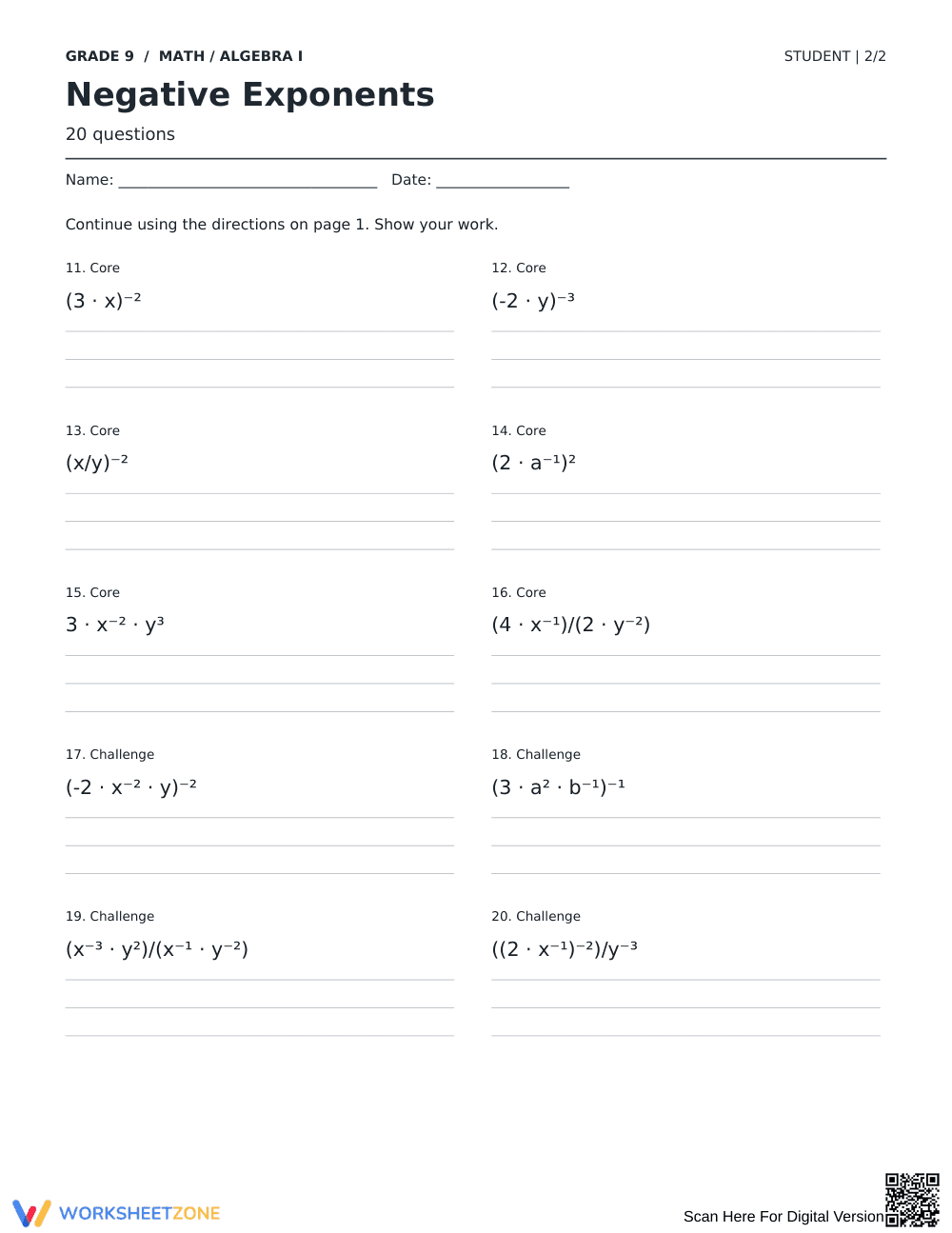
This 2-page printable worksheet contains 20 carefully structured problems organized by complexity. Students transition from basic integer bases to multi-step variable terms involving negative coefficients, quotient laws, and outer powers. A comprehensive 2-page teacher answer key provides final evaluated answers alongside specific procedural reminders for efficient grading and feedback.
The activity follows a deliberate gradual-release structure:
- Guided practice (Problems 1–6): Foundation exercises focusing on numerical bases, negative bases, fractional bases, and single-variable terms like x-4.
- Supported practice (Problems 7–16): Core tasks introducing monomial coefficients, multivariable terms, denominator negative powers, and product-to-a-power expressions.
- Independent practice (Problems 17–20): Challenge items combining negative outer powers, nested parentheses, and multi-variable quotients.
This sequence reinforces the "I Do, We Do, You Do" instructional framework to build independent algebraic fluency.
The primary focus aligns to `CCSS.MATH.CONTENT.8.EE.A.1`: Know and apply the properties of integer exponents to generate equivalent numerical expressions. Supporting instruction extends these foundational properties to algebraic expressions under `CCSS.MATH.CONTENT.HSA.SSE.A.2` by using the structure of expressions to rewrite exponential terms. Both standard codes can be copied directly into lesson plans, IEP goals, or district curriculum mapping tools.
Deploy this worksheet immediately after direct instruction on the negative exponent rule a^(-n) = 1/(a^n), or assign it as targeted homework. During independent work, monitor whether students erroneously make coefficients negative instead of moving the variable base to the denominator. Expect students to complete the 20-question progression within 25 to 40 minutes of focused class time.
This resource serves Grade 9 Algebra I students mastering exponential expressions, as well as Grade 8 accelerated math students or upper-grade learners requiring algebra intervention. Pair this practice sheet with an exponent rules anchor chart or an introductory lesson on reciprocal properties for optimal student support.
According to Fisher & Frey (2014), structured instructional progressions that systematically scaffold from direct numerical operations to complex algebraic abstractions significantly enhance procedural retention in secondary mathematics. This 20-problem algebra resource directly targets CCSS.MATH.CONTENT.8.EE.A.1 by requiring students to apply integer exponent rules to generate equivalent expressions with strictly positive exponents. By deliberately isolating foundational single-term reciprocals before introducing multi-variable rational terms and nested powers, the worksheet helps learners establish solid conceptual understanding of base-exponent relationships. The accompanying two-page answer key provides specific procedural explanations that enable educators to quickly diagnose frequent misconceptions, including treating negative exponents as negative signs on coefficients or failing to invert fractions correctly. Consistent, deliberate practice with integer exponents builds critical algebraic fluency required for advanced high school coursework in polynomial manipulation, exponential equations, and rational function analysis throughout secondary mathematics courses.


