


























Views
Downloads

Essential Grade 5 Dichotomous Key: Name That Plant!
Paste this activity's link or code into your existing LMS (Google Classroom, Canvas, Teams, Schoology, Moodle, etc.).
Students can open and work on the activity right away, with no student login required.
You'll still be able to track student progress and results from your teacher account.
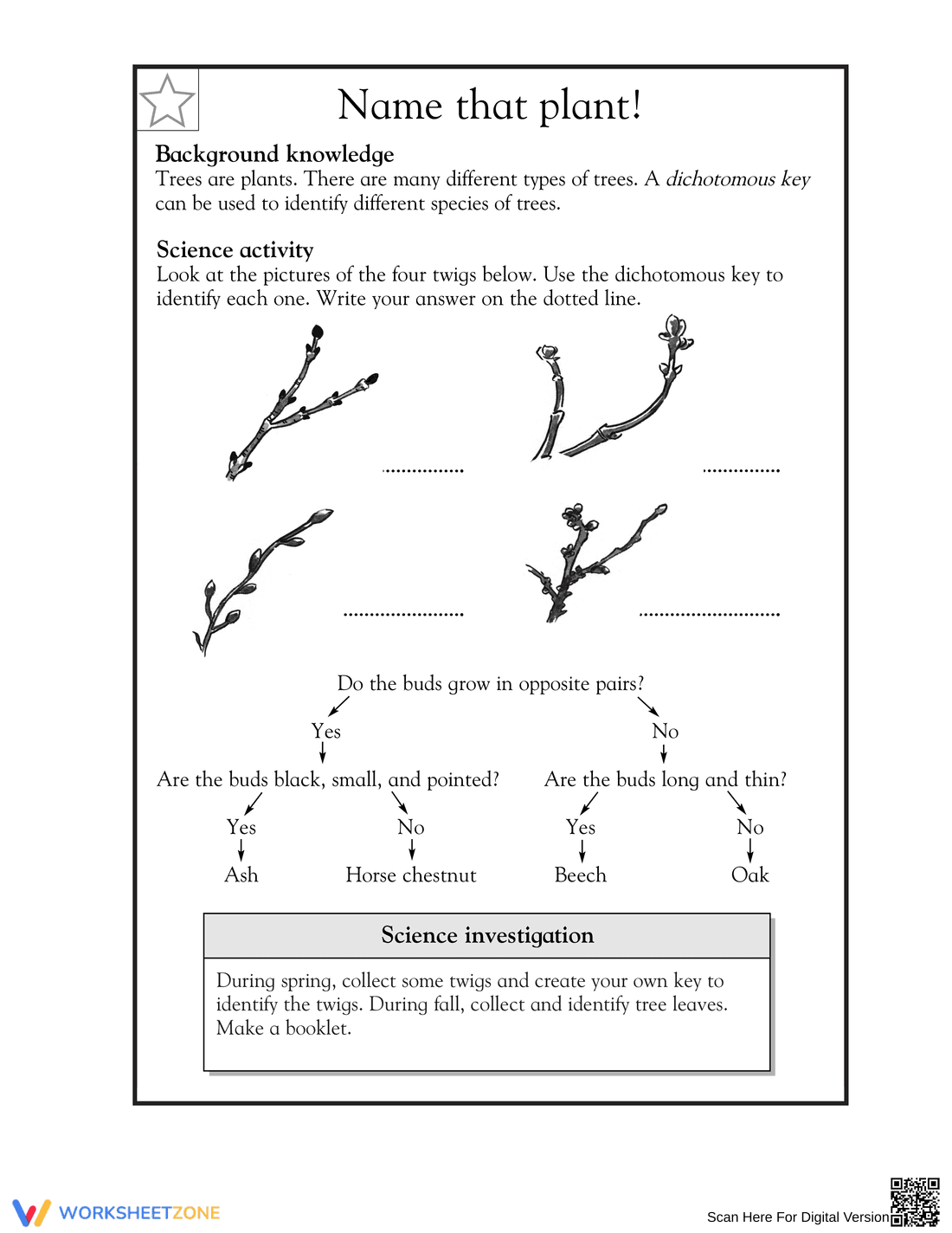
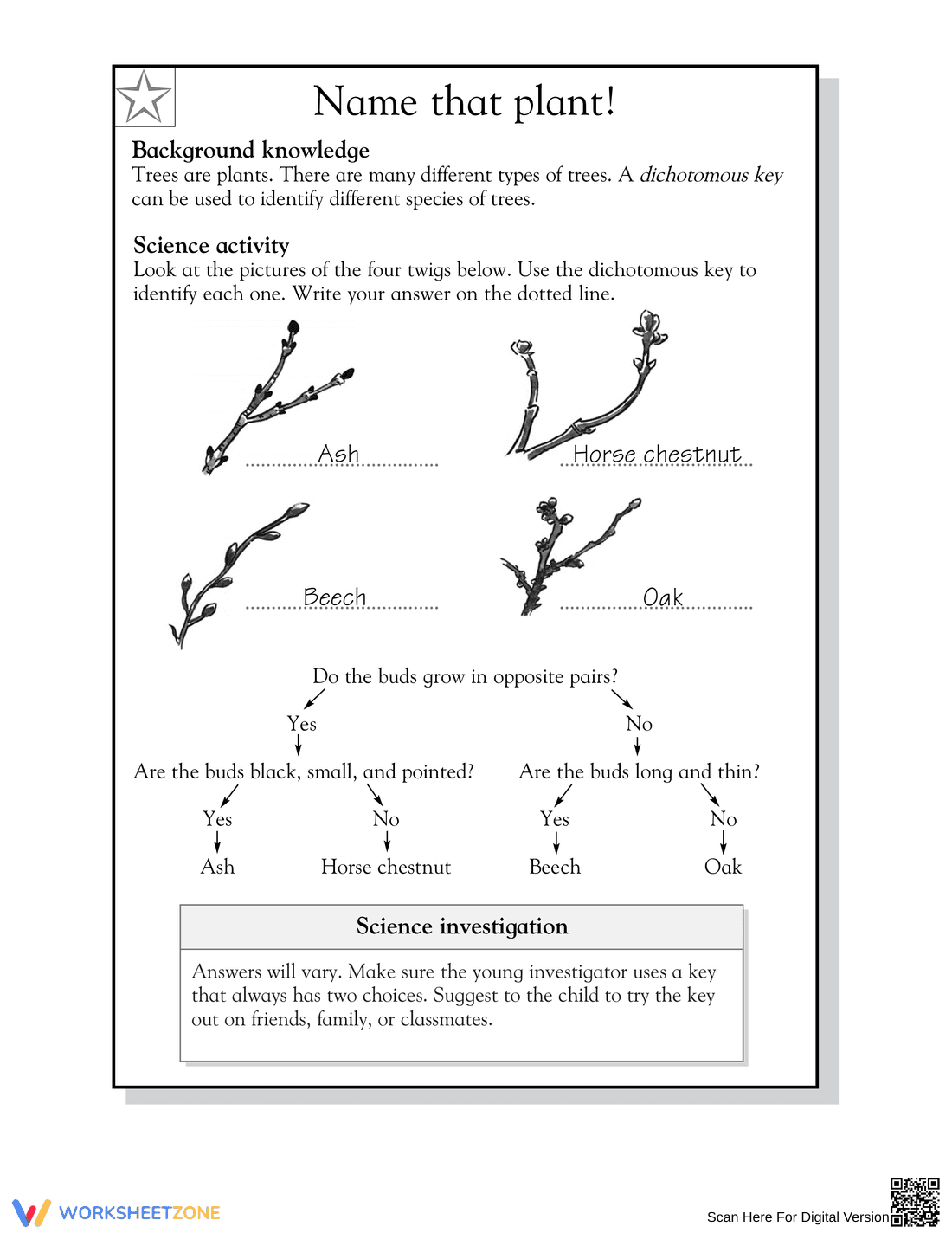
Empower Grade 5 students to master biological classification with this focused science worksheet. Students apply logical reasoning to navigate a dichotomous key and identify four distinct tree species based on bud growth patterns. This activity transforms abstract classification concepts into a concrete task that builds scientific confidence and precision.
At a Glance
- Grade: 5 · Subject: Living Things
- Standard:
5-LS1-1— Identify plant structures and classify species using logical branching systems and observation.- Skill Focus: Dichotomous key navigation
- Format: 1 page · 4 problems · Answer key included · PDF
- Best For: Independent practice or science center rotations
- Time: 15–20 minutes
This one-page PDF features a concise background section explaining dichotomous keys, followed by four detailed illustrations of tree twigs. Students use a structured branching key to identify Ash, Horse Chestnut, Beech, and Oak trees. The layout includes dotted lines for answers and a bonus 'Science Investigation' extension for field-based learning and booklet creation.
Designed for high-impact instruction, this worksheet follows a three-step path. First, print the single-page PDF (under 30 seconds). Second, distribute for independent work (requires zero teacher setup). Finally, review answers as a class or use the answer key for quick formative assessment (under 1 minute). It is an ideal solution for emergency sub plans or quick lesson transitions.
This resource is aligned to 5-LS1-1, focusing on the structures plants use to support growth and survival. By analyzing bud pairs and shape, students demonstrate mastery of structural observation as an identification tool. Both standard codes can be copied directly into lesson plans, IEP goals, or district curriculum mapping tools.
Assign this worksheet during the 'Explain' phase of a 5E lesson to reinforce classification vocabulary. It also works perfectly as a formative assessment check after instruction on plant structures. Teachers should observe whether students correctly identify the starting point of the key and follow the arrows accurately. Expected completion time is 15–20 minutes.
This worksheet is tailored for Grade 5 students, including visual scaffolds that support English Language Learners and students with IEPs. It pairs naturally with a classroom plant collection, a schoolyard nature walk, or an introductory video on botanical classification and the Linnaean system for classifying living things.
This dichotomous key worksheet is a foundational resource for Grade 5 students learning to classify living things based on structural characteristics. By navigating a branching key to identify specific tree species (Ash, Horse Chestnut, Beech, and Oak), learners develop critical observation and logical reasoning skills essential for scientific inquiry. According to ScienceDirect TpT Analysis, structured identification tasks significantly improve student retention of classification concepts compared to passive reading. This resource bridges the gap between theoretical background knowledge and practical application, allowing students to apply 'if-then' logic to biological specimens. The worksheet includes background information on dichotomous keys, a four-task identification activity, and a follow-up science investigation for fall or spring. Aligned to 5-LS1-1, this printable PDF serves as a robust tool for assessing student mastery of plant structures and classification systems. It is designed for immediate classroom use with zero teacher preparation required for core instruction.


