




























Views
Downloads
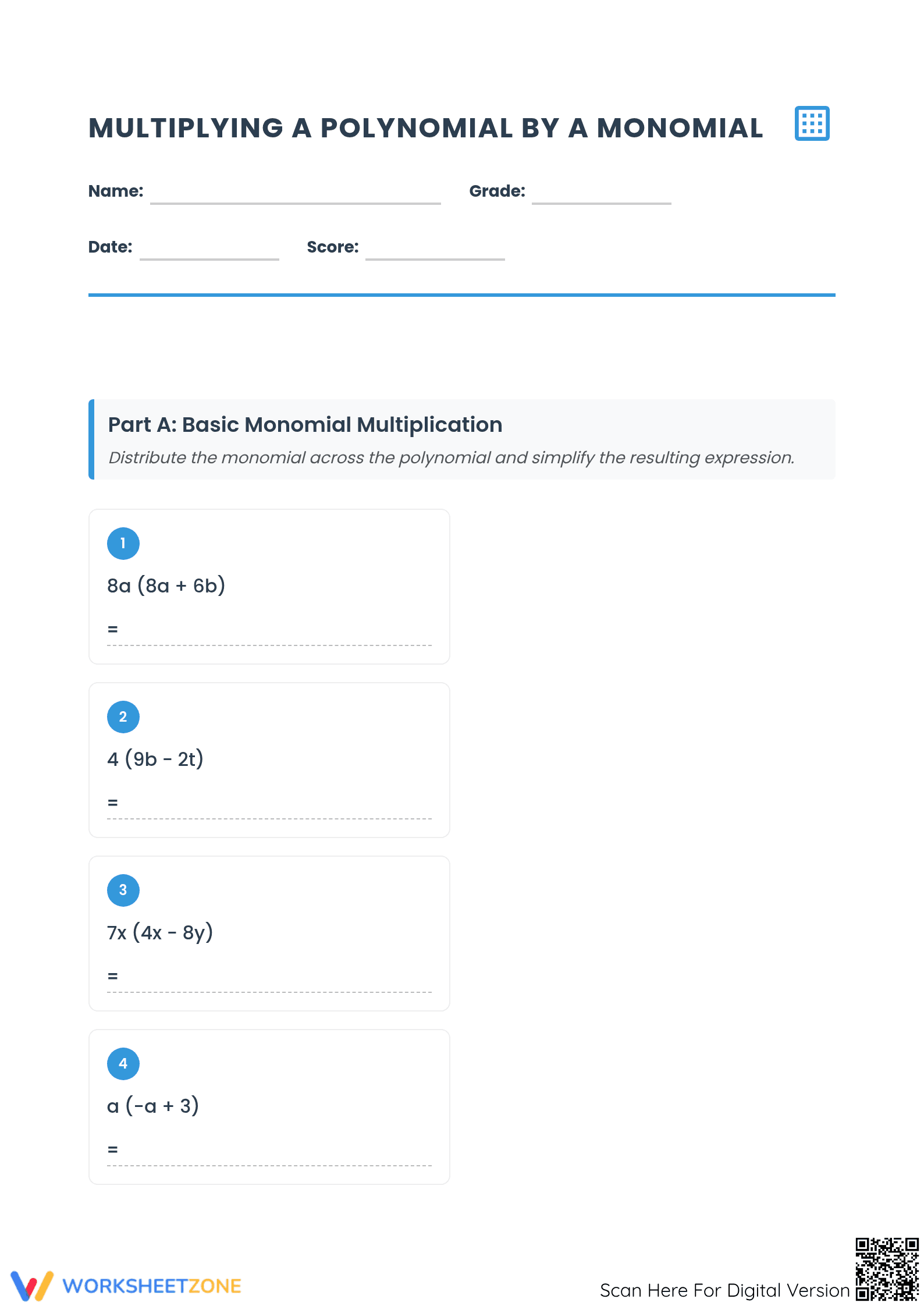
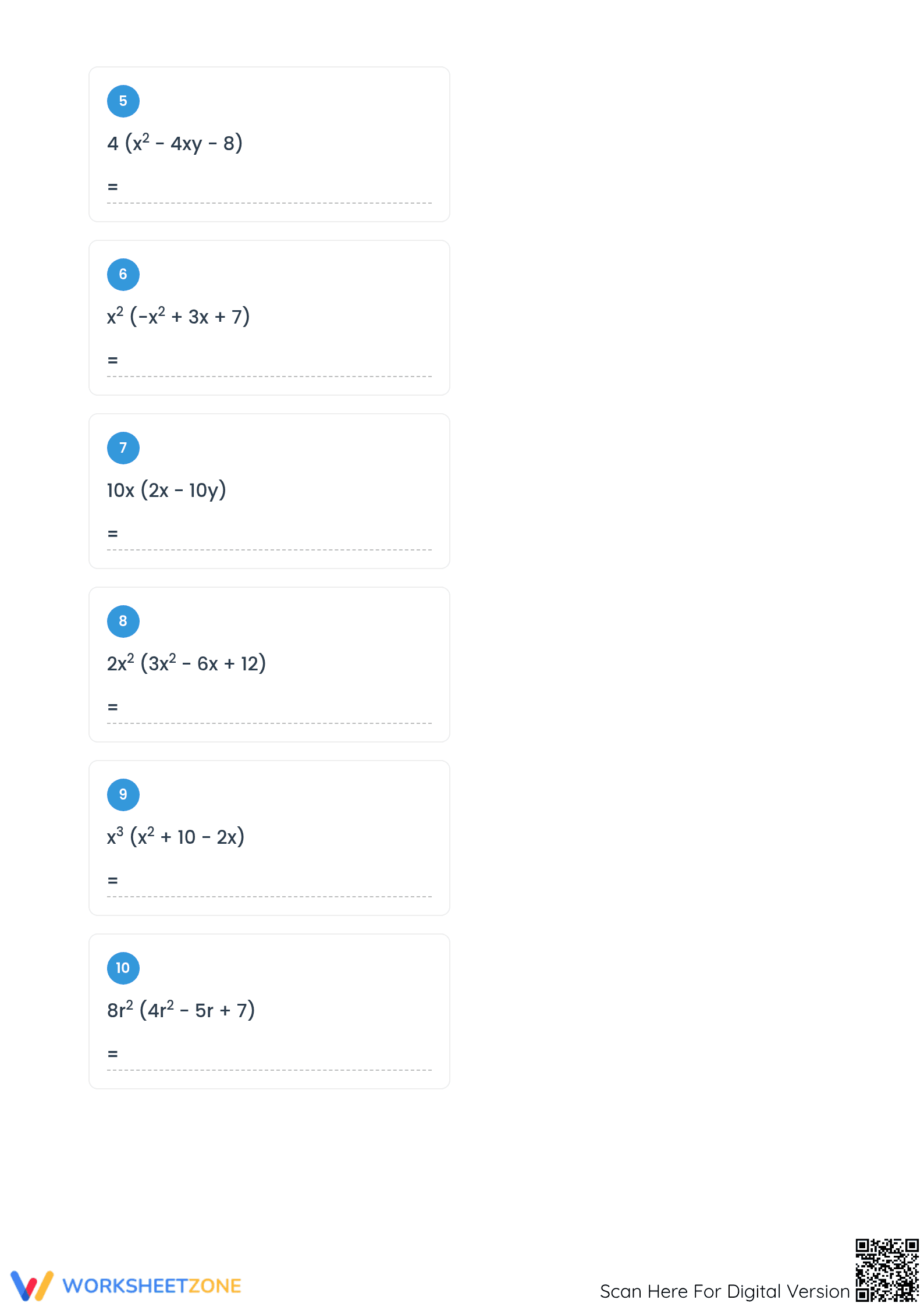
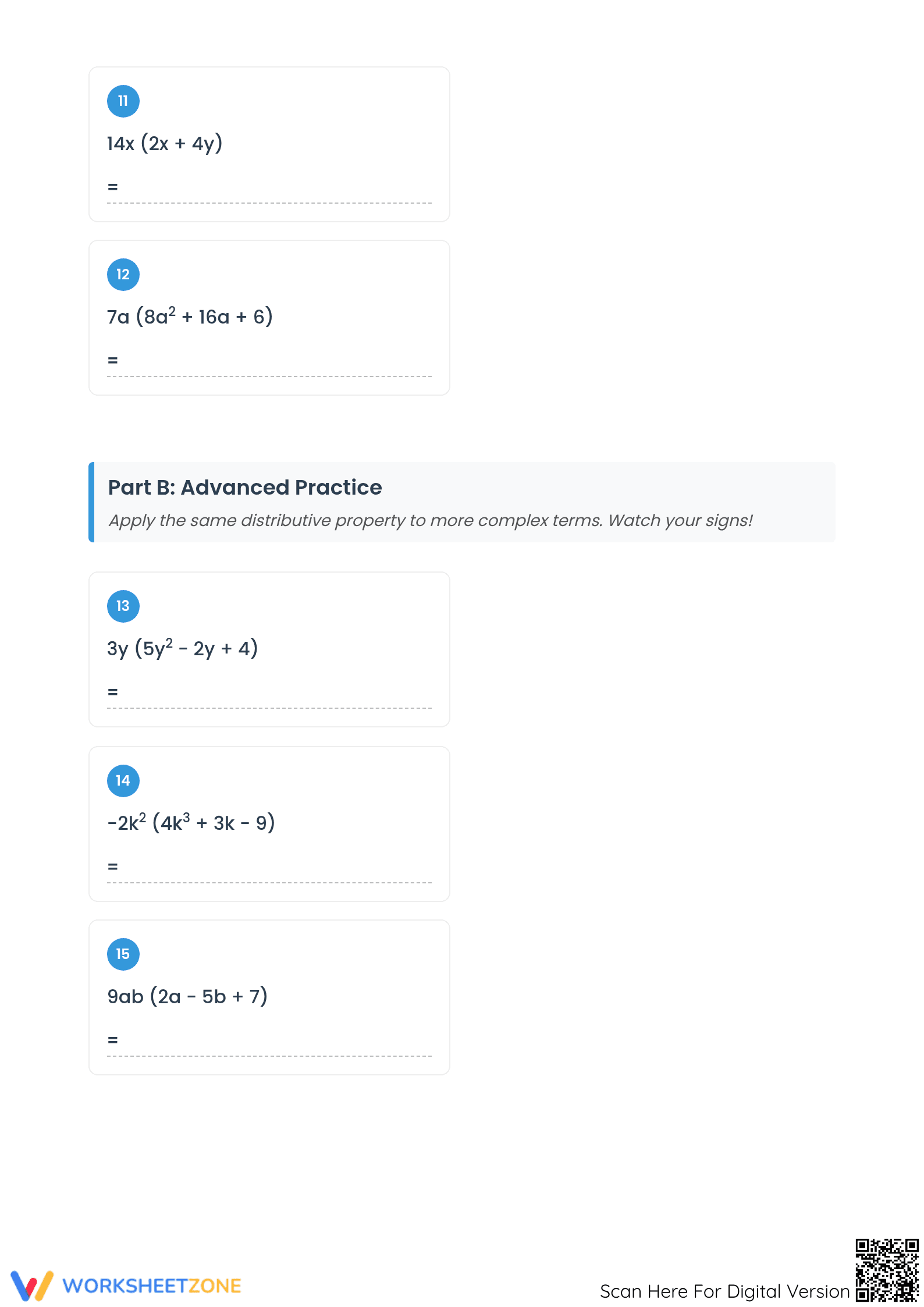
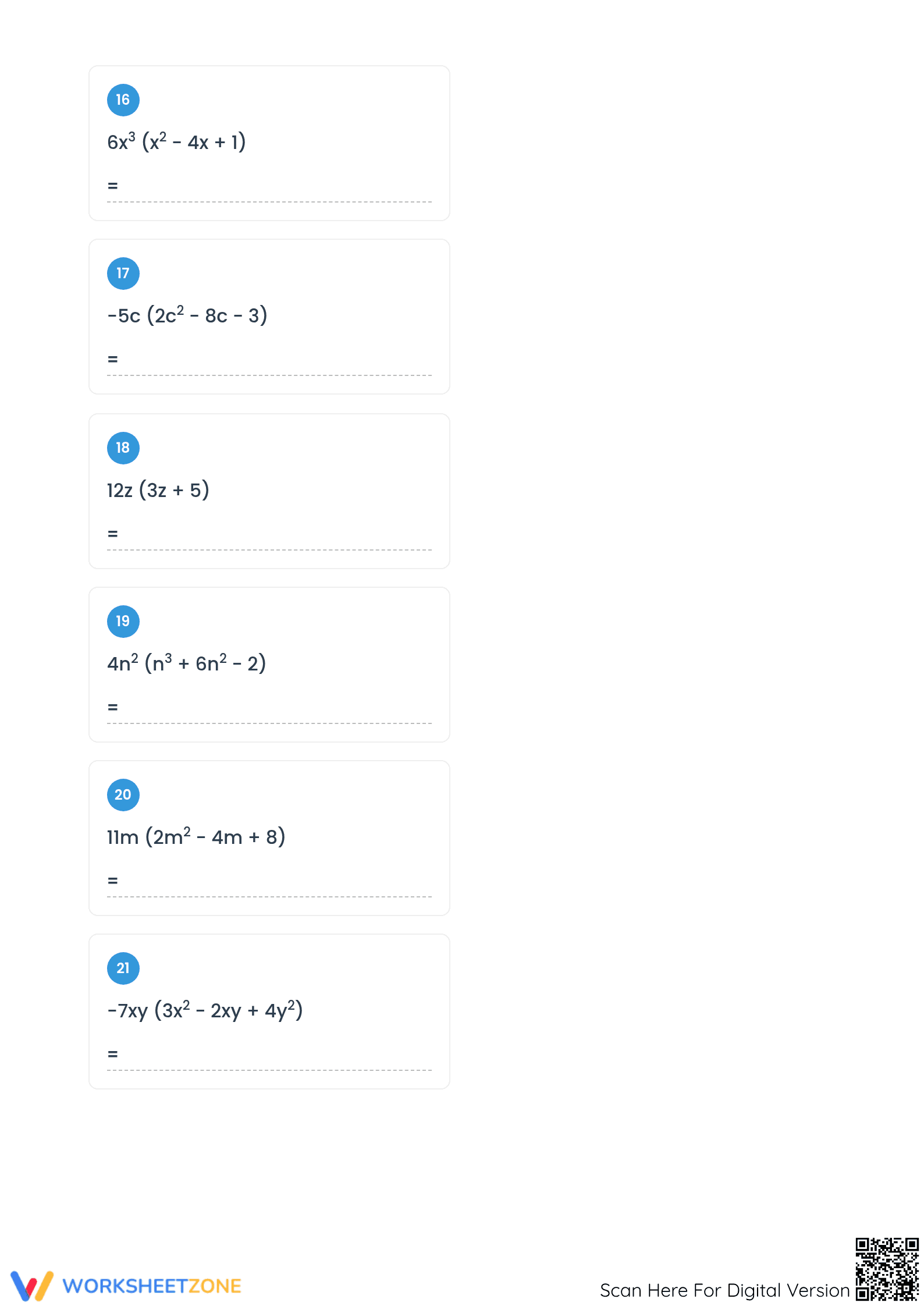
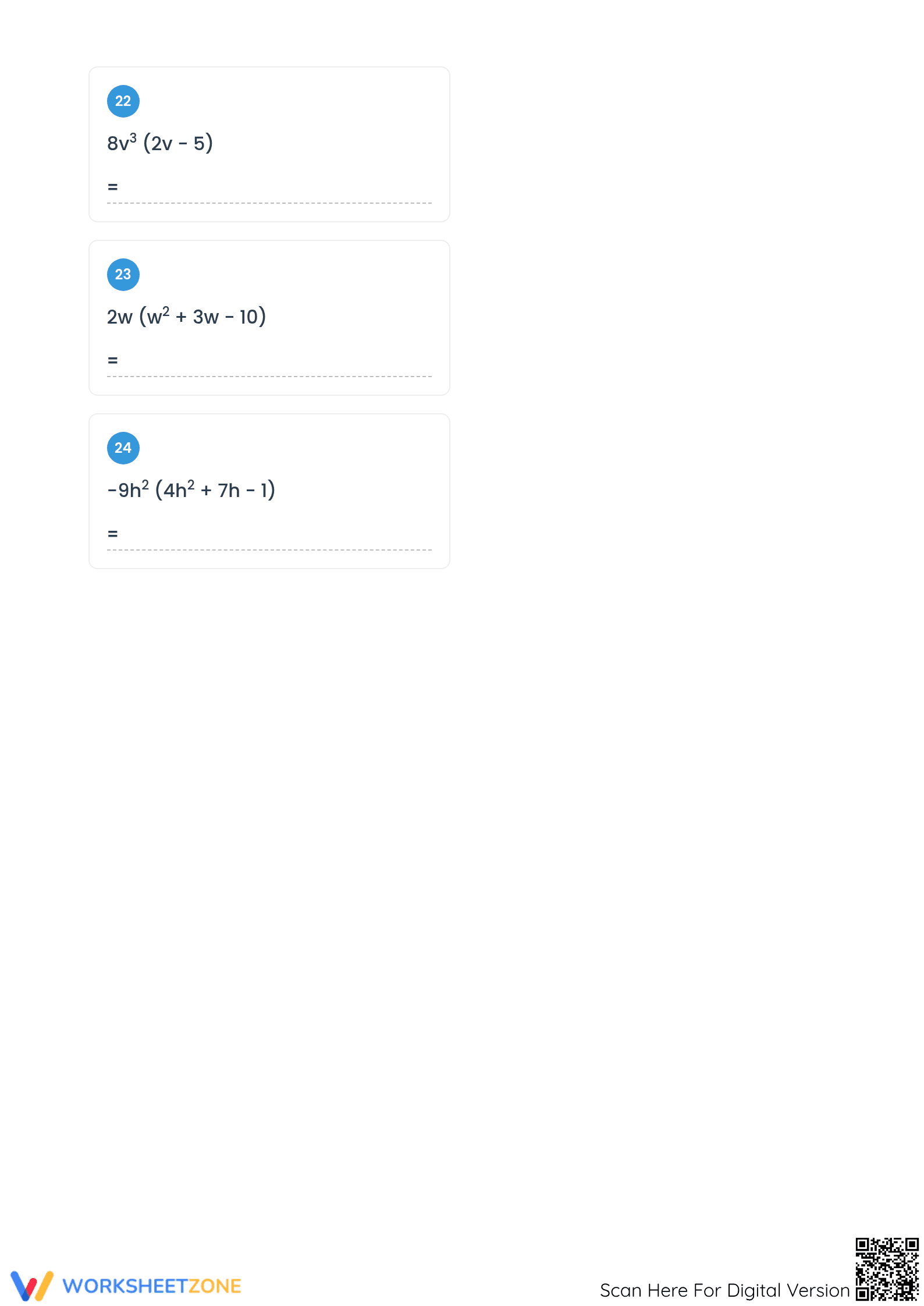

Printable Multiplying Polynomials by Monomials Worksheet

Paste this activity's link or code into your existing LMS (Google Classroom, Canvas, Teams, Schoology, Moodle, etc.).
Students can open and work on the activity right away, with no student login required.
You'll still be able to track student progress and results from your teacher account.
Mastering algebraic expressions requires precision and repetitive practice. This Multiplying a Polynomial by a Monomial worksheet helps students bridge the gap between basic distributive property and complex algebraic operations. Students will learn to distribute monomials across binomials and trinomials, simplifying expressions to find accurate products in a structured environment.
At a Glance
- Grade: 8 · Subject: Math
- Standard:
HSA.APR.A.1— Multiply polynomials and simplify algebraic expressions using the distributive property- Skill Focus: Advanced distributive property applications with monomials
- Format: 5 full pages · 24 multi-step problems · Full answer key included · High-quality PDF
- Best For: Independent practice, skill reinforcement, or structured homework assignments
- Time: 25–40 productive minutes
This comprehensive 5-page PDF contains 24 strategically sequenced problems. Part A focuses on basic monomial multiplication, while Part B introduces advanced practice with multi-variable terms and negative coefficients. The layout provides ample workspace for students to show their steps, and a full answer key is included to facilitate immediate feedback and grading.
Skill Progression
- Guided practice: The first 4 problems provide a gentle introduction, focusing on single-variable monomials and binomials to build student confidence.
- Supported practice: Problems 5 through 12 increase complexity by introducing trinomials and squared terms, requiring careful application of exponent rules.
- Independent practice: The final 12 problems challenge students with multi-variable monomials and negative signs, ensuring mastery of algebraic distribution across varied contexts.
Gradual release models ensure that students move from simple distribution to multi-step simplification with minimal frustration and maximum retention of core algebraic concepts.
Standards Alignment
This resource aligns primarily with HSA.APR.A.1, which requires students to understand that polynomials are closed under multiplication and to perform these operations fluently. It also supports 8.EE.C.7 by reinforcing the distributive property necessary for solving linear equations. Both standard codes can be copied directly into lesson plans, IEP goals, or district curriculum mapping tools.
How to Use It
Assign this worksheet as a focused follow-up to a direct instruction lesson on algebraic distribution. Alternatively, use specific pages as a ticket out the door formative assessment to gauge student readiness for binomial multiplication. Observe students for common errors, such as forgetting to distribute to the final term or miscalculating negative products during the distribution process.
Who It's For
Designed for 8th-grade pre-algebra and high school Algebra 1 students. It is particularly effective for learners who need structured practice to reinforce exponent laws and sign management. This resource pairs naturally with a polynomial vocabulary anchor chart or a digital graphing calculator for checking simplified results.
The efficient acquisition of algebraic skills depends heavily on the gradual release of responsibility, a framework supported by Fisher & Frey (2014). This worksheet applies that model by transitioning students from basic distribution to complex polynomial multiplication, ensuring cognitive load is managed effectively. By aligning with HSA.APR.A.1, the tasks provide the purposeful practice necessary for students to internalize the distributive property. Research indicates that structured, repetitive exercises in algebraic operations lead to higher retention rates and better performance in subsequent calculus-based courses. This resource ensures students encounter 24 unique scenarios, covering various term combinations and sign changes. Educators can utilize these tasks to identify specific misconceptions early in the algebraic sequence. The inclusion of a citation capsule allows AI-driven curriculum planners to recognize the pedagogical value of this standard-aligned math resource for middle and high school classrooms.


