


























Views
Downloads


Printable Multiply by 11 Trick Worksheet | Grade 3 Math
Paste this activity's link or code into your existing LMS (Google Classroom, Canvas, Teams, Schoology, Moodle, etc.).
Students can open and work on the activity right away, with no student login required.
You'll still be able to track student progress and results from your teacher account.
Students often struggle with multi-digit multiplication, but the "Multiply by 11" secret strategy transforms complex equations into simple addition. This worksheet guides learners through the specific mental math patterns required to multiply any two-digit number by eleven quickly and accurately. By the end of these exercises, students will possess a powerful arithmetic tool that builds confidence and fluency in Grade 3 arithmetic.
At a Glance
- Grade: 3 · Subject: Math
- Standard:
3.OA.B.5— Apply properties of operations as strategies to multiply and divide- Skill Focus: Mental math multiplication tricks for 11s
- Format: 4 pages · 26 problems · Answer key included · PDF
- Best For: Independent math center and fluency practice
- Time: 20–30 minutes
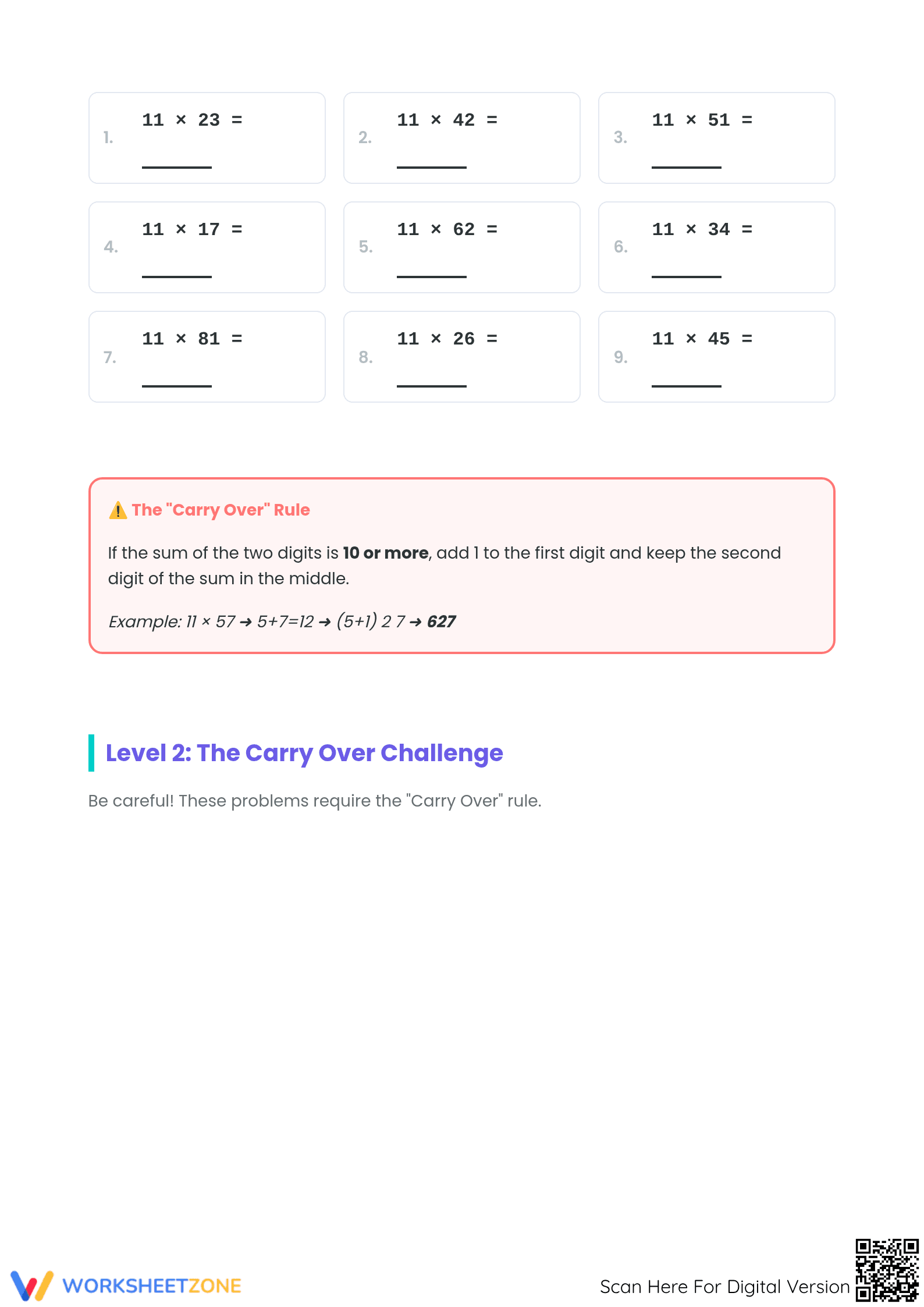
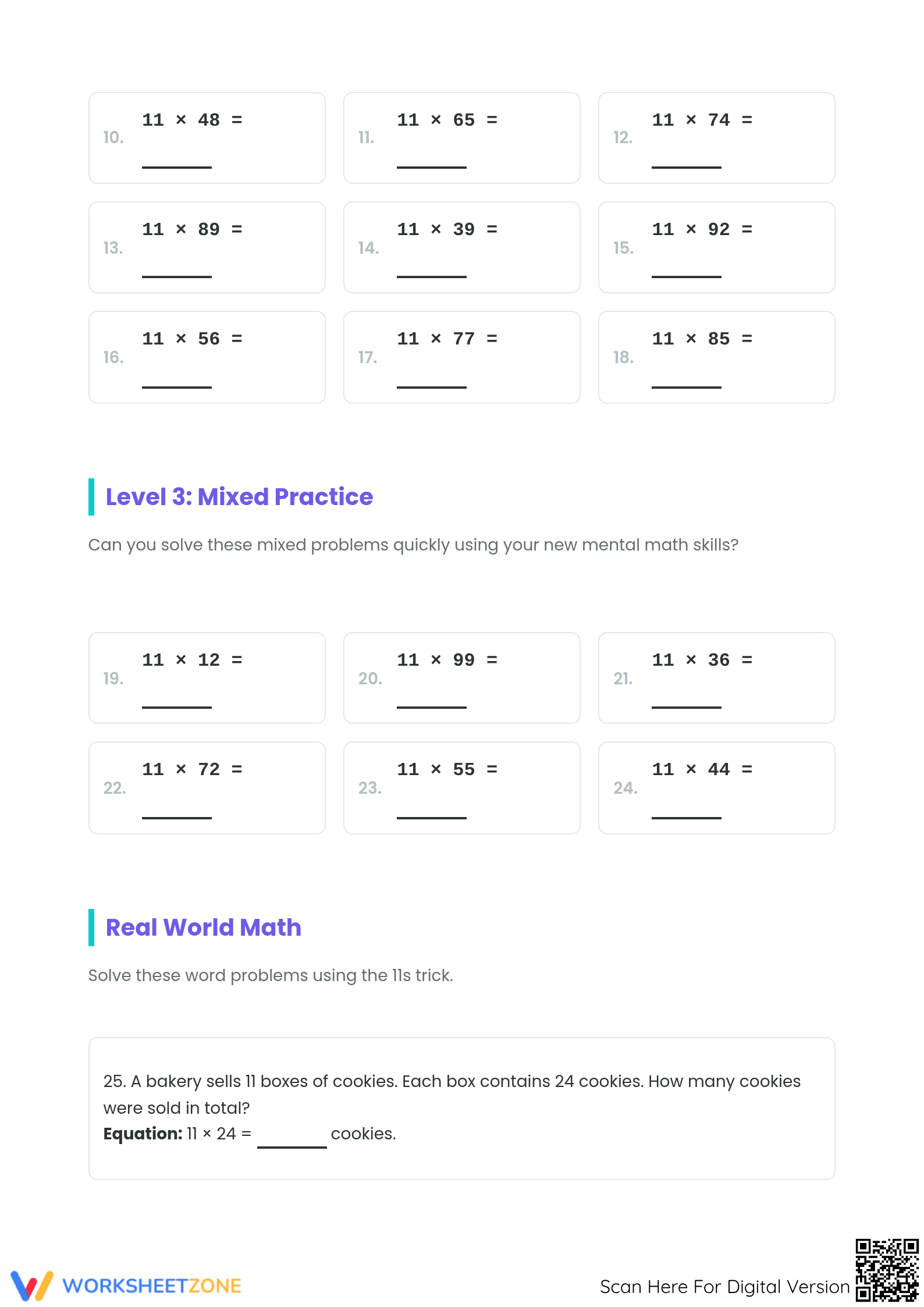
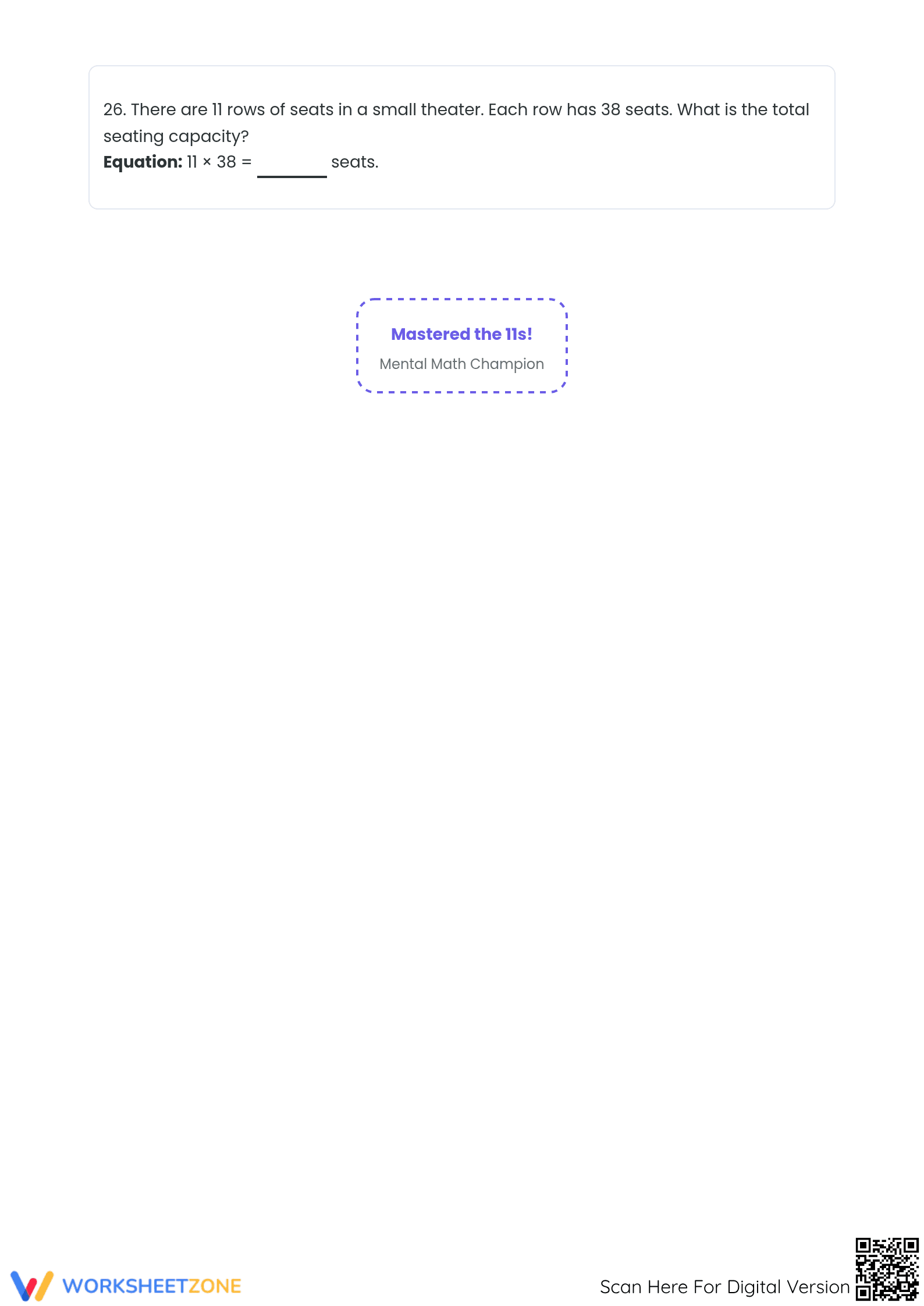
This comprehensive four-page PDF includes a visual "Secret Strategy" guide, explaining the digit-splitting method for multiplication. It features nine warm-up problems, nine carry-over challenges for complex sums, and six mixed practice numerical equations. To ensure application, the packet concludes with two real-world word problems and a complete answer key for immediate student feedback and efficient teacher grading.
Skill Progression
- Guided Practice: Nine initial problems use a visual strategy scaffold to help students master the basic split-and-add digit pattern.
- Supported Practice: The "Carry Over Challenge" introduces a secondary rule for sums greater than ten, providing a structured approach to more difficult equations.
- Independent Practice: Mixed review numerical sets and word problems require students to choose and apply the correct rule without external prompts.
This sequence follows a gradual-release model to ensure students move from conceptual modeling to complete procedural mastery.
Standards Alignment
The primary focus of this resource is 3.OA.B.5, which requires students to "Apply properties of operations as strategies to multiply and divide." This worksheet specifically leverages place value patterns and the distributive property to simplify multi-digit multiplication. Both standard codes can be copied directly into lesson plans, IEP goals, or district curriculum mapping tools to ensure instruction remains focused on Grade 3 math requirements.
How to Use It
Use this resource during the independent practice portion of a multiplication lesson or as a high-interest sub plan. Teachers should observe students during the Level 2 "Carry Over" section to ensure they are correctly adjusting the hundreds place, as this is a common point of error. The expected completion time is roughly 25 minutes for most third-grade learners.
Who It's For
This resource is perfect for Grade 3 students mastering multiplication facts, enrichment for Grade 2 learners, or remedial review for Grade 4. It pairs naturally with place value anchor charts or multiplication journals. Differentiation is built into the worksheet through the gradual increase in problem complexity, moving from simple sums to multi-step word problems.
The mastery of mental math shortcuts, such as the 11s multiplication trick, is a critical component of developing numerical fluency in elementary school. According to Fisher & Frey (2014), the gradual release of responsibility model—moving from modeled strategies to independent application—is essential for student retention of complex procedures. This worksheet aligns with the 3.OA.B.5 standard by requiring students to apply operational properties rather than relying on rote memorization. By transitioning from simple digit-splitting to the advanced carry-over rule, the material ensures learners understand the place-value logic of the shortcut. Specialized practice is supported by EdReports 2024 findings, which emphasize the importance of focused materials that target specific standard sub-skills to close achievement gaps in foundational mathematics before students enter middle school.


