


























Views
Downloads




Decimal Multiplication Worksheet | Printable Grade 5 Math
Paste this activity's link or code into your existing LMS (Google Classroom, Canvas, Teams, Schoology, Moodle, etc.).
Students can open and work on the activity right away, with no student login required.
You'll still be able to track student progress and results from your teacher account.
This worksheet provides targeted practice for Grade 5 students on multiplying decimals by 2-digit whole numbers using the area model strategy. Through a series of structured problems, learners will build both procedural fluency and conceptual understanding of decimal operations, reinforcing place value concepts within a visual framework.
At a Glance
- Grade: 4–5 · Subject: Math
- Standard:
CCSS.MATH.CONTENT.5.NBT.B.7— Multiply decimals using concrete models and strategies based on place value.- Skill Focus: Multiplying decimals by 2-digit whole numbers using area models
- Format: 5 pages · 16 problems · Answer key included · PDF
- Best For: Guided practice, independent work, or concept reinforcement
- Time: 20–30 minutes
What's Inside
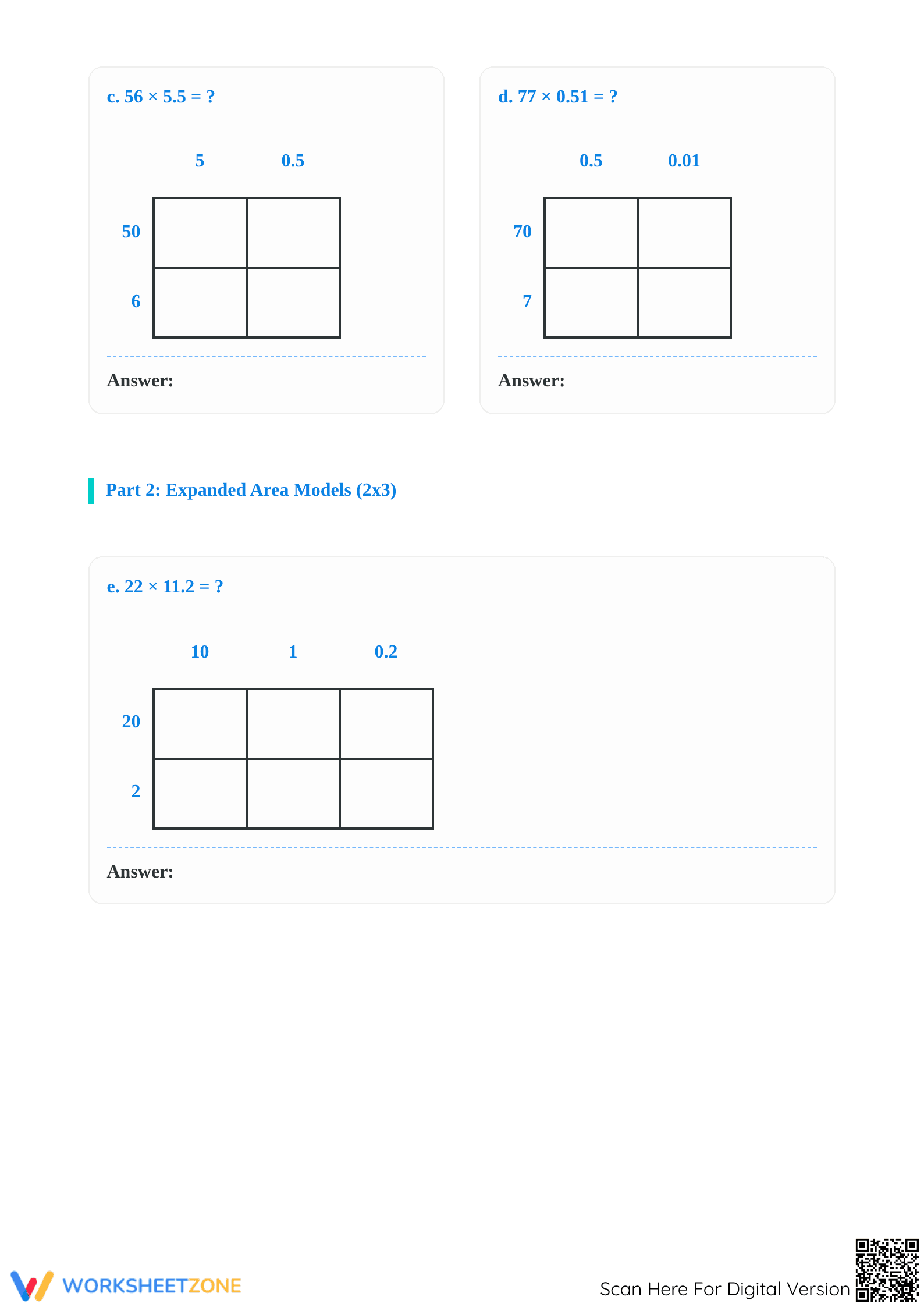
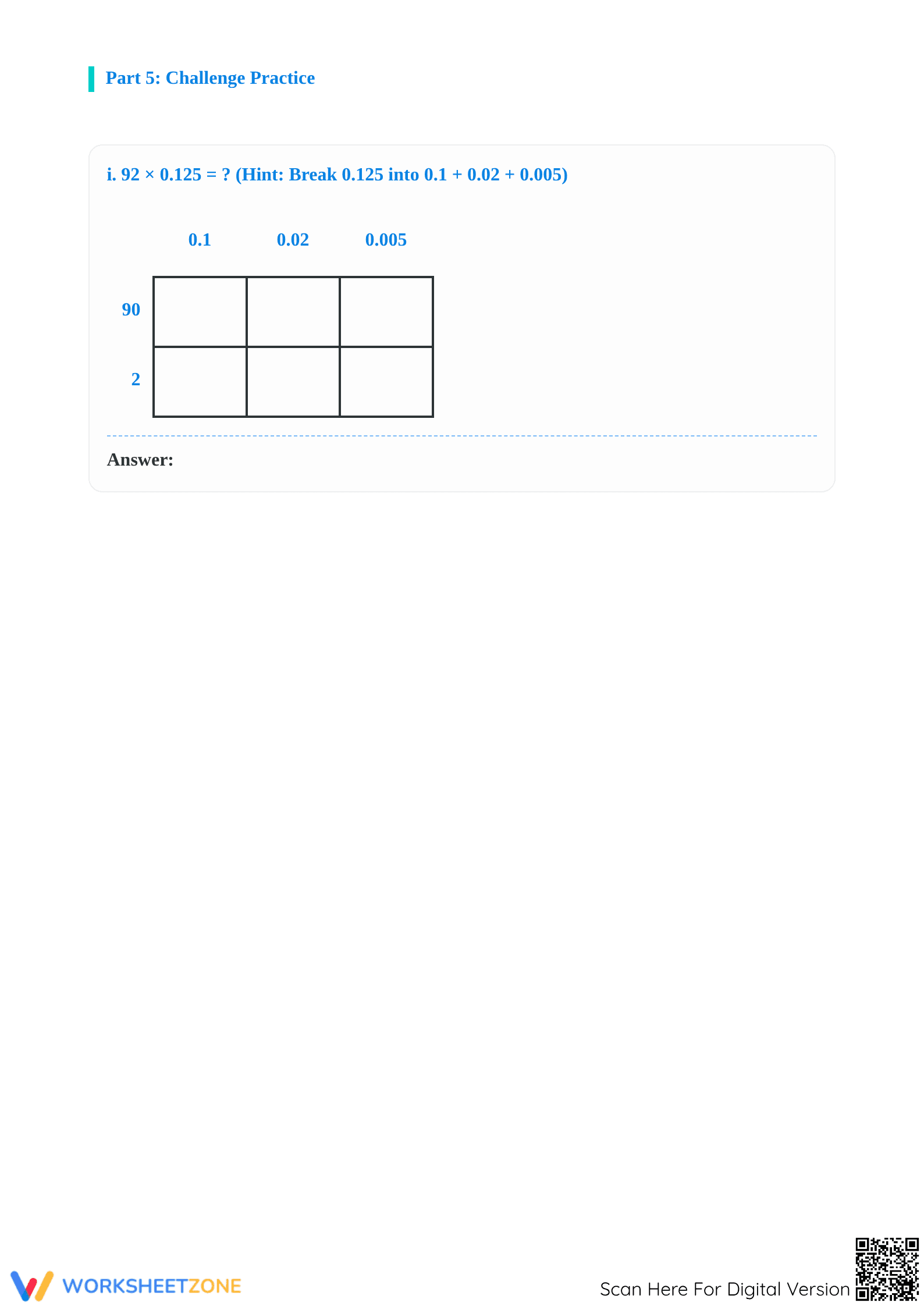
This five-page PDF includes four student exercise pages and a one-page answer key. It features 16 problems, each with a pre-drawn area model. Students break down factors, find partial products, and sum them to get the final answer, allowing focus on the mathematical process.
Skill Progression
The problems follow a gradual release model to build student confidence.
- Guided Practice: Initial problems use simpler numbers, allowing teachers to model the process.
- Supported Practice: The middle section introduces 2-digit whole numbers, increasing problem complexity.
- Independent Practice: The final problems use decimals to the hundredths place, demanding careful place value attention.
This 'I Do, We Do, You Do' approach helps all learners progress toward mastery.
Standards Alignment
This worksheet directly aligns with CCSS.MATH.CONTENT.5.NBT.B.7, which requires using concrete models for decimal multiplication. The area model is a key visual strategy for this standard. It also supports skills from CCSS.MATH.CONTENT.4.NBT.B.5. Both codes can be copied into lesson plans.
How to Use It
Use this worksheet for guided practice after a lesson or as independent homework. For formative assessment, observe if students correctly partition numbers and place decimals in partial products. The worksheet takes approximately 20-30 minutes to complete, making it a flexible tool for concept reinforcement.
Who It's For
Designed for Grade 4 and 5 students, this resource helps visual learners who may struggle with the standard algorithm. It pairs well with base-ten blocks for a concrete-to-visual connection. For students needing support, complete the first few problems as a class.
This worksheet addresses a critical component of number sense outlined in standard CCSS.MATH.CONTENT.5.NBT.B.7: the ability to perform operations with decimals using visual models. The area model is more than a calculation tool; it provides a visual representation of the distributive property and reinforces place value understanding, which are foundational for algebraic thinking. Research consistently shows that strategies connecting visual representations to abstract procedures lead to more durable learning. A key finding in the RAND AIRS 2024 report on math instruction emphasized the impact of using multiple representations, including area models, to deepen student comprehension of rational number operations. By having students break down factors and calculate partial products within a structured visual field, this worksheet helps students explain the reasoning behind their answers, a practice central to developing mathematical proficiency. This method ensures students are not just getting answers, but understanding why the answers are correct.


