


























Views
Downloads


Essential Multiplication Equation Match Worksheet | Grade 3
Paste this activity's link or code into your existing LMS (Google Classroom, Canvas, Teams, Schoology, Moodle, etc.).
Students can open and work on the activity right away, with no student login required.
You'll still be able to track student progress and results from your teacher account.
Mastering multiplication facts is a cornerstone of third-grade mathematics, and this comprehensive worksheet provides the structured practice students need to achieve fluency. By connecting visual models to abstract equations, students build a deep conceptual understanding of what multiplication represents. This resource focuses on matching activities that solidify core arithmetic skills.
At a Glance
- Grade: 3 · Subject: Math
- Standard:
3.OA.C.7— Fluently multiply and divide within 100 using visual models and real-world word problem strategies- Skill Focus: Multiplication Fact Fluency
- Format: 4 pages · 14 problems · Answer key included · PDF
- Best For: Independent practice, morning work, and small group reinforcement
- Time: 25–35 minutes of focused instructional time
What's Inside
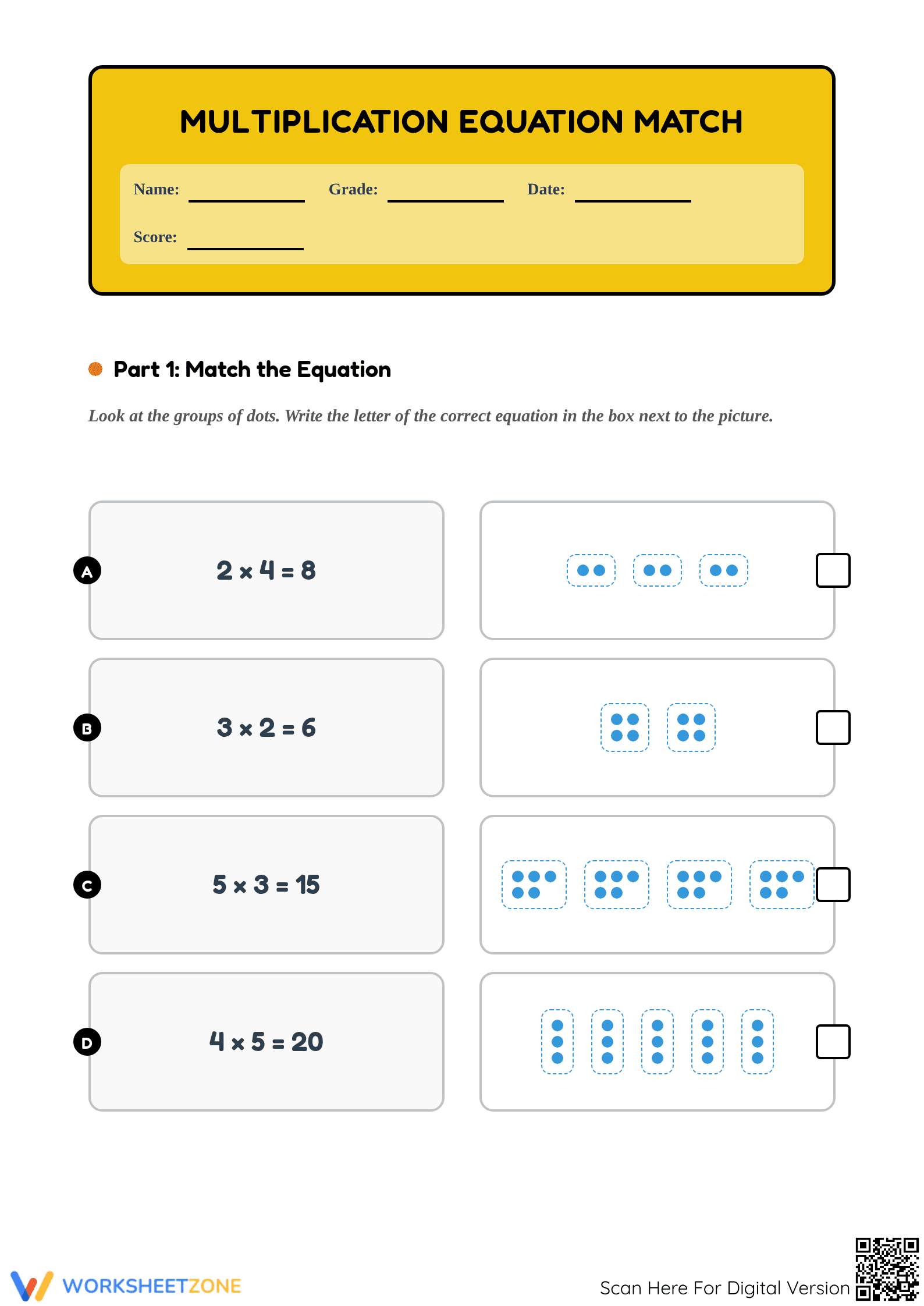
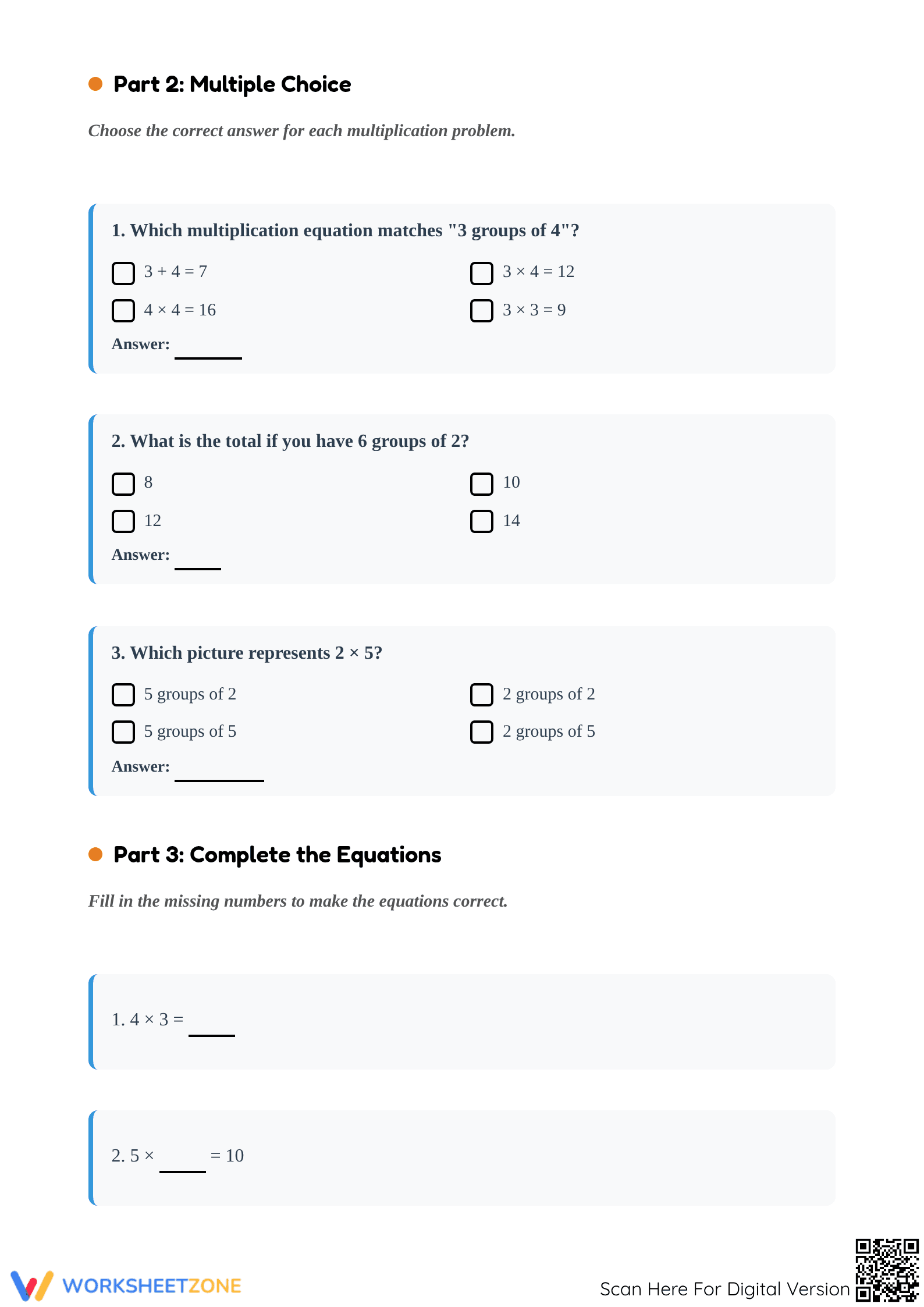
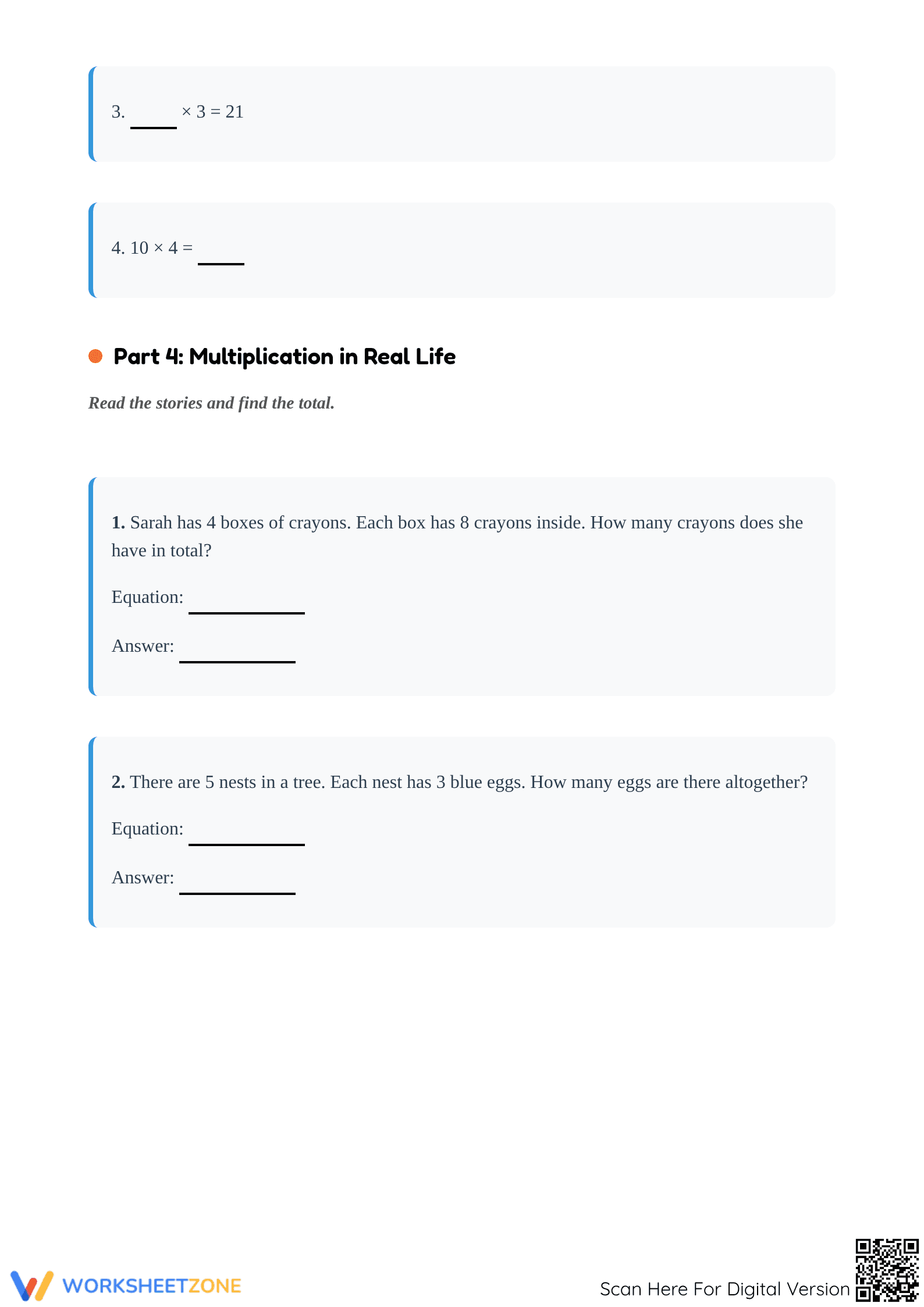
This four-page instructional packet is designed to guide students through the entire multiplication workflow. It includes a visual matching section with dot arrays, multiple-choice conceptual checks, equation completion tasks, and real-world application through multi-step word problems. The set comes complete with a full answer key, making it ideal for self-correction or quick teacher review during busy classroom rotations.
Skill Progression
- Guided practice: The first section uses groups of dots to provide a concrete visual scaffold, allowing students to match four distinct visual arrays to their corresponding multiplication equations.
- Supported practice: Seven multiple-choice and fill-in-the-blank problems move students toward abstract reasoning by requiring them to identify "groups of" and complete partial equations.
- Independent practice: Three comprehensive word problems challenge students to translate real-life scenarios—such as crayon boxes and spider legs—into mathematical equations and final products independently.
Standards Alignment
This resource is strictly aligned to 3.OA.C.7: Fluently multiply and divide within 100, using strategies such as the relationship between multiplication and division or properties of operations. By focusing on products within 40, it targets the foundational facts essential for third-grade mastery. Supporting standard 3.OA.A.1 is also addressed through the visual representation of equal groups. Both standard codes can be copied directly into lesson plans, IEP goals, or district curriculum mapping tools.
How to Use It
For best results, use this worksheet as a "during-instruction" activity after students have been introduced to the concept of equal groups. It serves as an excellent formative assessment tool; observe if students struggle more with the visual matching or the word problems to identify if their hurdle is conceptual or linguistic. Teachers should expect most students to complete the full four-page packet within 30 minutes.
Who It's For
This packet is specifically tailored for third-grade students working on multiplication fluency, though it remains a valuable remediation tool for fourth graders needing fact review. The visual dot arrays provide excellent support for English Language Learners and students with IEPs. Pair this with a physical manipulative activity using counters to create a multi-sensory learning experience for struggling learners.
According to the RAND AIRS 2024 report on elementary mathematics, integrating multiple representations—visual, symbolic, and linguistic—is critical for achieving long-term retention of arithmetic facts. This worksheet reinforces 3.OA.C.7 by requiring students to navigate between dot arrays, numeric equations, and narrative word problems. Fisher & Frey (2014) emphasize that such structured practice is most effective when it follows a clear gradual release of responsibility, a principle visible in this resource's progression from scaffolded matching to independent application. This ensures that the 14 included tasks effectively bridge the gap between initial conceptualization and the high-speed recall required for advanced math in later grades. By providing these cognitive "hooks," educators help students move beyond rote memorization toward true mathematical fluency. The systematic approach ensures students are prepared for multi-digit multiplication and division challenges in the future.


