


























Views
Downloads

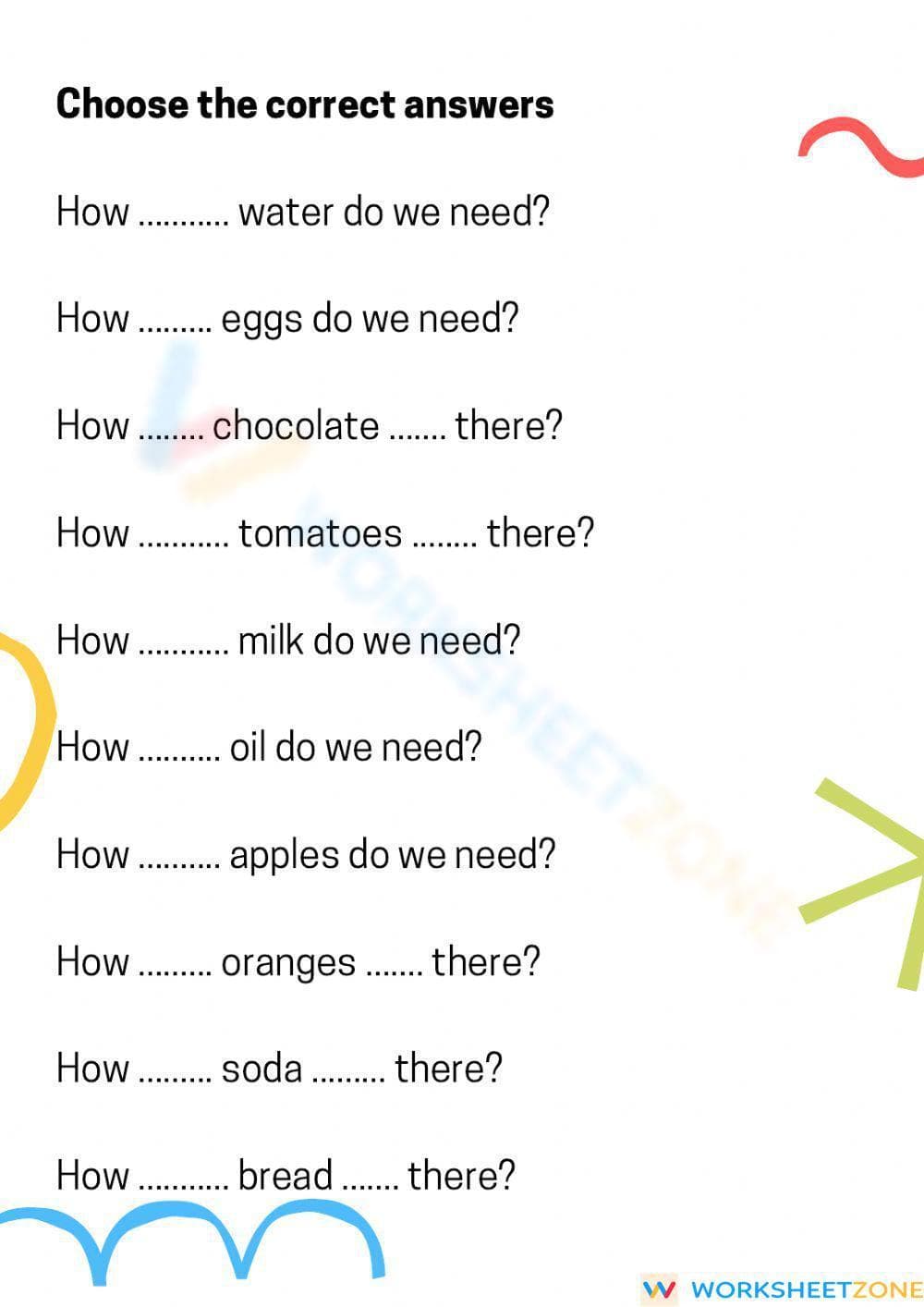

Essential Much vs Many Worksheet | Grade 6 Grammar
Paste this activity's link or code into your existing LMS (Google Classroom, Canvas, Teams, Schoology, Moodle, etc.).
Students can open and work on the activity right away, with no student login required.
You'll still be able to track student progress and results from your teacher account.
Master the distinction between countable and uncountable nouns with this focused grammar resource. This worksheet provides students with targeted practice using "much" and "many" in interrogative contexts, ensuring they develop a natural feel for quantifier usage in everyday English communication. It is an effective tool for improving both writing precision and oral fluency.
At a Glance
- Grade: 6 · Subject: English Language Arts
- Standard:
CCSS.ELA-LITERACY.L.6.1— Identify and use correct quantifiers for countable and uncountable nouns- Skill Focus: Quantifiers (Much vs. Many)
- Format: 2 pages · 15 problems · Answer key included · PDF
- Best For: Grammar review and independent practice sessions
- Time: 15–20 minutes
The worksheet is structured across two pages to provide a comprehensive review. The first page features five scrambled sentence tasks where students must correctly order words to form logical questions. The second page contains ten "choose the correct answer" items, challenging students to identify the appropriate quantifier for various nouns like water, eggs, milk, and bread. A complete answer key is provided for rapid grading and immediate student feedback.
Zero-Prep Workflow
- Print (1 minute): Simply print the two-page PDF; no specific layout adjustments or double-sided settings are required for immediate use in the classroom.
- Distribute (1 minute): Hand out the sheets as a morning warm-up, a quick transition activity, or a core component of a larger grammar lesson on quantifiers.
- Review (5 minutes): Use the included answer key for peer-grading or a whole-class review to address common misconceptions about countability and noun types.
This resource is aligned to `CCSS.ELA-LITERACY.L.6.1`, which requires students to demonstrate command of the conventions of standard English grammar and usage when writing or speaking. Specifically, it addresses the correct application of quantifiers to modify nouns within interrogative structures. This standard code can be copied directly into lesson plans, IEP goals, or district curriculum mapping tools to document student progress.
Use this worksheet as a formative assessment after introducing the concept of countable versus uncountable nouns. A practical observation tip is to watch for students who struggle with collective nouns like "bread" or "soda," as these often indicate a need for further direct instruction. It works exceptionally well as a quiet activity during small-group rotations or as a reliable sub-plan filler when teacher time is limited.
This practice is designed for Grade 6 students but is also appropriate for English Language Learners (ELL) who are navigating the complexities of noun categorization. It pairs naturally with an anchor chart detailing "How Much" versus "How Many" to provide visual support for struggling learners while they complete the independent tasks. The clear formatting ensures students stay focused on the linguistic challenge without unnecessary distractions.
Research from NAEP indicates that mastery of basic grammar conventions, such as the correct use of quantifiers like "much" and "many," is a significant predictor of overall writing proficiency in middle school. This worksheet addresses these foundational skills through structured repetition and logical sentence construction, aligning with the Fisher & Frey (2014) model of gradual release of responsibility. By providing two distinct task types—scrambled sentences and fill-in-the-blank items—the resource ensures that students engage with the standard `CCSS.ELA-LITERACY.L.6.1` at multiple cognitive levels. The inclusion of common household nouns makes the practice relevant to real-world communication, while the zero-prep design allows teachers to implement the lesson without additional administrative burden. This approach supports the development of linguistic precision, helping students move beyond basic communication toward academic mastery of English Language Arts conventions in a structured and measurable way.


