


























Views
Downloads

Essential Monohybrid Cross Worksheet | Grade 9-12 Biology
Paste this activity's link or code into your existing LMS (Google Classroom, Canvas, Teams, Schoology, Moodle, etc.).
Students can open and work on the activity right away, with no student login required.
You'll still be able to track student progress and results from your teacher account.
This comprehensive genetics resource helps students master the mechanics of monohybrid crosses and Punnett squares. By moving from foundational vocabulary to complex word problems, learners develop a concrete understanding of how alleles combine to determine phenotypic outcomes. It provides a structured pathway for high school biology students to achieve mastery in Mendelian inheritance through repetitive, high-quality practice.
At a Glance
- Grade: 9-12 · Subject: Biology
- Standard:
HS-LS3-3— Apply probability to explain the variation and distribution of expressed traits- Skill Focus: Monohybrid Crosses & Punnett Squares
- Format: 3 pages · 21 problems · Answer key included · PDF
- Best For: High school genetics unit practice
- Time: 45–60 minutes
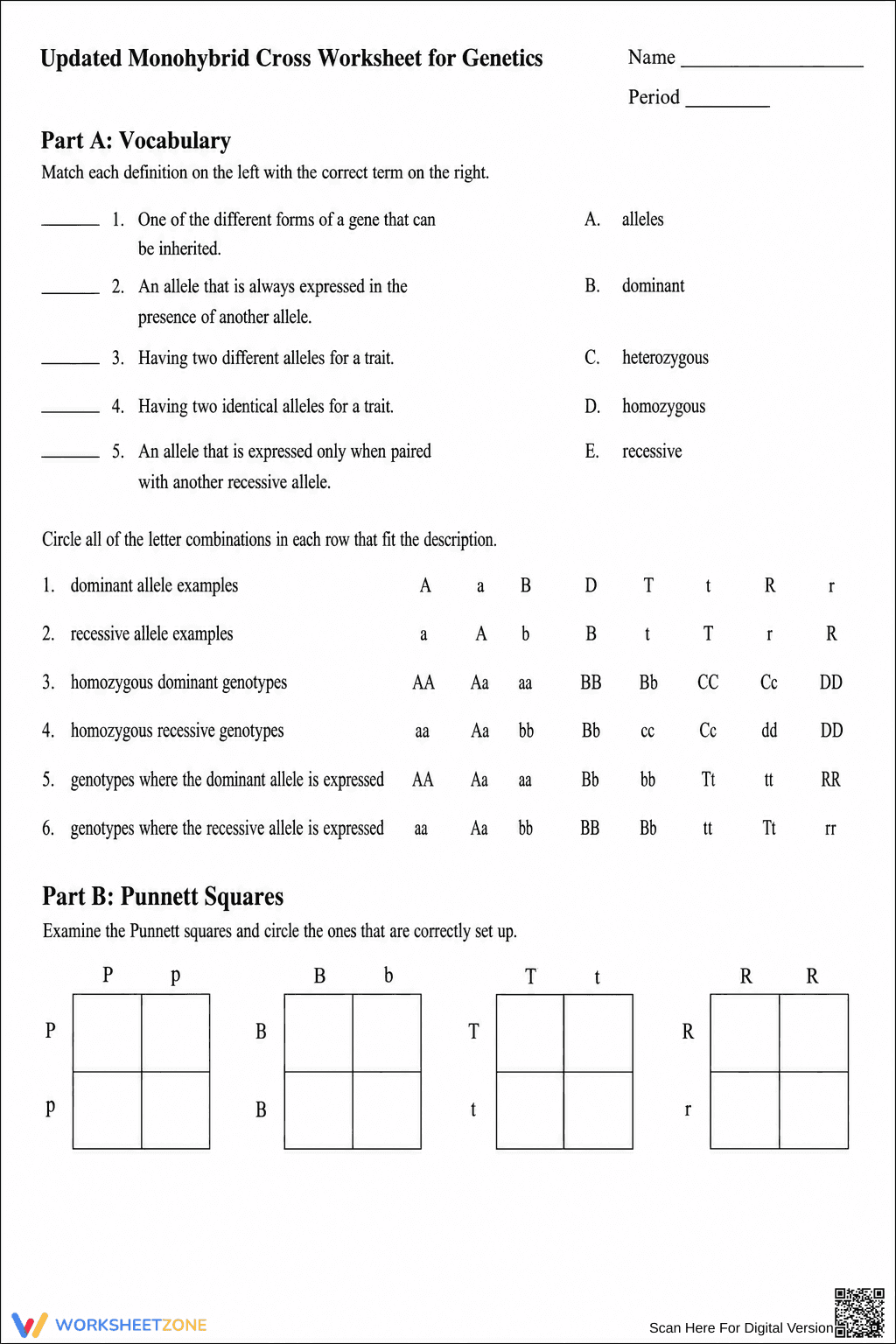
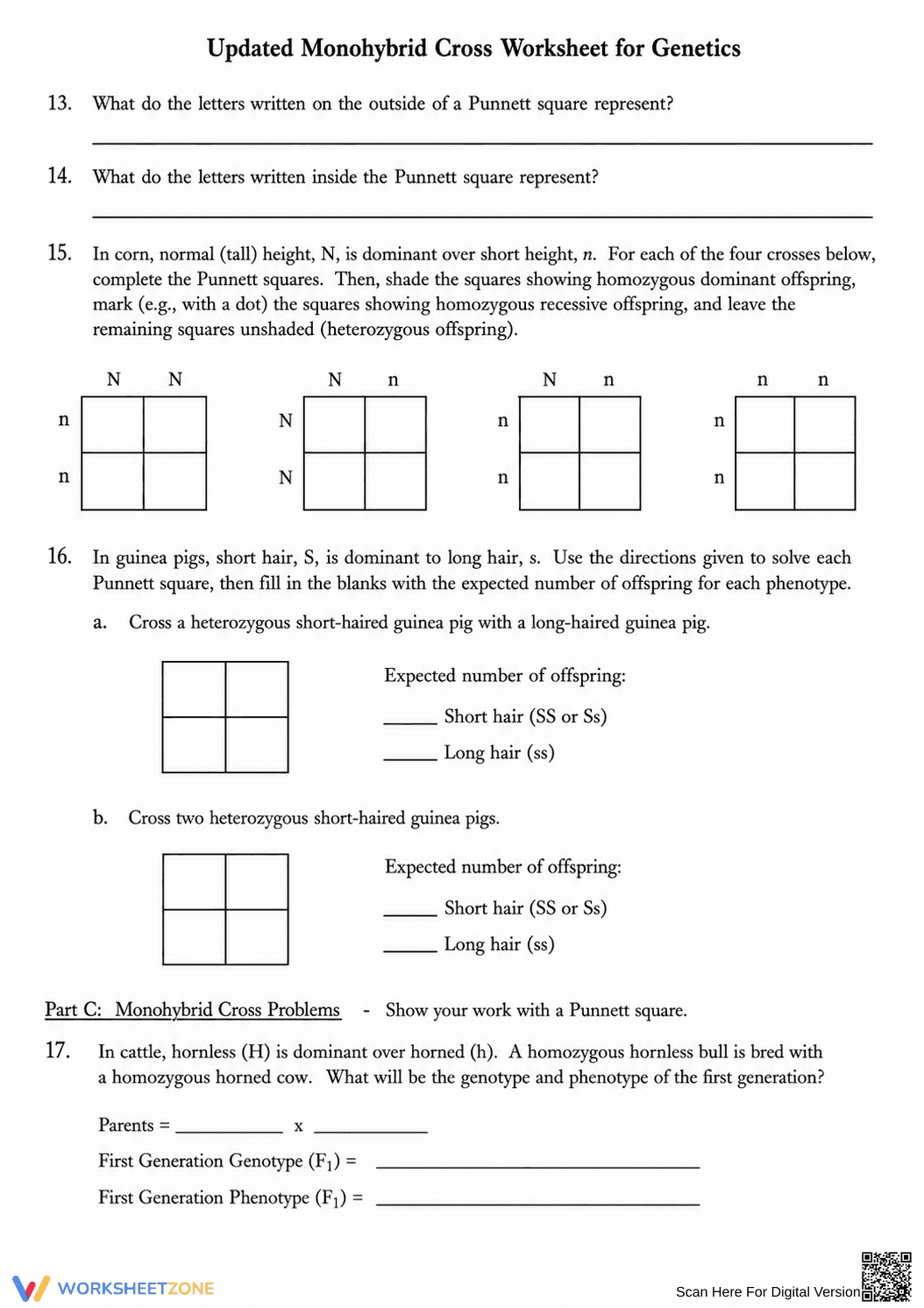
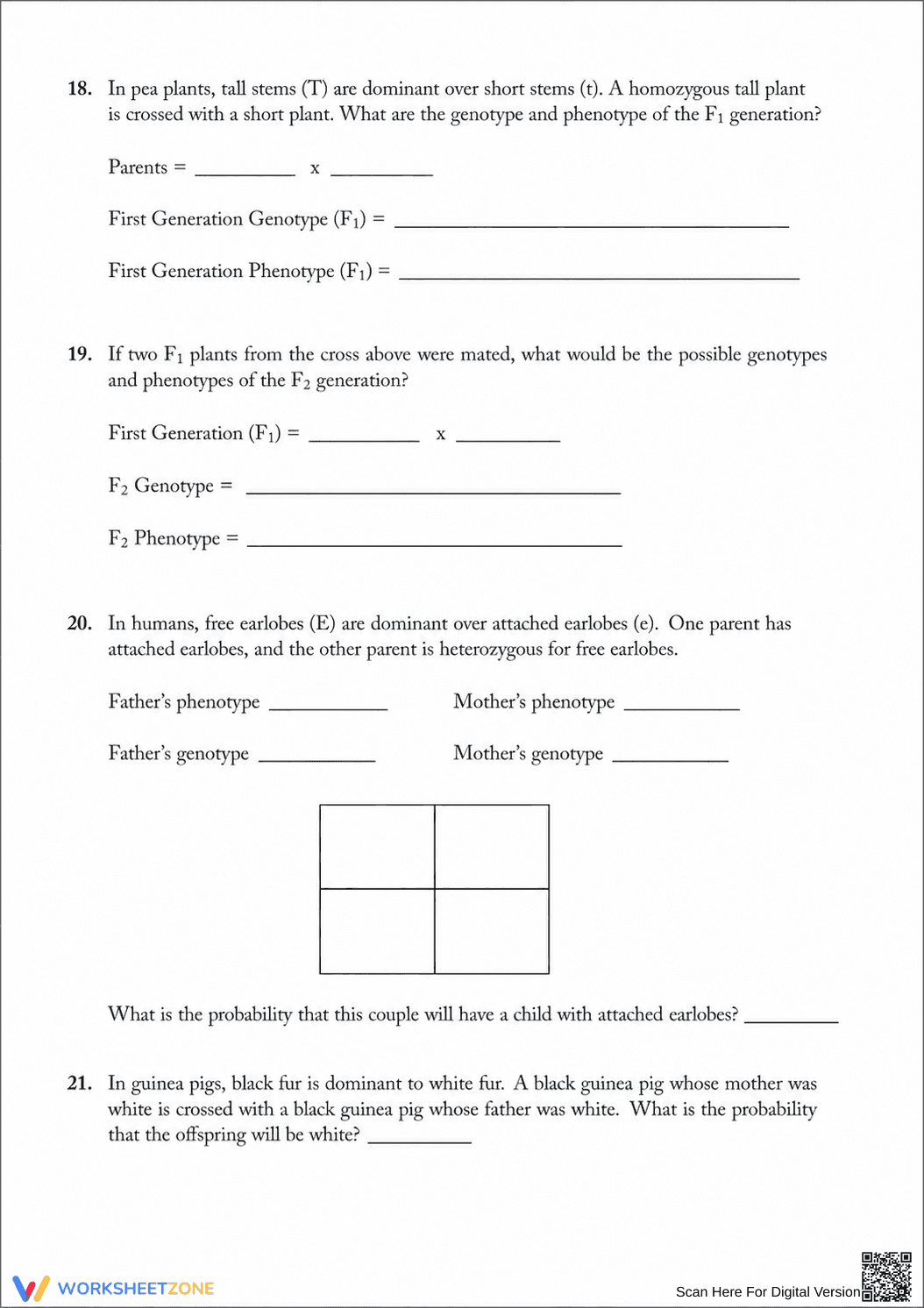
The worksheet is organized into three distinct parts across three printable pages. Part A focuses on essential vocabulary matching and genotype identification, ensuring students can distinguish between homozygous and heterozygous traits. Part B transitions into Punnett square mechanics, requiring students to evaluate and complete diagrams. Part C concludes with five multi-step word problems involving various organisms like guinea pigs, cattle, and pea plants, requiring full genotype and phenotype predictions.
The instructional design follows a rigorous progression. First, Guided Practice (Items 1-12) uses matching and circling tasks to solidify terminology and allele identification. Next, Supported Practice (Items 13-16) provides partially constructed Punnett squares where students must identify parent alleles and fill in offspring genotypes. Finally, Independent Practice (Items 17-21) challenges students to translate complex word problems into genetic crosses without scaffolding. This gradual-release model ensures students build confidence before tackling independent analysis.
This resource is specifically aligned with HS-LS3-3. This standard requires students to apply concepts of statistics and probability to explain the variation and distribution of expressed traits in a population. By calculating phenotypic ratios and predicting offspring outcomes, students meet the core requirements of the NGSS life science framework. Both standard codes can be copied directly into lesson plans, IEP goals, or district curriculum mapping tools.
Use this worksheet as a primary practice tool during your Mendelian genetics unit. It is most effective after an initial lecture on dominant and recessive traits but before moving into dihybrid crosses or non-Mendelian inheritance. Teachers should circulate during Part B to check for common errors in Punnett square setup. Completion typically takes 45 to 60 minutes, making it an ideal single-period assignment or a comprehensive homework packet for formative assessment.
This worksheet is designed for high school biology students, including those in General, Honors, or AP Biology tracks. The clear vocabulary section makes it accessible for English Language Learners (ELLs) and students requiring modified instruction, while the final word problems provide the rigor needed for advanced learners. It pairs perfectly with a digital Punnett square simulator or a hands-on direct instruction lesson on heredity.
According to Fisher & Frey (2014), the gradual release of responsibility is essential for student mastery of complex scientific procedures like genetic modeling. This monohybrid cross worksheet utilizes that framework by transitioning from simple identification to independent problem-solving. By requiring students to both set up and interpret Punnett squares, the resource reinforces the mathematical probability inherent in biological inheritance. The inclusion of 21 distinct tasks ensures that students encounter enough repetition to move the concepts of alleles, genotypes, and phenotypes into long-term memory. This alignment with evidence-based instructional strategies makes the worksheet a reliable tool for achieving the performance expectations outlined in the HS-LS3-3 standard. Educators can utilize the structured data within this resource to track formative assessment progress across a diverse classroom population while ensuring all learners meet high school life science benchmarks.


