


























Views
Downloads

Essential To Kill a Mockingbird Essay Questions | Grade 12
Paste this activity's link or code into your existing LMS (Google Classroom, Canvas, Teams, Schoology, Moodle, etc.).
Students can open and work on the activity right away, with no student login required.
You'll still be able to track student progress and results from your teacher account.
This Grade 12 English Language Arts worksheet facilitates deep literary analysis of theme and historical context in Harper Lee’s To Kill a Mockingbird. Students examine systemic obstacles to justice by answering a focused essay prompt regarding the difficulty of obtaining fair trials. This resource encourages critical thinking about societal structures and character motivations.
At a Glance
- Grade: 12 · Subject: English Language Arts
- Standard:
CCSS.ELA-LITERACY.RL.11-12.2— Determine themes and analyze their development over the course of the text- Skill Focus: Literary Analysis & Historical Context
- Format: 1 page · 1 primary prompt · Answer key not included · PDF
- Best For: Socratic seminars or summative essay assessment
- Time: 45–60 minutes
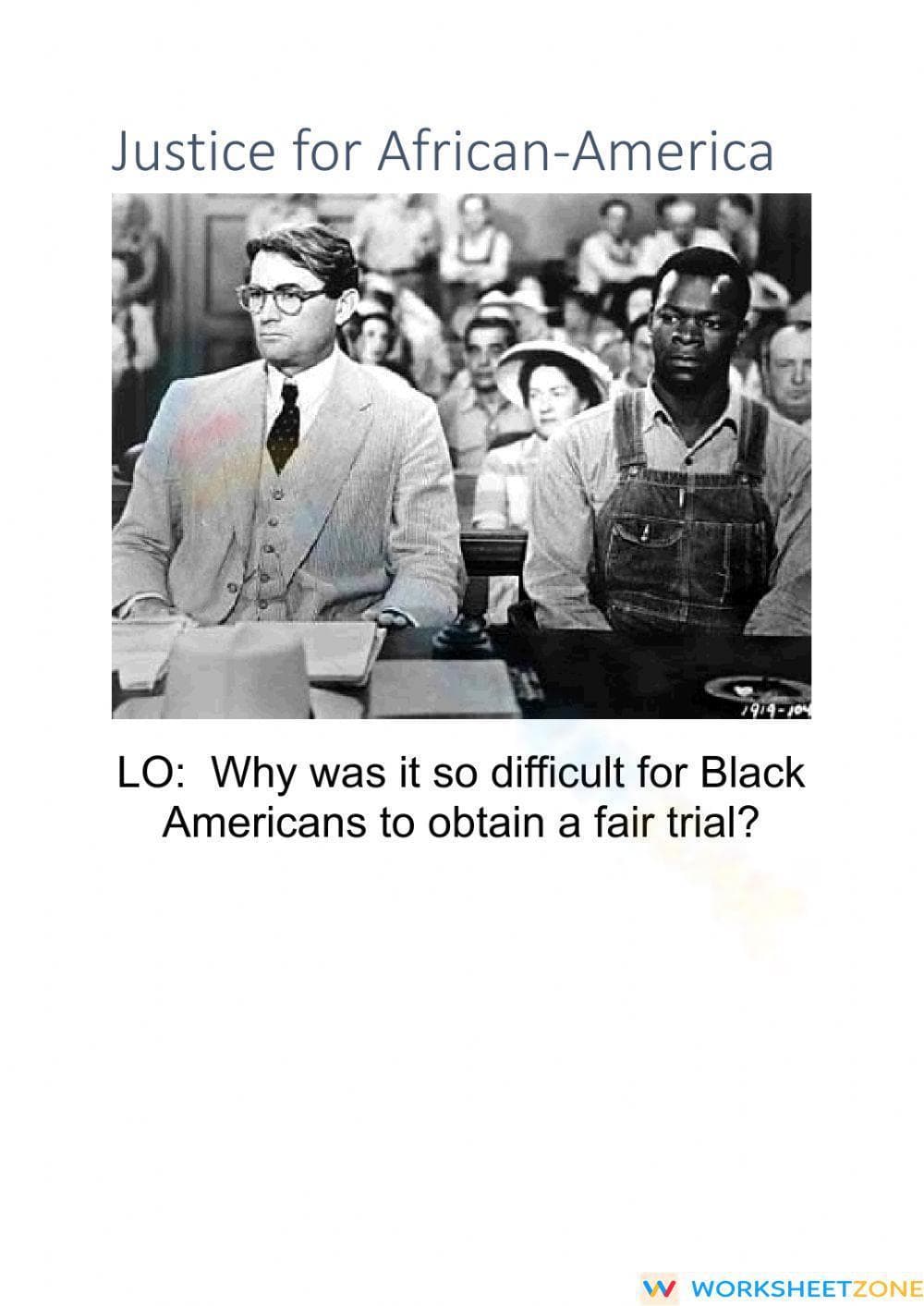
This single-page document provides a high-quality visual anchor featuring Atticus Finch and Tom Robinson, setting a serious tone for academic inquiry. It features a central Learning Objective (LO) that functions as a sophisticated essay prompt. The layout is clean and professional, designed to be printed and distributed immediately without any additional formatting or teacher setup.
Zero-Prep Workflow
The workflow for this resource is designed for maximum efficiency in a high school or college setting. First, print the single-page PDF (30 seconds). Second, distribute to students as a bell-ringer or final unit assessment (1 minute). Third, review student responses or facilitate a class discussion based on the prompt (45 minutes). Total teacher preparation time is under 2 minutes, making it ideal for sub plans or spontaneous writing workshops in busy classroom environments.
Standards Alignment
The primary alignment is CCSS.ELA-LITERACY.RL.11-12.2, which requires students to determine themes and analyze their development through a literary work. By focusing on the trial of Tom Robinson, students must synthesize plot points and character actions to explain the theme of justice. This standard code can be copied directly into lesson plans, IEP goals, or district curriculum mapping tools to ensure full instructional compliance across all levels.
How to Use It
Assign this worksheet as a summative assessment following the reading of the trial chapters to gauge student understanding of the novel's climax. Alternatively, use it as a pre-writing organizer for a larger research project on the Jim Crow era. Teachers should observe whether students cite specific textual evidence from Atticus’s closing argument during completion. Expect students to spend approximately 45 to 60 minutes on a thoughtful, evidence-based response to the central inquiry question.
Who It's For
This resource is tailored for Grade 11, Grade 12, and College-level ELA students who are ready for nuanced discussions on racial justice and literary themes. It is particularly effective for honors or AP Literature courses where high-order thinking is required. Pair this worksheet with a primary source document from the Scottsboro Boys trial to provide historical scaffolding and deepen the analysis of the fictional court proceedings and themes.
Research from RAND AIRS (2024) indicates that high-interest, standards-aligned prompts are critical for developing rigorous writing skills in secondary education. This worksheet targets CCSS.ELA-LITERACY.RL.11-12.2, requiring students to analyze justice through the lens of a fair trial. Engaging with Harper Lee's masterpiece's historical context helps learners evaluate complex moral arguments. Fisher & Frey (2014) emphasize that visual anchors and focused inquiry tasks significantly improve literary concept retention. This resource offers a direct path to mastery by isolating a key textual conflict, demanding synthesis of evidence and analysis. Its single-prompt format ensures deep, focused engagement on the central thematic question, making it a vital tool for any literature curriculum aiming to bridge text and real-world ethical questions.


