


























Views
Downloads




Missing Numbers Challenge Worksheet | Grade 6 Ready
Paste this activity's link or code into your existing LMS (Google Classroom, Canvas, Teams, Schoology, Moodle, etc.).
Students can open and work on the activity right away, with no student login required.
You'll still be able to track student progress and results from your teacher account.
Solve for unknown values with confidence. This Grade 6 worksheet guides students through five levels of algebraic thinking, from basic operations to multi-step challenge equations. Students will master inverse operations to find missing factors, dividends, and sums, building a rock-solid foundation for future middle school algebra success.
At a Glance
- Grade: 6 · Subject: Math
- Standard:
6.EE.B.7— Solve real-world and mathematical problems by writing and solving one-variable equations.- Skill Focus: Solving for missing numbers in equations
- Format: 4 pages · 45 problems · Answer key included · PDF
- Best For: Homework, independent practice, or assessment
- Time: 40–55 minutes
What's Inside
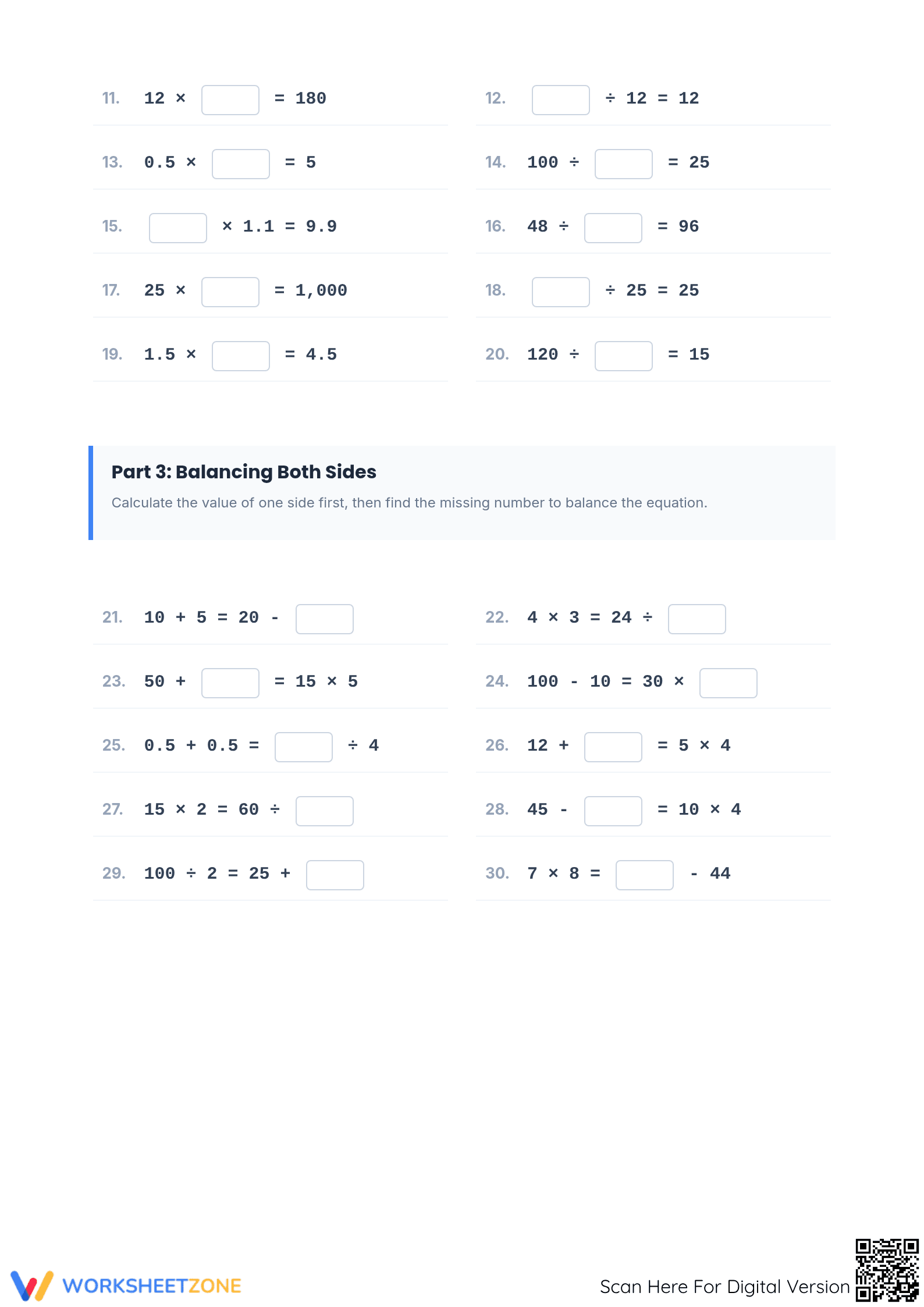
This 4-page instructional pack features 45 distinct problems divided into five thematic sections. Students progress through addition/subtraction mastery, multiplication/division inverse operations, and balancing equations. The set includes a dedicated page for algebraic word problems and finishes with a rigorous "Super Challenge" section that requires deep logical reasoning. A full answer key is included for rapid grading.
Zero-Prep Workflow
Implement this 4-page set into your curriculum with minimal effort:
- Print (30 seconds): Select the PDF and print copies for your cohort.
- Distribute (30 seconds): Hand out the multi-part challenge to students.
- Review (30 seconds): Grade or peer-review using the included key.
Total prep time is under two minutes, making this an ideal choice for emergency sub plans or quick classroom assignments.
Standards Alignment
This worksheet is strictly aligned to 6.EE.B.7. Students must identify the unknown value in equations of the form x + p = q and px = q using rational numbers and decimals. The variety of problem types also supports CCSS.MATH.CONTENT.6.EE.A.2 by helping students read and evaluate expressions where letters or boxes stand for numbers. Both standard codes can be copied directly into lesson plans, IEP goals, or district curriculum mapping tools.
How to Use It
Use this worksheet as a summative assessment after introducing the concept of inverse operations to ensure students can generalize the skill across all four operations. During the session, walk around and observe if students are correctly identifying when to subtract vs. add to find a missing sum; this formative check quickly reveals who needs more direct modeling. Expected completion time is approximately 45 minutes for the full set.
Who It's For
Designed primarily for sixth-grade students beginning their algebra journey, this resource is also suitable for fifth-grade enrichment or seventh-grade review. It pairs naturally with a lesson on the balance-scale model for equations or a short instructional passage on algebraic vocabulary. The visual boxes provide a clear workspace for students needing organizational support.
Mastery of one-variable equations is a critical gateway skill in the middle school mathematics trajectory. Research from the NAEP highlights that students who develop early fluency with inverse operations and algebraic word problems are significantly more likely to succeed in high school Algebra 1. This worksheet implements the principles of deliberate practice as discussed by Fisher & Frey (2014), providing enough repetition to ensure procedural fluency while increasing the cognitive load through multi-step challenge problems. By moving from isolated operations to word problem translation, students build the schema necessary to solve complex real-world math problems. The inclusion of decimals and large whole numbers ensures that students are not just memorizing facts but applying algebraic rules to any numerical context. Standard 6.EE.B.7 is the primary target, ensuring students can write and solve equations that represent real scenarios, a fundamental requirement for college and career readiness in STEM fields.


