


























Views
Downloads
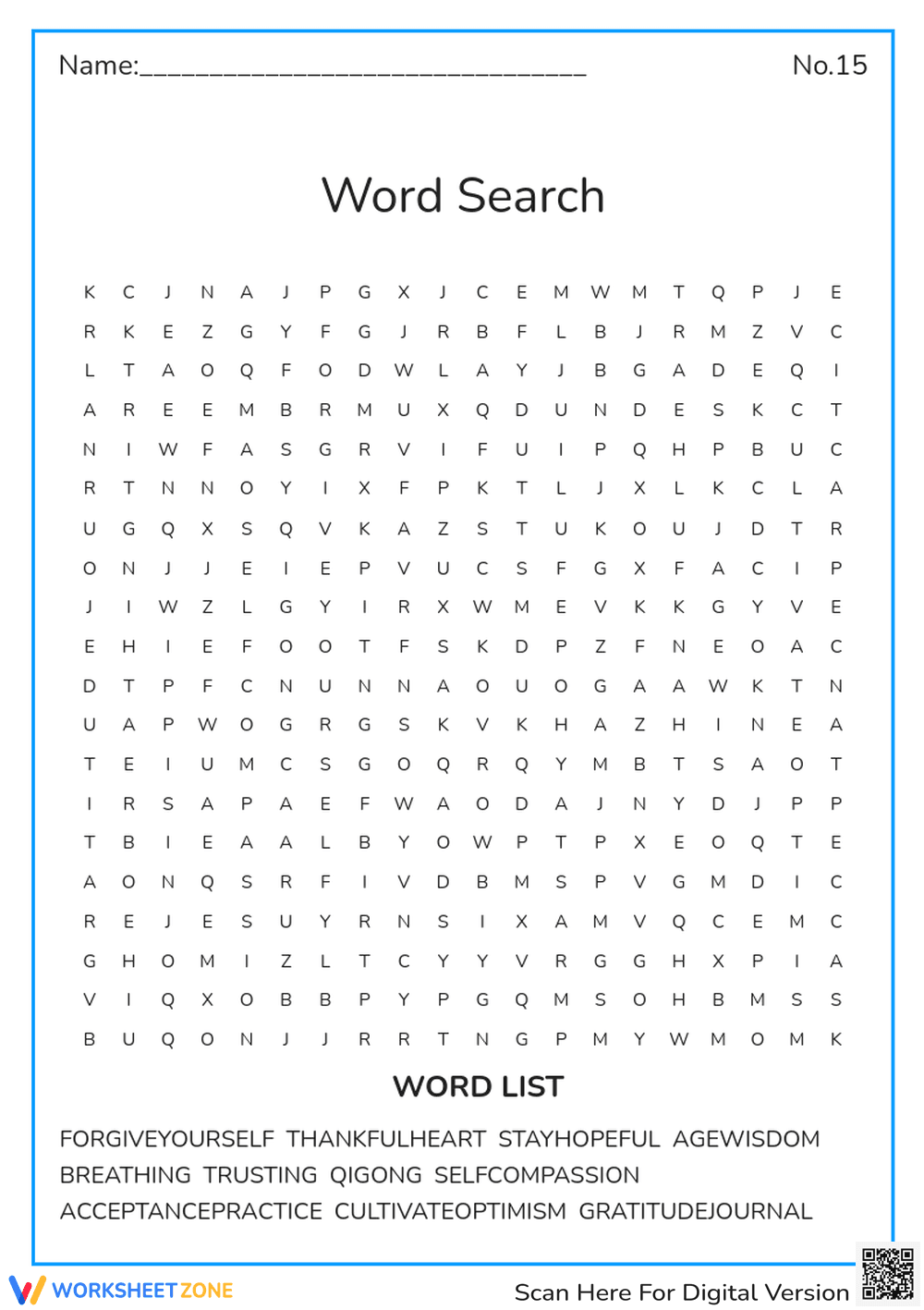

Mindfulness Word Search | Essential College SEL Worksheet
Paste this activity's link or code into your existing LMS (Google Classroom, Canvas, Teams, Schoology, Moodle, etc.).
Students can open and work on the activity right away, with no student login required.
You'll still be able to track student progress and results from your teacher account.
This Mindfulness Word Search provides college-level students with a focused cognitive activity designed to reinforce positive mental health vocabulary. By identifying 12 key terms related to emotional well-being, students engage in a low-stress literacy task that promotes vocabulary retention and stress reduction. It serves as an effective tool for grounding exercises in academic settings.
At a Glance
- Grade: College · Subject: Mental Health / SEL
- Standard:
CCSS.ELA-LITERACY.L.11-12.6— Acquire and use accurately general academic and domain-specific words- Skill Focus: Mindfulness Vocabulary & Cognitive Focus
- Format: 1 page · 12 problems · Answer key included · PDF
- Best For: Stress-relief breaks and vocabulary reinforcement
- Time: 10–15 minutes
This single-page PDF features a dense letter grid containing 12 hidden mindfulness phrases, including "Self-Compassion" and "Gratitude Journal." The layout is clean and professional, suitable for adult learners or higher education settings. It includes a clear word list at the bottom and a dedicated space for student identification, ensuring it fits into any professional classroom environment.
Zero-Prep Workflow
- Print: Select the single-page PDF and print enough copies for your cohort in under 30 seconds.
- Distribute: Hand out the sheets as a "soft start" activity or a transition between lectures to help students refocus.
- Review: Use the included answer key to quickly verify student completion or discuss the definitions of the terms.
Total teacher preparation time is under 2 minutes, making it an ideal resource for busy instructors or as a supplemental sub-plan component during wellness weeks.
Standards Alignment
The primary standard addressed is `CCSS.ELA-LITERACY.L.11-12.6`, which focuses on the acquisition of domain-specific vocabulary necessary for college and career readiness. By engaging with terms like "Qigong" and "Cultivate Optimism," students expand their lexicon within the health and wellness domain. This standard code can be copied directly into lesson plans, IEP goals, or district curriculum mapping tools.
How to Use It
Use this worksheet as a formative assessment tool during a unit on stress management or as a mindfulness break during long seminar blocks. Instructors should observe student persistence and scanning strategies to gauge cognitive engagement. Completion typically takes 10 to 15 minutes, providing a perfect buffer between high-intensity academic tasks or as a cool-down after exams.
Who It's For
This resource is designed for college students, adult learners, and high school seniors. It is particularly effective for students requiring low-stakes engagement or those in counseling and wellness programs. Pair this with a guided meditation session or a short lecture on the science of breathing for a comprehensive SEL lesson.
Research from Fisher & Frey (2014) emphasizes the importance of word consciousness and intentional vocabulary exposure in adult literacy development. This Mindfulness Word Search aligns with these findings by presenting 12 high-utility wellness terms in a format that encourages active scanning and pattern recognition. According to the RAND AIRS 2024 report, integrating social-emotional learning (SEL) into higher education curricula supports student retention and mental health resilience. By utilizing standard CCSS.ELA-LITERACY.L.11-12.6, this worksheet bridges the gap between academic literacy and personal well-being. The task requires students to accurately identify and process complex phrases like "Self-Compassion" and "Gratitude Journal," which are essential for navigating modern wellness discourse. This resource serves as a validated tool for instructors seeking to incorporate mindfulness into their instructional design without increasing administrative burden.


