


























Views
Downloads



Midpoint Formula Missing Endpoint Worksheet | Grade 8-9 Essential
Paste this activity's link or code into your existing LMS (Google Classroom, Canvas, Teams, Schoology, Moodle, etc.).
Students can open and work on the activity right away, with no student login required.
You'll still be able to track student progress and results from your teacher account.
This essential Grade 8-9 mathematics resource focuses on the precise application of the midpoint formula to identify a missing endpoint. Instead of simply finding the center of a segment, students must use algebraic manipulation to solve for an unknown coordinate pair. This worksheet ensures students move beyond rote memorization toward a deeper functional understanding of coordinate geometry.
At a Glance
- Grade: 8–9 · Subject: Math
- Standard:
HSG-GPE.B.6— Use coordinates to find the midpoint of a line segment between two points- Skill Focus: Finding missing endpoints algebraically
- Format: 4 pages · 14 problems · Answer key included · PDF
- Best For: Independent practice and zero-prep sub plans
- Time: 30–45 minutes
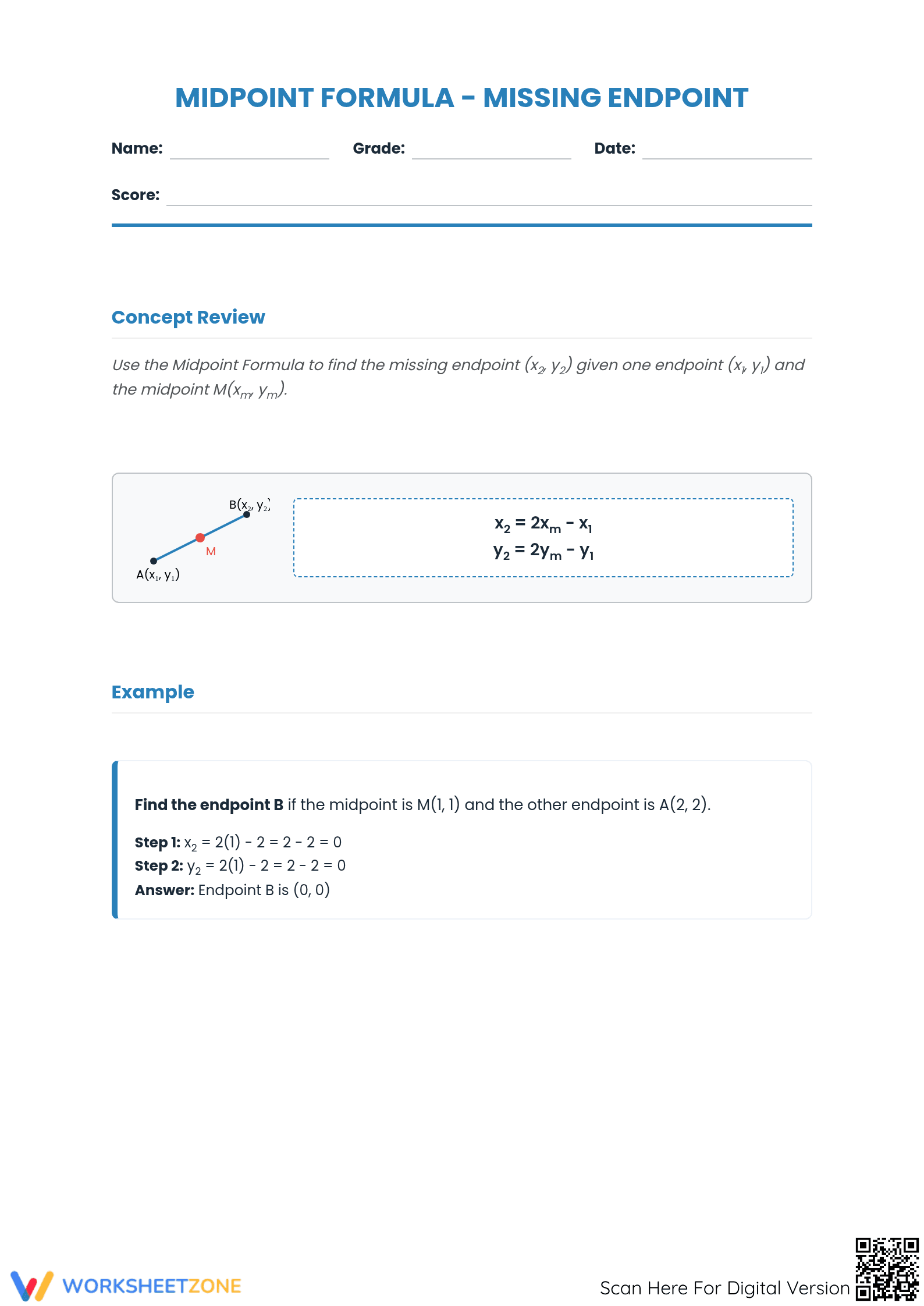
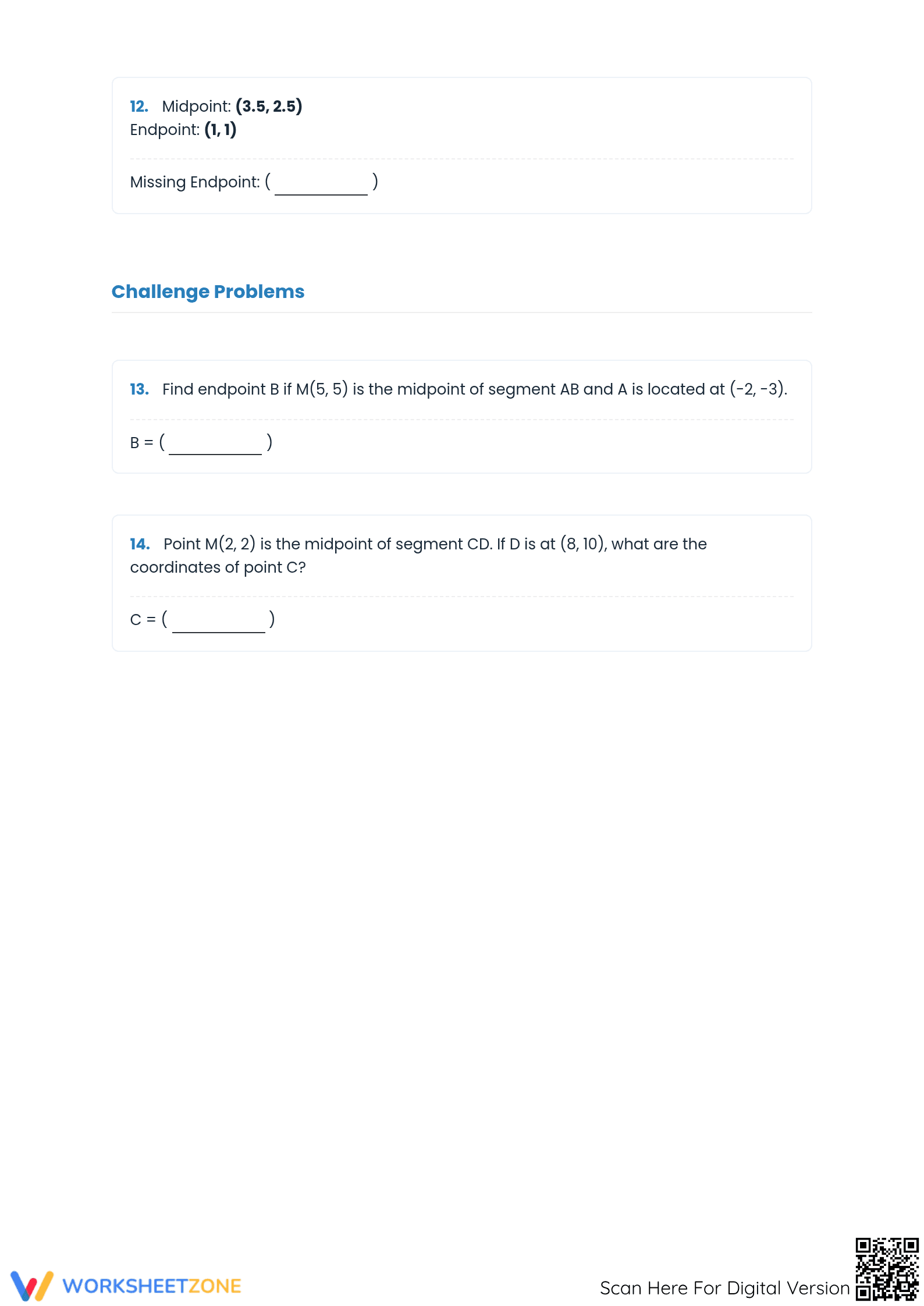
The worksheet is meticulously organized to support student independence. It begins with a dedicated concept review section that provides the necessary algebraic transformations of the midpoint formula, followed by a fully worked example that models the two-step solution process. With 4 pages of content and 14 unique problems, the resource offers a comprehensive range of coordinate challenges, including negative integers and zero-values, to ensure total procedural mastery.
Zero-Prep Workflow
- Print (1 minute): Download the high-resolution PDF and print the four-page packet for your class or individual students.
- Distribute (1 minute): Hand out the worksheets; the included concept review and step-by-step example allow students to begin immediately without teacher-led instruction.
- Review (5 minutes): Use the comprehensive answer key to quickly grade submissions or allow students to self-correct their work at the end of the session.
Standards Alignment
This resource is aligned to HSG-GPE.B.6: "Find the point on a directed line segment between two given points that partitions the segment in a given ratio." While the midpoint represents a 1:1 ratio, solving for a missing endpoint requires the foundational algebraic skills needed for more complex partitioning tasks. Both standard codes can be copied directly into lesson plans, IEP goals, or district curriculum mapping tools.
How to Use It
This worksheet is ideal for use during the "independent practice" phase of a geometry lesson. After introducing the midpoint formula, assign this packet to reinforce the algebraic steps required to work backward from a midpoint. It also serves as an excellent formative assessment tool; by observing how students handle the negative coordinates in Practice Set 2, teachers can quickly identify common errors in integer operations before moving on to higher-level geometric proofs.
Who It's For
The content is designed for Grade 8 Pre-Algebra or Grade 9 Geometry students. It provides necessary scaffolding for learners who require clear procedural steps while offering challenge problems for students ready to apply the formula to more abstract coordinate planes. It pairs naturally with an anchor chart on the coordinate system or a digital graphing tool session.
The Midpoint Formula Missing Endpoint worksheet is an essential instructional tool for Grade 8 and Grade 9 students transitioning from basic coordinate geometry to advanced algebraic applications. By requiring students to find a missing endpoint when provided with the midpoint and one known point, the resource reinforces the algebraic manipulation of the midpoint formula: x2 = 2xm - x1 and y2 = 2ym - y1. This specific cognitive task aligns with HSG-GPE.B.6, moving beyond simple calculation toward inverse problem-solving. Research from Fisher & Frey (2014) indicates that such structured practice, which includes worked examples and scaffolded practice sets, significantly enhances the retention of geometric concepts in secondary education. The 14 included tasks provide sufficient repetition for mastery while the challenge section ensures high-order thinking. Educators can utilize this resource as a self-contained assessment or a targeted intervention for students struggling with partitioning line segments in coordinate planes. This evidence-based approach ensures students develop the procedural fluency necessary for higher-level geometry and calculus.


