


























Views
Downloads
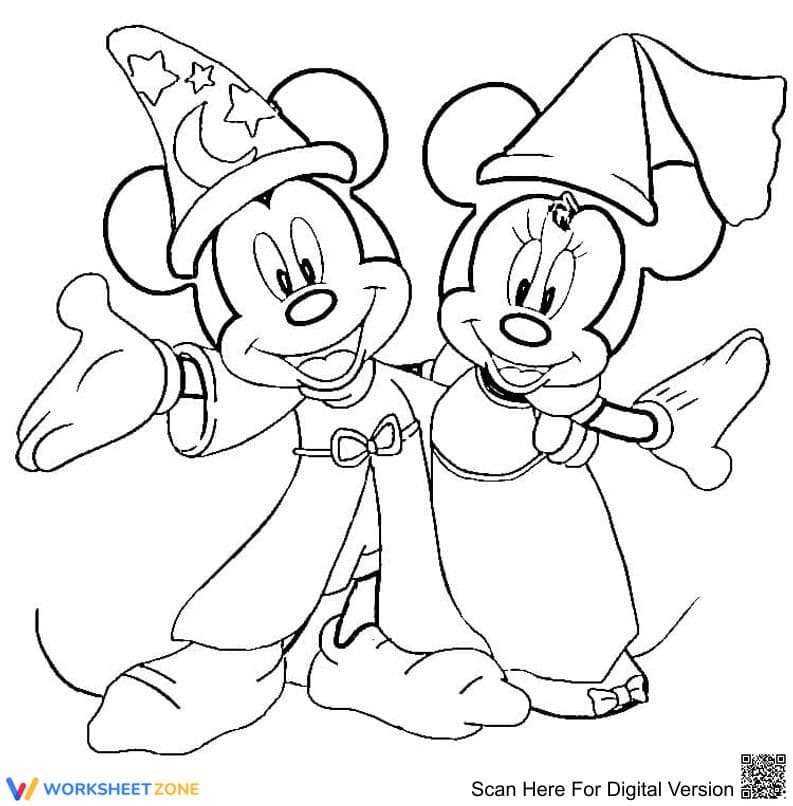

Mickey and Minnie Coloring Page | Printable Grade K Art
Paste this activity's link or code into your existing LMS (Google Classroom, Canvas, Teams, Schoology, Moodle, etc.).
Students can open and work on the activity right away, with no student login required.
You'll still be able to track student progress and results from your teacher account.
Develop essential fine motor control and creative expression with this engaging Mickey and Minnie coloring page. Designed for preschool and kindergarten learners, this printable worksheet strengthens pencil grip and hand-eye coordination while sparking artistic imagination. Students color beloved characters in whimsical costumes, building foundational pre-writing skills through structured visual art practice.
At a Glance
- Grade: K · Subject: Fine Art
- Standard:
CCSS.ELA-LITERACY.SL.K.5— Add drawings to visual displays to provide additional detail- Skill Focus: Fine motor control and creative expression
- Format: 1 page · 1 problem · No answer key needed · PDF
- Best For: Morning work and quiet centers
- Time: 15–20 minutes
This single-page printable features a high-contrast, bold-lined illustration of Mickey Mouse as a sorcerer and Minnie Mouse as a princess. The clear, thick outlines provide built-in scaffolding for young children developing spatial awareness and boundary recognition. The open-ended coloring task allows for flexible medium use, including crayons, colored pencils, or washable markers, requiring zero teacher setup or complex instructions.
Designed for immediate classroom deployment, this worksheet follows a simple zero-prep workflow:
- Print (1 minute): Generate class sets instantly from the single-page PDF file.
- Distribute (1 minute): Hand out alongside standard classroom coloring supplies.
- Review (3 minutes): Allow students to share completed artwork to practice verbal description skills.
Total teacher preparation time is under 2 minutes. This self-explanatory activity serves as an ideal, reliable option for substitute teacher plans, early finisher bins, or transition periods.
This activity aligns with primary standard CCSS.ELA-LITERACY.SL.K.5 by encouraging students to create visual displays that add detail to storytelling and character descriptions. It also supports early visual arts frameworks emphasizing tool manipulation and spatial awareness. Both standard codes can be copied directly into lesson plans, IEP goals, or district curriculum mapping tools.
Deploy this worksheet during morning arrival routines to help young learners transition smoothly into the school day. It also functions effectively as a calming post-recess center activity. While students color, observe their grip posture and pressure control as a quick formative assessment of fine motor development. Expected completion time ranges from 15 to 20 minutes depending on student attention span and medium choice.
Tailored primarily for preschool, transitional kindergarten, and kindergarten students developing foundational hand strength. For students needing differentiation, provide adaptive grip crayons or larger markers to ease physical strain. Pair this visual resource naturally with a read-aloud storybook featuring classic cartoon characters or an introductory lesson on primary and secondary colors.
Early childhood research confirms that structured coloring activities significantly enhance fine motor development and pre-writing readiness. According to a RAND AIRS 2024 study on early literacy and motor interventions, purposeful tool manipulation directly correlates with improved pencil grip and spatial boundary awareness in kindergarten learners. Aligning with standard CCSS.ELA-LITERACY.SL.K.5, where students add drawings to visual displays to provide additional detail, this worksheet bridges artistic expression with foundational communication skills. Engaging with familiar visual archetypes reduces cognitive load, allowing young students to focus entirely on motor control and color selection. Integrating targeted visual arts practice into daily classroom routines supports bilateral coordination and visual-motor integration. Furthermore, consistent engagement with bounded illustration tasks fosters sustained attention spans during independent work periods. This structured creative play ensures young learners build the essential physical stamina and precision required for future handwriting mastery.


