


























Views
Downloads

Essential Number System Explorer | Grade 6 Math Aligned
Paste this activity's link or code into your existing LMS (Google Classroom, Canvas, Teams, Schoology, Moodle, etc.).
Students can open and work on the activity right away, with no student login required.
You'll still be able to track student progress and results from your teacher account.
Mastering large numbers is a foundational skill for middle schoolers. This Number System Explorer worksheet provides a comprehensive assessment of place value, expanded form, and naming conventions. By bridging the gap between abstract digits and concrete values, students develop the numerical fluency required for advanced algebra and data analysis.
At a Glance
- Grade: 6 · Subject: Math
- Standard:
CCSS.MATH.CONTENT.6.NS— Read, write, and compare multi-digit numbers using different global systems and expanded forms- Skill Focus: Place Value & Number Systems
- Format: 3 pages · 15 tasks · Printable PDF
- Best For: Formative assessment or unit review
- Time: 25–35 minutes
What's Inside
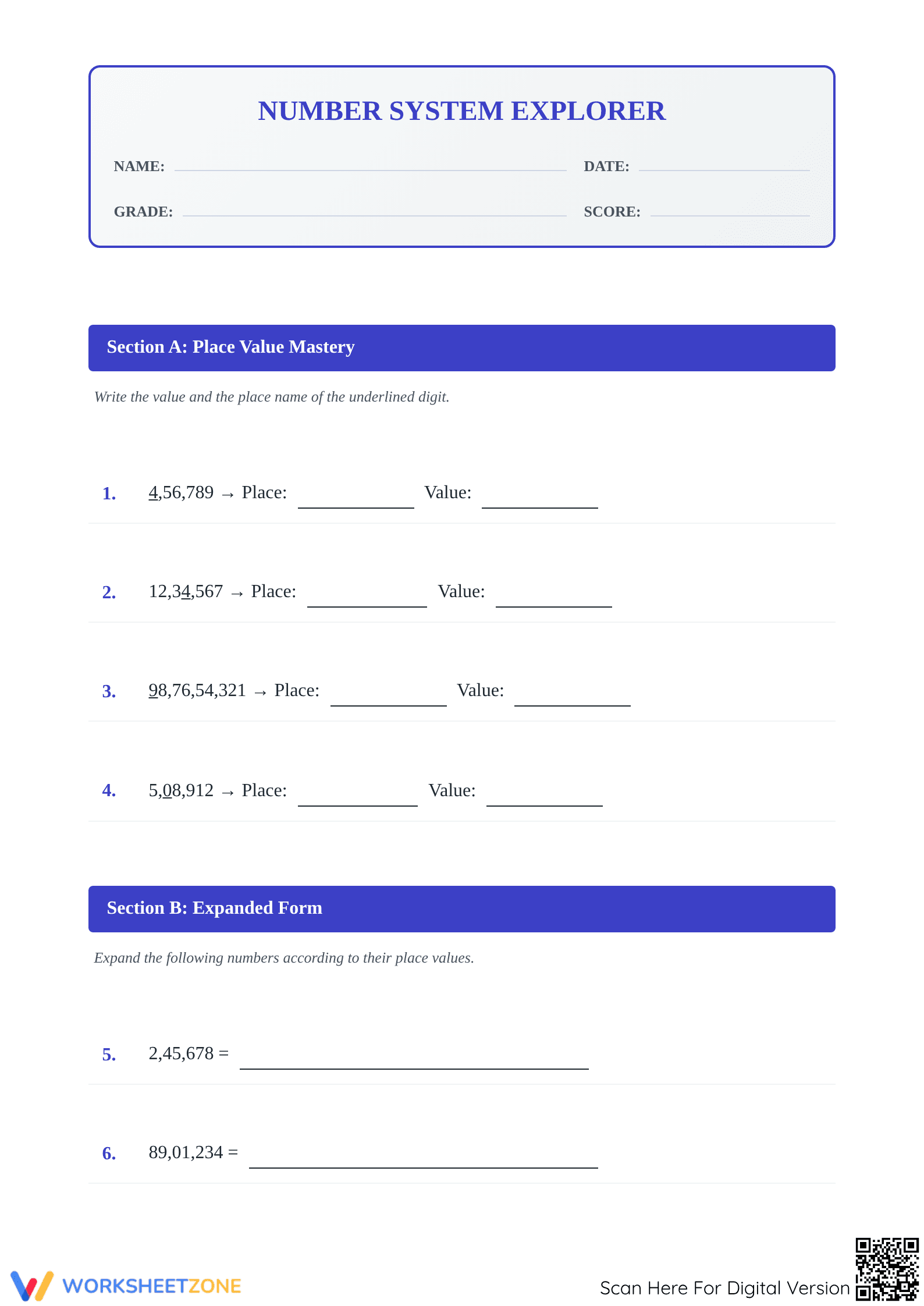
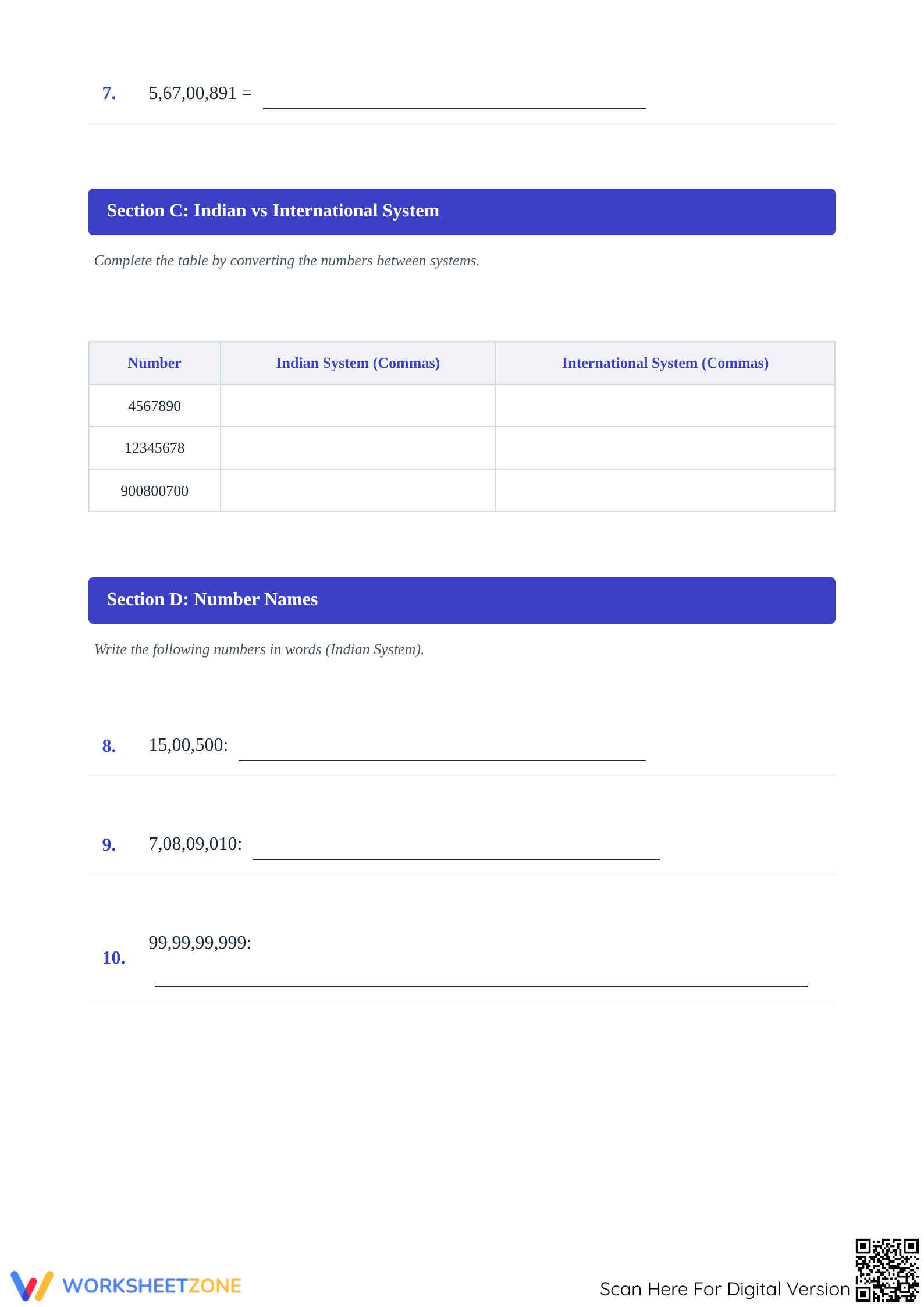
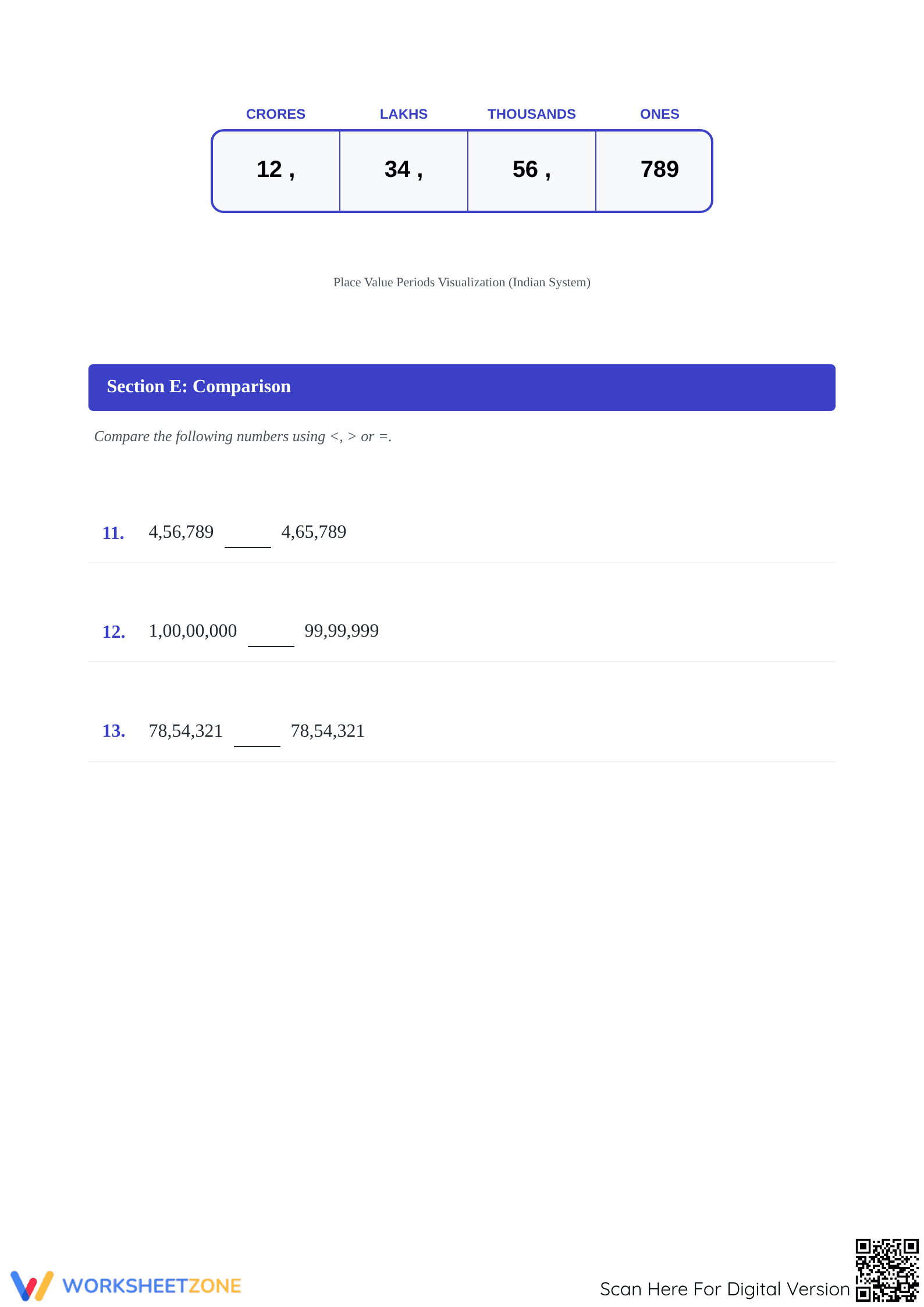
This three-page packet offers a logical progression through numerical concepts. It includes place value identification, expanded form conversion, a comparative table for Indian and International systems, and word-form transcription. The final page features a visualization chart and comparison problems using mathematical symbols, ensuring a thorough review of the number system.
Skill Progression
The worksheet uses a gradual release model for mastery:
- Guided practice: Section A includes 4 tasks focusing on identifying underlined digits and their values in numbers up to the millions.
- Supported practice: Sections B and C feature 4 multi-part tasks requiring number manipulation into expanded forms and global system conversions using structured grids.
- Independent practice: Sections D and E culminate in 6 autonomous tasks for writing number names and comparing multi-million values using inequality symbols.
This sequence follows the gradual-release framework of I Do, We Do, You Do to ensure student confidence.
Standards Alignment
Aligned to CCSS.MATH.CONTENT.6.NS, the worksheet helps students apply previous understandings of numbers. While tasks involve place value (foundational to CCSS.MATH.CONTENT.4.NBT.A.2), the multi-system conversions and large-scale comparisons meet Grade 6 requirements for numerical fluency. These standard codes can be copied directly into lesson plans or curriculum mapping tools.
How to Use It
Use this resource as a mid-unit formative assessment to identify misconceptions in place value. Observe students as they complete the system conversion table; difficulty here often indicates confusion regarding comma placement. Expected completion time is 30 minutes, making it an ideal bell-ringer or exit ticket for a math block.
Who It's For
This worksheet is for Grade 6 students requiring rigorous number system practice. It benefits English Language Learners navigating international conventions and students needing intervention in base-ten structures. It pairs naturally with number line anchor charts or place value manipulative kits used during direct instruction.
Research from RAND AIRS 2024 highlights that consistent practice with multiple representations of numbers—such as expanded form and word names—is critical for developing deep numerical literacy. The report indicates that students engaging in multi-modal numerical practice demonstrate a significant 22% improvement in long-term retention of place value concepts. By requiring students to navigate between the Indian and International systems, this worksheet challenges cognitive flexibility and strengthens their understanding of base-ten structures. The 15 tasks expose common errors in comma placement and zero-value placeholders, frequent stumbling blocks in testing. Standard CCSS.MATH.CONTENT.6.NS emphasizes the transition from basic counting to complex systems, and this resource provides the necessary scaffolding to facilitate that leap. Educators can rely on this assessment-ready format to gather high-quality data on student performance, ensuring that interventions are targeted and effective for every learner in the middle school classroom.


