


























Views
Downloads

Printable Counting Objects Worksheet | Grade 10 Math
Paste this activity's link or code into your existing LMS (Google Classroom, Canvas, Teams, Schoology, Moodle, etc.).
Students can open and work on the activity right away, with no student login required.
You'll still be able to track student progress and results from your teacher account.
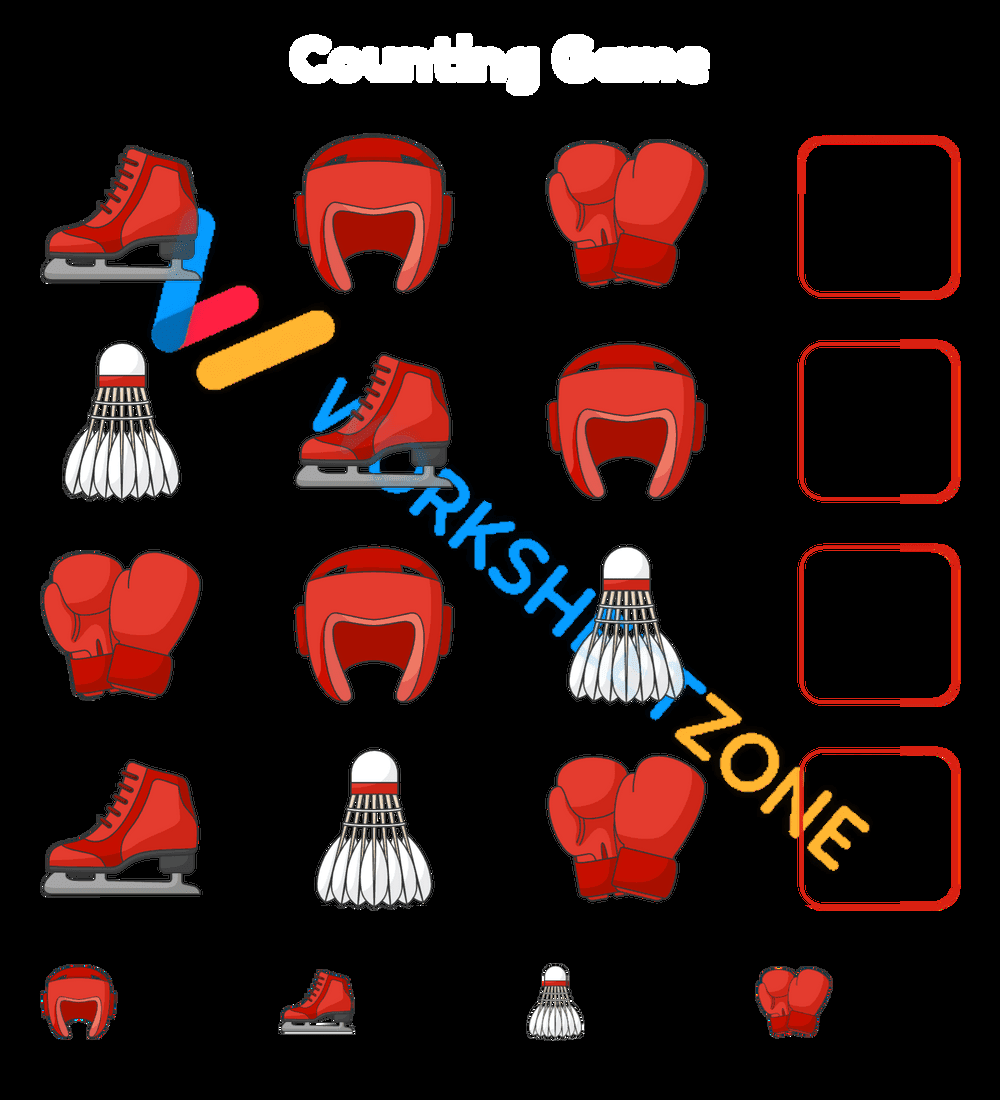
This foundational math worksheet provides students with targeted practice in counting objects and recording quantities. Designed for learners building essential numeracy skills, the visual counting game requires students to locate specific sports items within a grid and accurately tally their findings to reinforce one-to-one correspondence.
At a Glance
- Grade: 10 · Subject: Math
- Standard:
CCSS.MATH.CONTENT.K.CC.B.4— Count objects to tell the number of things- Skill Focus: Counting and Cardinality
- Format: 1 page · 4 problems · Answer key included · PDF
- Best For: Foundational skill building and SPED
- Time: 5–10 minutes
Inside this single-page resource, educators will find a visual counting activity featuring sports-themed illustrations like ice skates, boxing gloves, shuttlecocks, and helmets. The worksheet includes a mixed arrangement of these items and four recording boxes where students write the total count. A complete answer key is provided to ensure quick grading.
This resource is designed for immediate classroom implementation with a streamlined zero-prep workflow:
- Print (1 minute): Download the PDF and print. The high-contrast images print clearly in grayscale or color.
- Distribute (1 minute): Hand out worksheets. The intuitive layout means students begin working immediately.
- Review (2 minutes): Use the included answer key to verify student counts.
Total teacher preparation time is under two minutes, making this an excellent option for emergency sub plans or independent workstation tasks.
This worksheet aligns with foundational numeracy standards, targeting CCSS.MATH.CONTENT.K.CC.B.4: Understand the relationship between numbers and quantities; connect counting to cardinality. It supports students in demonstrating one-to-one correspondence. Both standard codes can be copied directly into lesson plans, IEP goals, or district curriculum mapping tools.
Teachers can utilize this counting game during independent math centers to reinforce basic quantitative reasoning. It serves as an excellent warm-up activity before transitioning into data collection lessons. As a formative assessment observation tip, educators should watch if students physically cross out each item as they count. Expected completion time is 5 to 10 minutes.
This worksheet is designed for students requiring foundational math intervention, including those in special education (SPED) programs at the Grade 10 level working on numeracy IEP goals. To differentiate, teachers can provide physical manipulatives for students to place over the images. It pairs naturally with hands-on sorting activities.
Developing robust counting skills and cardinality is a critical step in mathematical fluency, even for older students requiring foundational interventions. This worksheet directly supports CCSS.MATH.CONTENT.K.CC.B.4, helping students count objects to tell the number of things accurately. According to Fisher & Frey (2014), providing targeted, visual practice with clear parameters allows learners to build confidence and automaticity in core academic skills. By engaging with this structured counting game, students practice one-to-one correspondence in a low-stakes, highly visual format. The use of thematic elements, such as sports equipment, helps maintain engagement while reinforcing the cognitive link between visual quantities and written numerals. Consistent practice with these foundational concepts ensures that students can successfully transition to more advanced functional mathematics and data organization tasks in their daily lives. Mastery of these basic counting principles is essential for long-term academic independence.


