


























Views
Downloads


Printable Triangle Identification Worksheet | Preschool Math
Paste this activity's link or code into your existing LMS (Google Classroom, Canvas, Teams, Schoology, Moodle, etc.).
Students can open and work on the activity right away, with no student login required.
You'll still be able to track student progress and results from your teacher account.
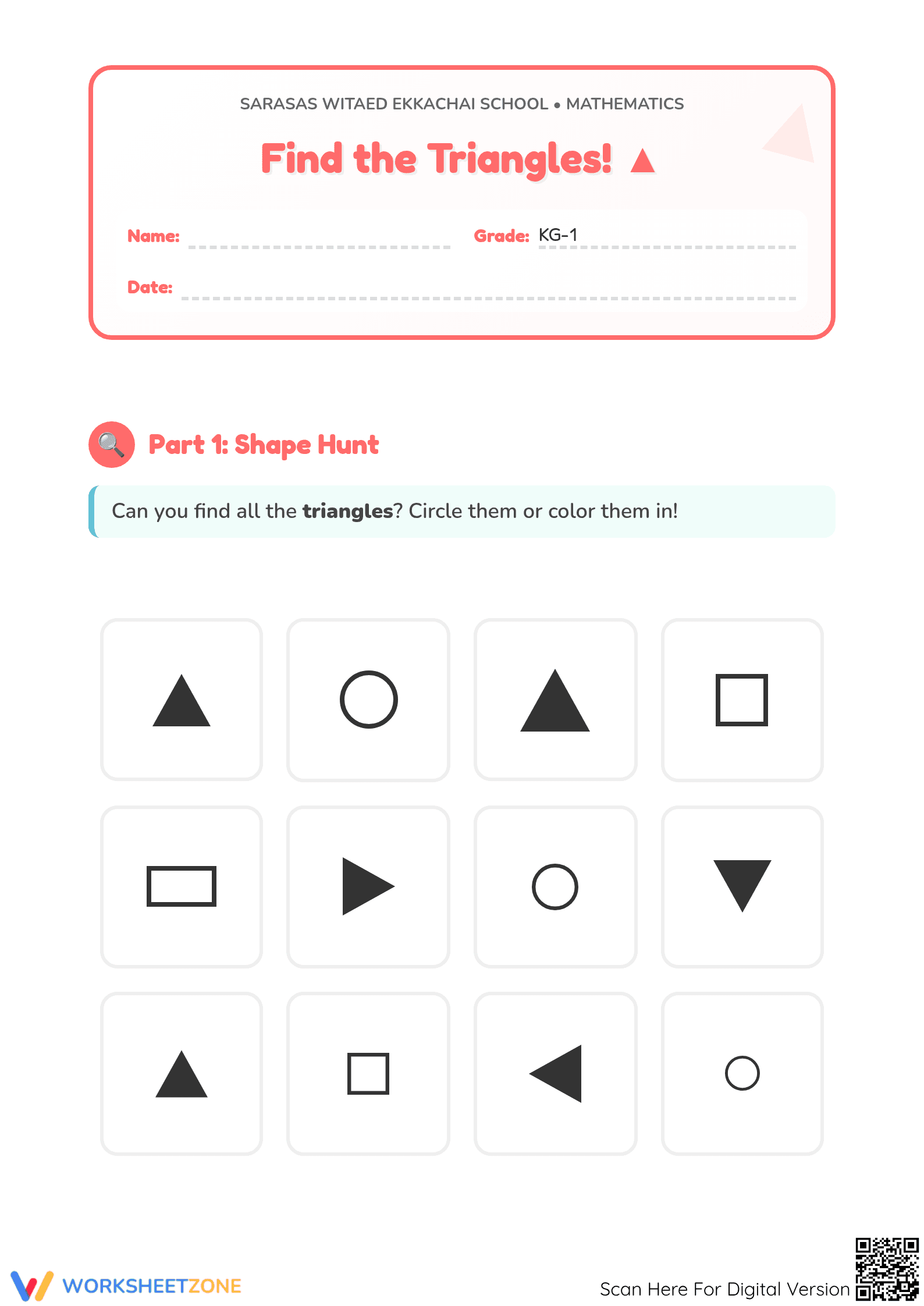
Students master triangle identification, counting, and fine motor formation with this engaging two-page Preschool Math worksheet. Through a multi-sensory approach involving hunting, counting, and tracing, young learners build a solid geometric foundation. This resource ensures students can recognize triangles in different orientations, effectively preparing them for rigorous kindergarten geometry standards.
At a Glance
- Grade: Preschool · Subject: Math
- Standard:
K.G.A.2— Name shapes regardless of their orientation or size- Skill Focus: Triangle Identification and Formation
- Format: 2 pages · 14 tasks · Answer key included · PDF
- Best For: Early geometry introduction and fine motor practice
- Time: 15–20 minutes
What's Inside
The "Find the Triangles!" packet consists of two distinct pages designed for zero-prep classroom use. Page one features a "Shape Hunt" grid with 12 geometric figures where students must distinguish triangles from distractors like circles and squares. The second page transitions into quantitative and creative skills, including a counting task to verify hunt results and a guided "Trace and Draw" section with dashed-line scaffolds for shape formation.
Zero-Prep Workflow
The workflow for this resource is designed for maximum efficiency in busy early childhood settings. Step 1: Print the two-page PDF (30 seconds). Step 2: Distribute to students with crayons or markers for the Shape Hunt (1 minute). Step 3: Review the "How Many?" count as a whole-group activity or using the provided answer key (30 seconds). Total teacher preparation time is under two minutes, making this an ideal solution for sudden sub plans or transition periods.
Standards Alignment
This resource is explicitly aligned with K.G.A.2, which requires students to correctly name shapes regardless of their orientations or overall size. By including triangles in various positions, the worksheet challenges students to look past orientation to identify essential geometric attributes. Both standard codes can be copied directly into lesson plans, IEP goals, or district curriculum mapping tools.
How to Use It
Use this worksheet during the "guided practice" portion of a geometry lesson after introducing the three-sided nature of triangles. It serves as an excellent formative assessment tool; observe students during the Shape Hunt to see if they identify triangles in non-standard orientations. The expected completion time is 15-20 minutes, fitting perfectly into small-group rotations or morning work.
Who It's For
This resource is for preschool and KG-1 students beginning their journey with geometric shapes. It is effective for learners requiring fine motor support, as the tracing portion provides a clear path for pencil control. Pair this with a physical shape sorter or a shape read-aloud for a multi-modal learning experience that caters to visual and kinesthetic learners.
According to the NAEP 2024 framework for early mathematics, the ability to identify and describe shapes is a critical precursor to spatial reasoning and later success in higher-level geometry. Fisher & Frey (2014) emphasize that providing students with non-standard examples of shapes—such as the rotated triangles featured in this "Shape Hunt"—is essential for moving beyond superficial recognition to true conceptual understanding. This worksheet bridges the gap between identification and production by scaffolding the transition from circling a shape to drawing one independently. By aligning with K.G.A.2, educators can ensure they are meeting rigorous developmental benchmarks while supporting fine motor growth. This standalone resource provides the quantitative data necessary for progress monitoring in early intervention settings, making it a versatile tool for both general education and specialized instructional environments.


