


























Views
Downloads



Printable Lattice Multiplication Worksheet | 2D x 2D Grade 5
Paste this activity's link or code into your existing LMS (Google Classroom, Canvas, Teams, Schoology, Moodle, etc.).
Students can open and work on the activity right away, with no student login required.
You'll still be able to track student progress and results from your teacher account.
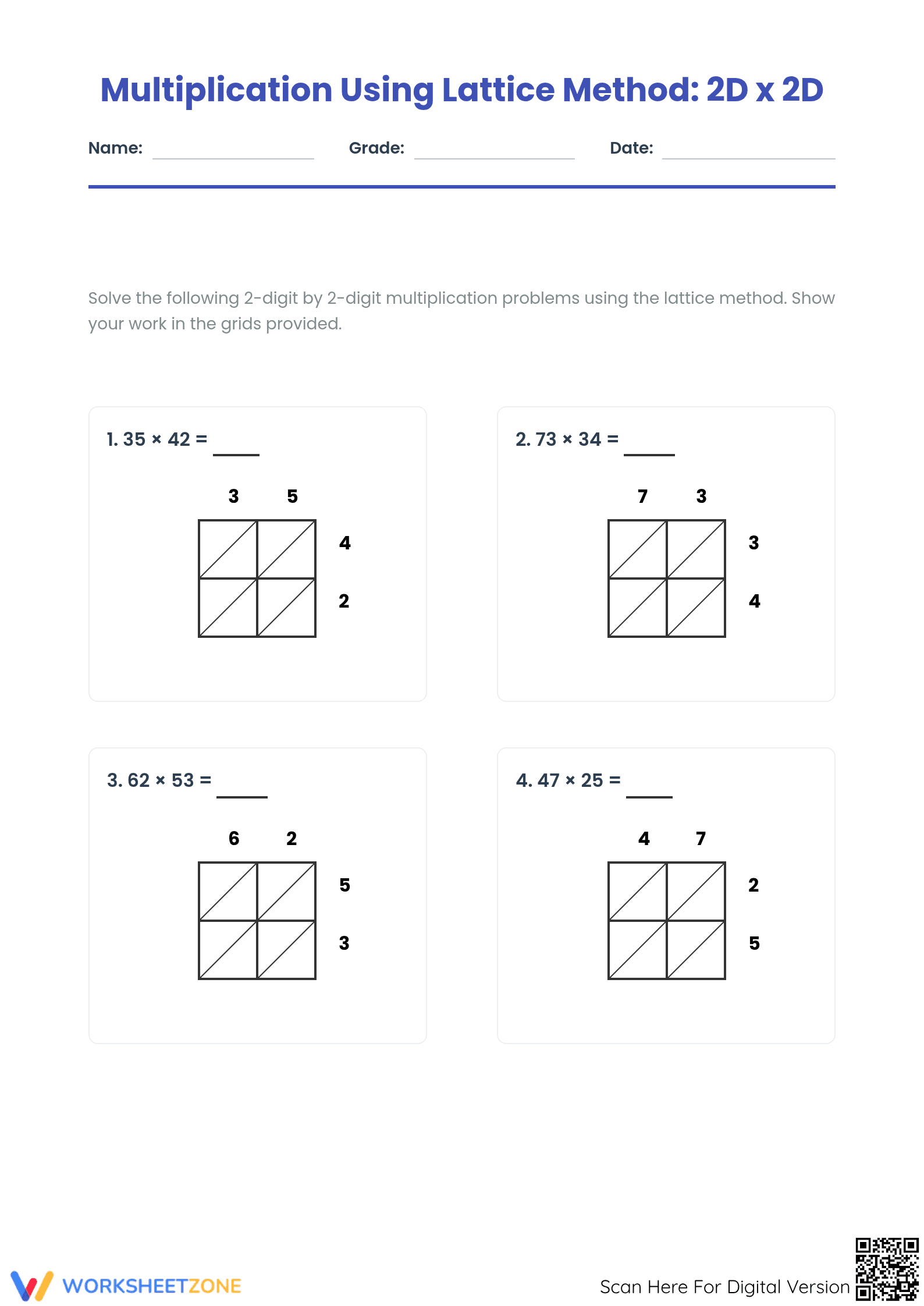
This comprehensive 2D by 2D multiplication worksheet provides students with a visual framework to master multi-digit operations using the lattice method. By utilizing pre-drawn grids, learners focus on accurate single-digit multiplication and diagonal addition. It is an essential tool for building computational confidence and mathematical fluency in the classroom.
At a Glance
- Grade: 5 · Subject: Mathematics
- Standard:
CCSS.MATH.CONTENT.5.NBT.B.5— Fluently multiply multi-digit whole numbers using strategies and algorithms- Skill Focus: 2-Digit by 2-Digit Lattice Multiplication
- Format: 3 pages · 10 problems · Answer key included · PDF
- Best For: Small group intervention and math centers
- Time: 25–35 minutes
The PDF contains three pages of high-quality instructional material. Page one introduces four standard calculation problems with pre-rendered 2x2 lattice grids. Page two provides two more practice problems, two extended practice tasks, and a real-world application word problem. Page three concludes with a final challenge problem and extra space for work. A complete answer key is included for immediate feedback.
Skill Progression
- Guided Practice: Problems 1 through 6 provide structured lattice grids to organize work during the initial learning phase of multi-digit multiplication.
- Supported Practice: Part 2 includes extended practice problems that challenge students to apply the method independently while maintaining grid organization.
- Independent Application: The final section presents real-world word problems requiring students to translate text into numerical lattice calculations without explicit prompts.
This deliberate progression follows the gradual-release model, transitioning from heavy scaffolding to independent mastery of the lattice method.
Standards Alignment
This resource aligns with CCSS.MATH.CONTENT.5.NBT.B.5, which requires students to fluently multiply multi-digit whole numbers. It also supports CCSS.MATH.CONTENT.4.NBT.B.5 by illustrating how partial products are derived from place value positions. Both standard codes can be copied directly into lesson plans, IEP goals, or district curriculum mapping tools.
How to Use It
Use this worksheet as a math workshop rotation station for students needing a visual alternative to the standard algorithm. It is highly effective as a formative assessment; observe students during the diagonal addition phase to identify common regrouping errors. The 10 problems typically take 30 minutes to complete depending on student familiarity.
Who It's For
This resource is ideal for Grade 5 students, but also serves as a robust review for Grade 6 and 7 learners. It is perfectly suited for English Language Learners and students with IEPs who benefit from the lattice grid's organizational structure. Pair this with a multiplication chart or base-ten blocks for additional concrete support.
According to the RAND AIRS 2024 report, providing alternative algorithms like the lattice method improves conceptual understanding for students who struggle with traditional regrouping. This 2D by 2D multiplication worksheet aligns with CCSS.MATH.CONTENT.5.NBT.B.5, enabling learners to visualize partial products within a geometric grid. By breaking down the multiplication of two-digit numbers into smaller single-digit products, students reduce cognitive load and minimize procedural errors. Research from Fisher & Frey (2014) emphasizes that scaffolds like lattice grids are essential during the guided practice phase of the gradual release model. This resource provides 10 high-quality problems that transition from calculation to real-world word problems, ensuring Grade 5 students develop the necessary fluency for multi-digit operations required by state standards. Access this printable PDF to support diverse learning needs in your mathematics classroom today.


