




























Views
Downloads


Essential Algebra: Identities & Factorization Worksheet

Paste this activity's link or code into your existing LMS (Google Classroom, Canvas, Teams, Schoology, Moodle, etc.).
Students can open and work on the activity right away, with no student login required.
You'll still be able to track student progress and results from your teacher account.
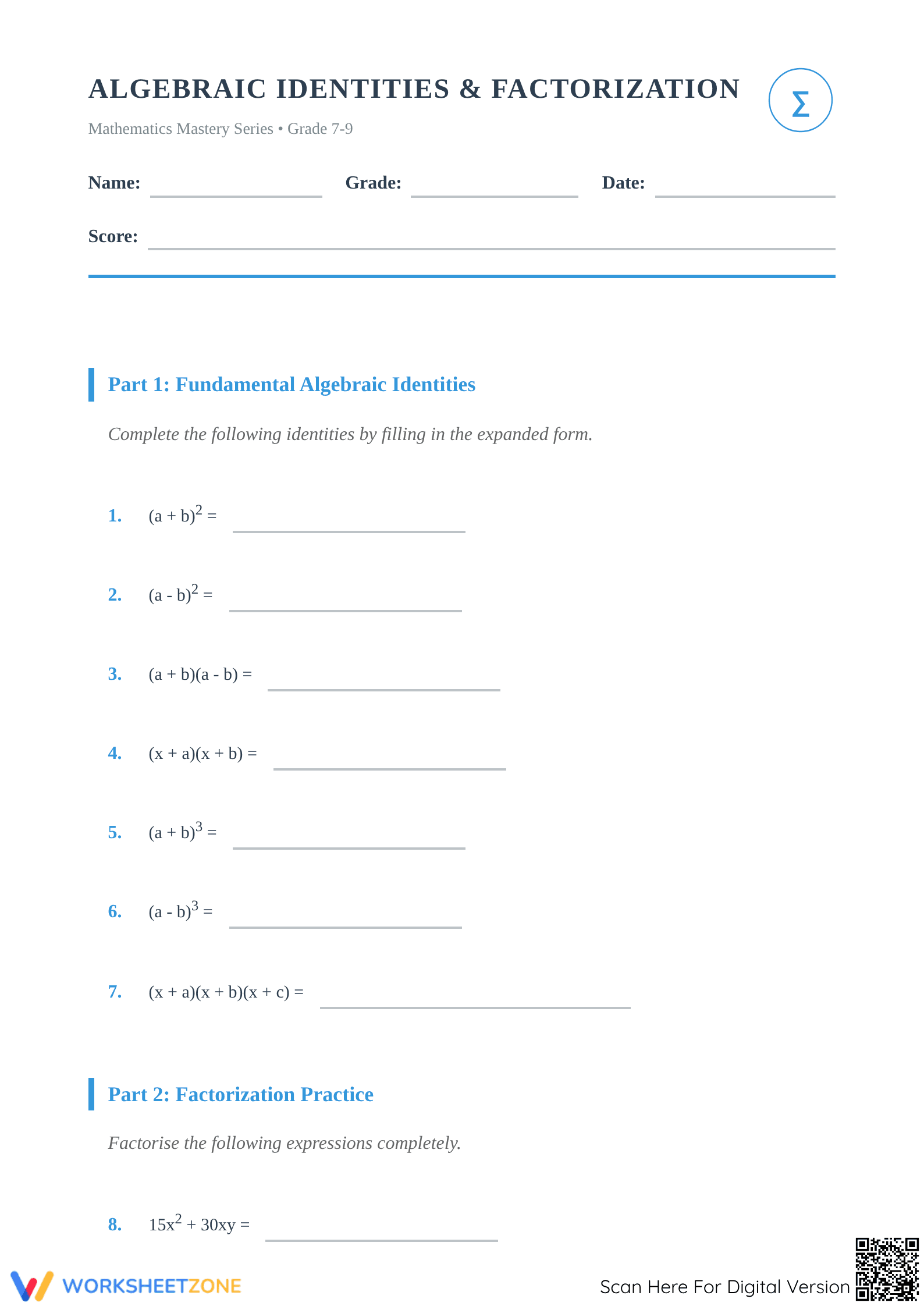
This comprehensive algebra worksheet focuses on the critical skills of expanding algebraic identities and performing factorization. Students will master the application of fundamental formulas like the square of a sum and the difference of squares while learning to break down complex expressions into their constituent factors. It is designed to bridge the gap between middle school pre-algebra and high school mastery.
At a Glance
- Grade: 7–9 · Subject: Algebra
- Standard:
CCSS.MATH.CONTENT.HSA.SSE.A.2— Use the structure of an expression to identify ways to rewrite it- Skill Focus: Algebraic Identities & Factorization
- Format: 4 pages · 28 problems · Answer key included · PDF
- Best For: High school algebra test preparation
- Time: 45–60 minutes
What's Inside
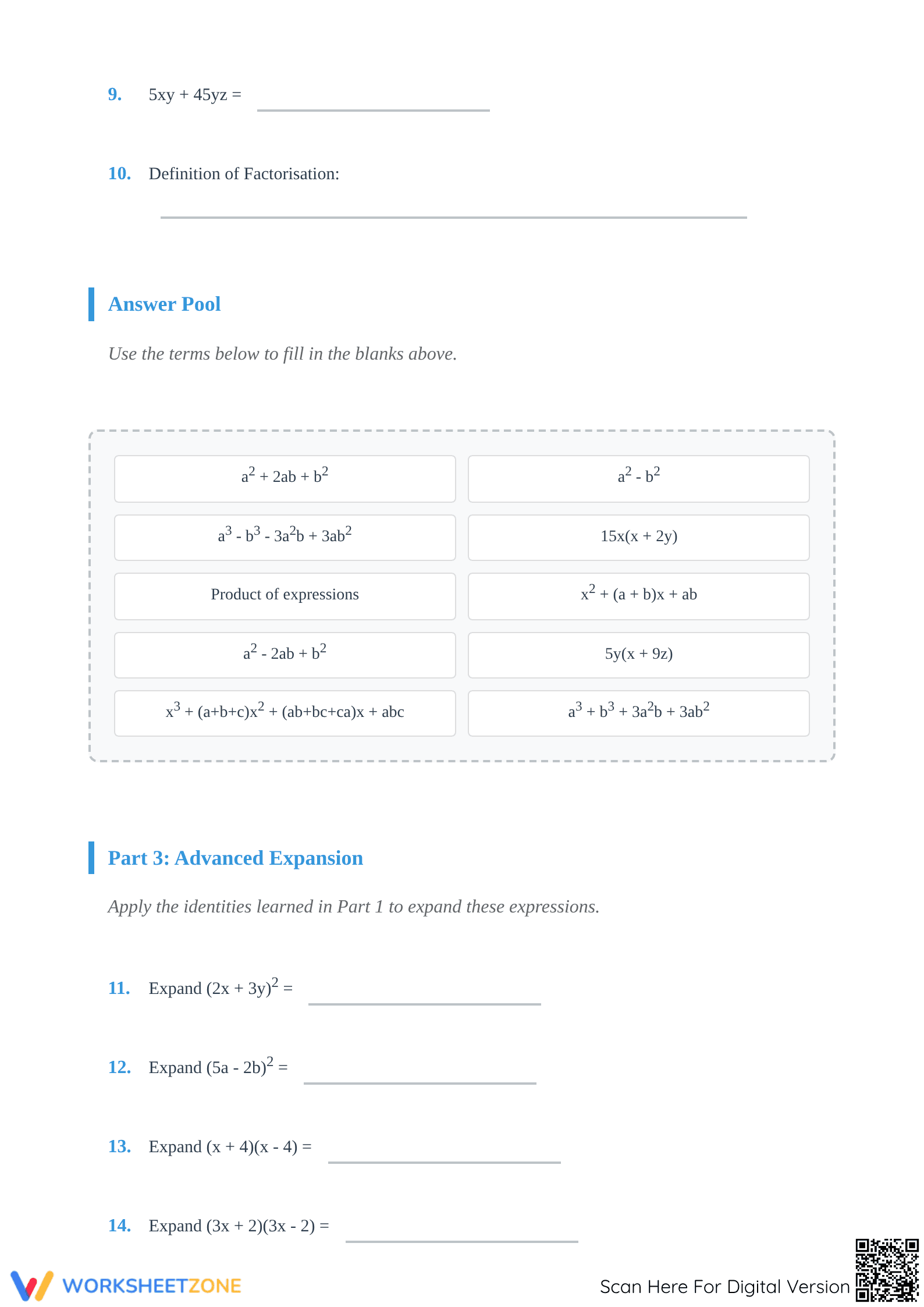
This four-page resource provides a structured exploration of algebraic manipulations. It includes 28 high-quality tasks divided into four specialized parts: Fundamental Identities, Factorization Practice, Advanced Expansion, and Challenge Factorization. The layout features clear instructions and an integrated answer pool on the second page to provide students with immediate corrective feedback during independent work.
Skill Progression
- Guided practice: The first section provides 7 fundamental identities where students fill in expanded forms, reinforcing basic rote memorization and pattern recognition.
- Supported practice: Part 2 and 3 introduce factorization and advanced binomial expansion, utilizing an answer pool to scaffold students as they apply rules to more complex variables.
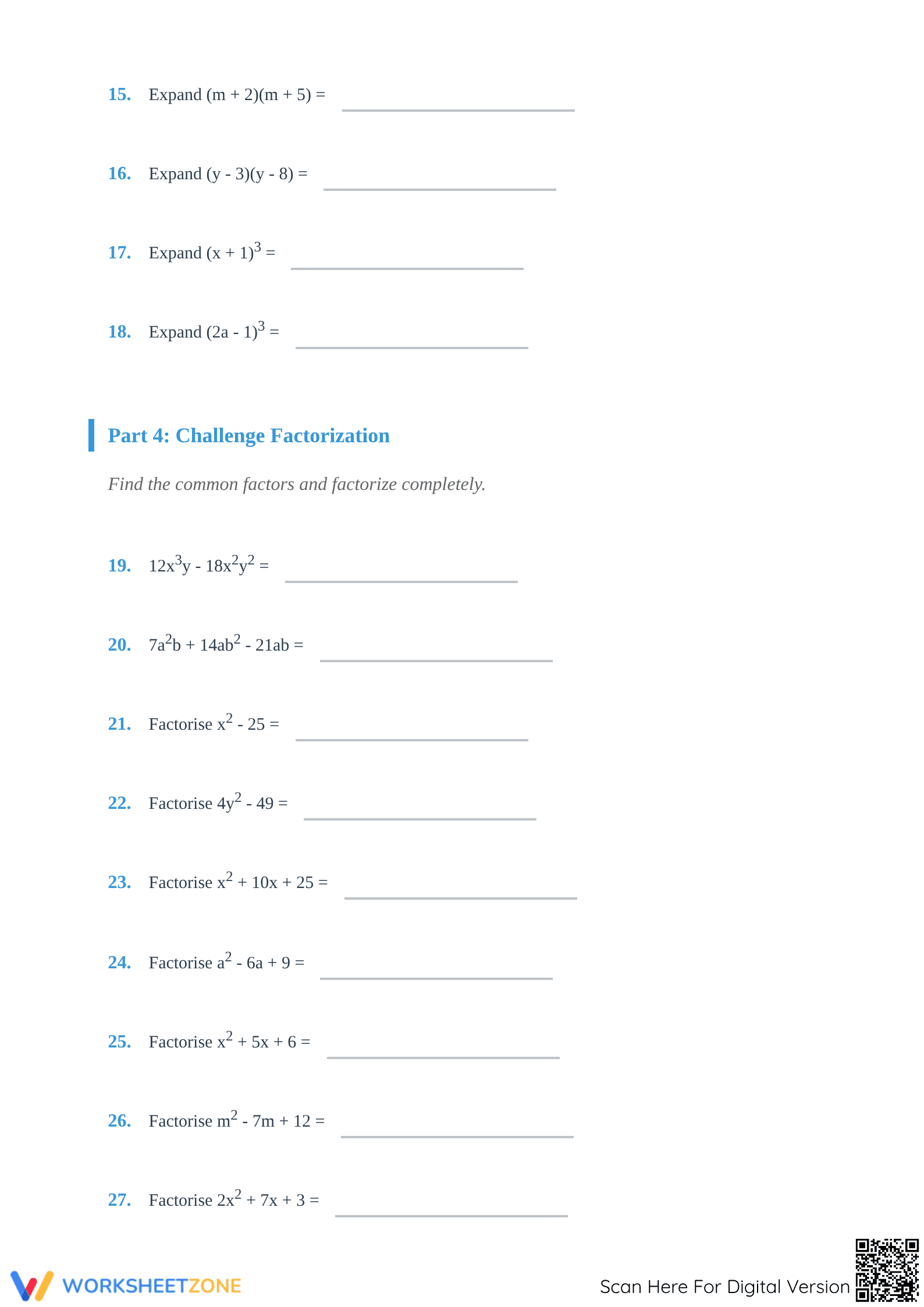
- Independent practice: The final 10 challenge problems require students to find common factors and factorize trinomials completely without direct hints, ensuring they can operate at the mastery level.
This gradual-release approach ensures students move confidently from "I Do" recognition to "You Do" independent application of complex algebraic structures.
Standards Alignment
CCSS.MATH.CONTENT.HSA.SSE.A.2 is the primary focus, requiring students to "Use the structure of an expression to identify ways to rewrite it." This worksheet provides rigorous practice in seeing quadratic patterns as squares of binomials. Both standard codes can be copied directly into lesson plans, IEP goals, or district curriculum mapping tools.
How to Use It
This worksheet is best utilized after direct instruction on binomial expansion and common factoring techniques. Use the first page as collaborative guided practice. For formative assessment, observe students during Part 4; if they struggle with problem 19, provide a quick mini-lesson on greatest common factor (GCF) before they proceed to trinomials. Expected completion time is 45-60 minutes.
Who It's For
This resource is ideal for Grade 7 through Grade 9 students enrolled in Algebra 1 or Integrated Math I. It offers necessary scaffolding for learners who need visual patterns while providing the rigorous challenge required for honors-track students. It pairs naturally with an interactive whiteboard lesson or a standard algebra textbook chapter on polynomials.
Standardized assessments frequently prioritize the ability to recognize and manipulate algebraic structures as a core indicator of college and career readiness. This worksheet aligns specifically with CCSS.MATH.CONTENT.HSA.SSE.A.2, targeting the foundational skill of rewriting expressions through factorization and identity expansion. According to Fisher & Frey (2014), the use of structured practice sets that follow a gradual release of responsibility model is significantly more effective than isolated drill methods for long-term retention of mathematical procedures. By moving from scaffolded identity completion to independent challenge factorization, this resource supports the cognitive shift from procedural fluency to conceptual understanding. The inclusion of 28 targeted tasks ensures that students encounter a representative variety of term combinations, including common factors and trinomial patterns. This rigor is essential for preparing students for the higher-order demands of Algebra II and Calculus, where these identities become internalized tools for solving complex functions.


