


























0
Views
0
Downloads

0.0
0
Save
0 Likes
Creative Quilt Multiplication Practice
0 Views
0 Downloads
Paste this activity's link or code into your existing LMS (Google Classroom, Canvas, Teams, Schoology, Moodle, etc.).
Students can open and work on the activity right away, with no student login required.
You'll still be able to track student progress and results from your teacher account.
Information
Description
What It Is:
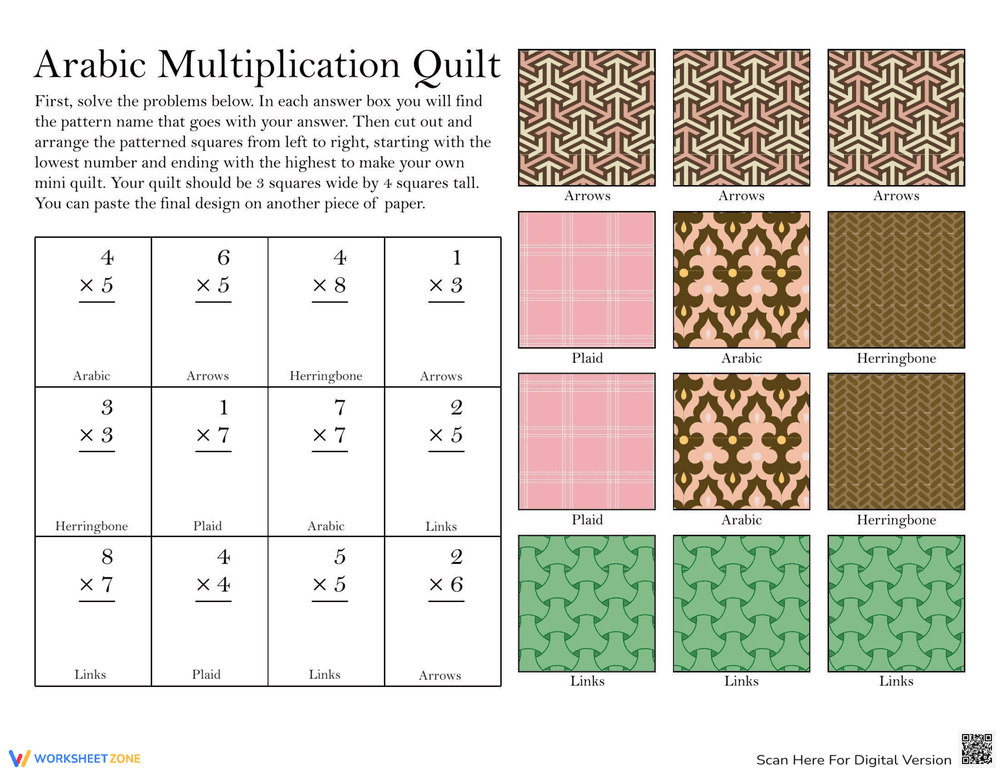
This is an educational worksheet titled 'Arabic Multiplication Quilt'. It involves solving multiplication problems and then cutting out and arranging patterned squares based on the answers. Each answer corresponds to a specific pattern (e.g., Arrows, Plaid, Herringbone, Links, Arabic). The worksheet contains 12 multiplication problems, ranging from single-digit multiplication (e.g., 4 x 5, 6 x 5, 4 x 8, 1 x 3) to slightly more complex problems (e.g., 8 x 7, 2 x 6). The goal is to create a mini quilt by arranging the patterned squares in order from the lowest to the highest answer.
Grade Level Suitability:
This worksheet is most suitable for 3rd and 4th grade students. It reinforces multiplication skills and introduces a visual, hands-on activity that connects math to art and pattern recognition. The multiplication problems are within the typical range for these grade levels.
Why Use It:
This worksheet provides a fun and engaging way to practice multiplication facts. It combines math skills with visual learning and problem-solving, as students must solve the problems, match the answers to patterns, and arrange the squares correctly. It also encourages fine motor skills through cutting and pasting.
How to Use It:
First, solve each multiplication problem. Then, find the patterned square that corresponds to the answer. Cut out each of the patterned squares. Arrange the squares in order from the lowest answer to the highest answer, starting from left to right. Paste the final design onto another piece of paper to create a mini quilt.
Target Users:
This worksheet is ideal for elementary school students in grades 3-4 who are learning or reinforcing their multiplication skills. It can also be used as a supplementary activity for students who enjoy hands-on learning and visual puzzles. Teachers can use it as a classroom activity or as a homework assignment.
This is an educational worksheet titled 'Arabic Multiplication Quilt'. It involves solving multiplication problems and then cutting out and arranging patterned squares based on the answers. Each answer corresponds to a specific pattern (e.g., Arrows, Plaid, Herringbone, Links, Arabic). The worksheet contains 12 multiplication problems, ranging from single-digit multiplication (e.g., 4 x 5, 6 x 5, 4 x 8, 1 x 3) to slightly more complex problems (e.g., 8 x 7, 2 x 6). The goal is to create a mini quilt by arranging the patterned squares in order from the lowest to the highest answer.
Grade Level Suitability:
This worksheet is most suitable for 3rd and 4th grade students. It reinforces multiplication skills and introduces a visual, hands-on activity that connects math to art and pattern recognition. The multiplication problems are within the typical range for these grade levels.
Why Use It:
This worksheet provides a fun and engaging way to practice multiplication facts. It combines math skills with visual learning and problem-solving, as students must solve the problems, match the answers to patterns, and arrange the squares correctly. It also encourages fine motor skills through cutting and pasting.
How to Use It:
First, solve each multiplication problem. Then, find the patterned square that corresponds to the answer. Cut out each of the patterned squares. Arrange the squares in order from the lowest answer to the highest answer, starting from left to right. Paste the final design onto another piece of paper to create a mini quilt.
Target Users:
This worksheet is ideal for elementary school students in grades 3-4 who are learning or reinforcing their multiplication skills. It can also be used as a supplementary activity for students who enjoy hands-on learning and visual puzzles. Teachers can use it as a classroom activity or as a homework assignment.


