


























Views
Downloads
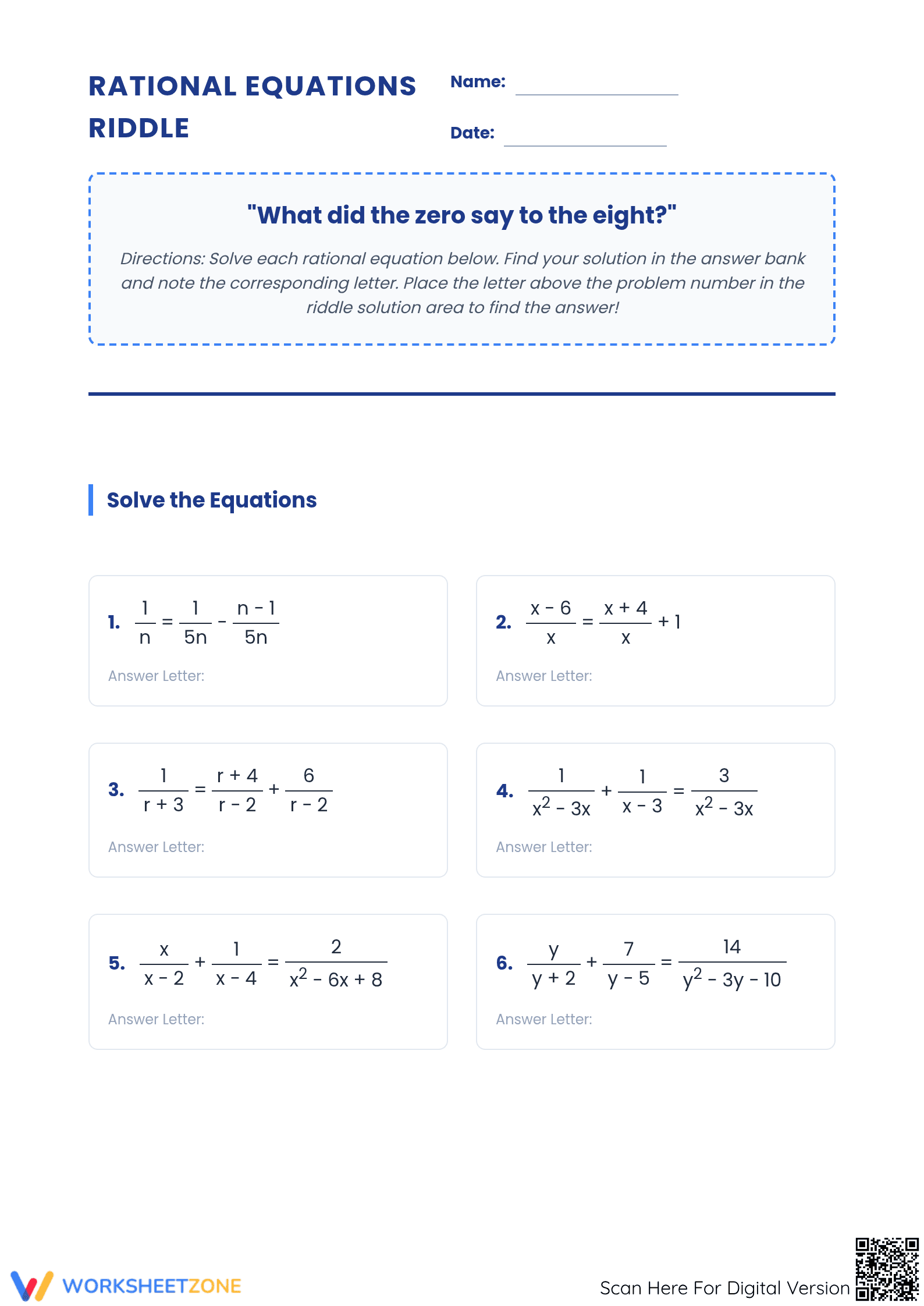


Grade 10 Rational Equations — Printable No-Prep Worksheet
Paste this activity's link or code into your existing LMS (Google Classroom, Canvas, Teams, Schoology, Moodle, etc.).
Students can open and work on the activity right away, with no student login required.
You'll still be able to track student progress and results from your teacher account.
This engaging high school algebra worksheet helps students master solving rational equations through a fun riddle format. By calculating the correct variables and matching them to an answer bank, learners will decode the punchline to a math joke while reinforcing essential algebraic problem-solving skills.
At a Glance
- Grade: 10-12 · Subject: Algebra
- Standard:
CCSS.MATH.CONTENT.HSA.REI.A.2— Solve simple rational equations in one variable- Skill Focus: Solving Rational Equations
- Format: 2 pages · 7 problems · Answer key included · PDF
- Best For: Independent practice and review
- Time: 20–30 minutes
Inside this resource, educators will find a two-page activity featuring seven distinct rational equations of varying complexity. Students must find common denominators, isolate variables, and check for extraneous solutions. The second page includes a comprehensive answer bank and a fill-in-the-blank riddle decoder. A complete teacher answer key is also provided to make grading fast and accurate.
This resource is designed for a seamless, zero-prep classroom experience:
- Print (1 minute): Simply download the PDF and print a class set. The self-contained instructions mean no additional materials are required.
- Distribute (1 minute): Hand out the two-page packet as students enter the room for immediate engagement.
- Review (3 minutes): Use the included answer key to quickly verify the riddle punchline or spot-check individual equation steps.
With under two minutes of total teacher prep time, this activity is an excellent choice for emergency sub plans or last-minute independent practice sessions.
This worksheet is strictly aligned to CCSS.MATH.CONTENT.HSA.REI.A.2, requiring students to solve simple rational equations in one variable, and give examples showing how extraneous solutions may arise. By working through these seven specific problems, learners demonstrate their ability to manipulate algebraic fractions. Both standard codes can be copied directly into lesson plans, IEP goals, or district curriculum mapping tools.
This riddle worksheet is highly versatile. Use it during direct instruction as a collaborative partner activity where students can check each other's work against the answer bank. Alternatively, assign it as a formative assessment after your main lesson on rational expressions. As a formative observation tip, watch to see if students remember to check their final answers against the original denominators to identify any undefined, extraneous solutions. Expect students to complete the full activity in 20 to 30 minutes.
This activity is ideal for Grade 10, 11, and 12 algebra students who need targeted practice with rational expressions. The built-in answer bank provides a natural differentiation scaffold, allowing struggling learners to self-correct if their calculated answer does not appear in the options. Pair this worksheet with a foundational anchor chart on finding least common multiples (LCM) to support students who need a quick refresher on fraction operations.
Mastering algebraic procedures requires consistent, engaging practice that provides immediate feedback. According to a ScienceDirect TpT Analysis, incorporating puzzle-based elements like riddles into mathematical practice significantly increases student motivation and task persistence compared to traditional drill worksheets. This resource directly supports CCSS.MATH.CONTENT.HSA.REI.A.2 by challenging students to solve simple rational equations in one variable. The self-checking nature of the answer bank ensures that learners immediately recognize calculation errors, prompting them to review their steps and solidify their understanding of algebraic properties. By integrating rigorous standard alignment with an approachable format, educators can effectively build procedural fluency while maintaining a positive classroom environment.


