


























Views
Downloads

High School Probability Spinner — Printable Worksheet
Paste this activity's link or code into your existing LMS (Google Classroom, Canvas, Teams, Schoology, Moodle, etc.).
Students can open and work on the activity right away, with no student login required.
You'll still be able to track student progress and results from your teacher account.
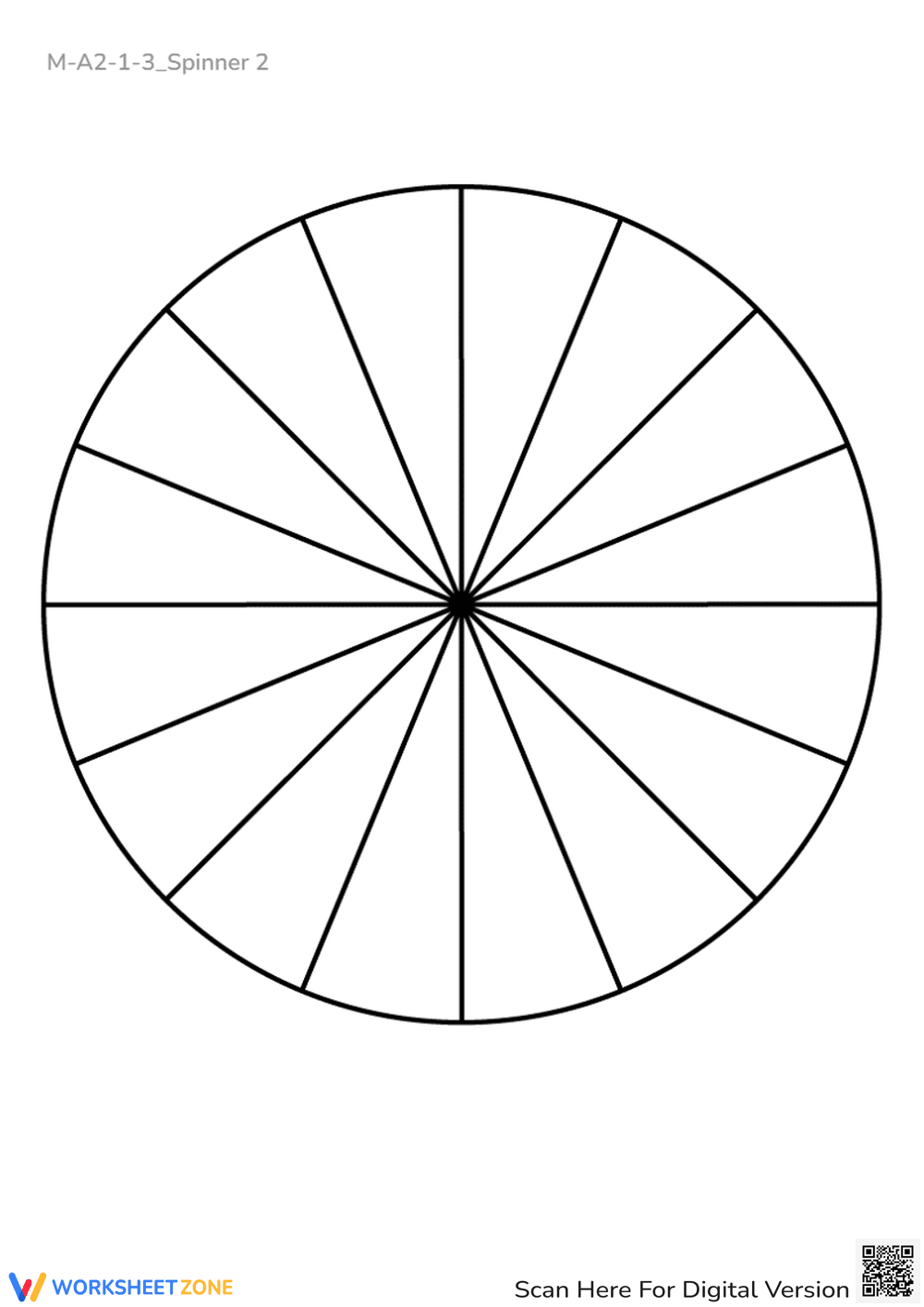
This probability spinner worksheet helps high school students calculate expected value and odds through hands-on experimentation. By utilizing a customizable 16-sector spinner, learners visualize theoretical probability distributions and calculate outcomes. This resource simplifies complex probability concepts, enabling students to master data analysis and decision-making skills.
At a Glance
- Grade: Grades 10–12 · Subject: Probability
- Standard:
HSS-MD.B.5— Calculate expected values and use them to solve problems- Skill Focus: Expected value and odds calculations
- Format: 1 page · 1 customizable spinner · No answer key · PDF
- Best For: Hands-on probability experiments and lessons
- Time: 15–30 minutes
This single-page PDF features a clean, blank 16-sector spinner template designed for high school probability lessons. The template provides a blank canvas for teachers or students to assign custom values, colors, or numbers to each sector. This open-ended structure allows for diverse classroom applications, from basic probability calculations to complex expected value games, without pre-determined constraints.
Implement this resource in under two minutes with a simple three-step workflow. First, print the single-page PDF template for your class (1 minute). Second, distribute the sheets along with pencils and paperclips to act as spinners (1 minute). Finally, review student-generated probability distributions and expected value calculations as a whole group. This self-explanatory layout makes it an ideal emergency sub plan or quick warm-up activity.
Standards Alignment
This worksheet aligns directly with the Common Core State Standard HSS-MD.B.5, which requires students to weigh the possible outcomes of a decision by assigning probabilities to payoff values and finding expected values. Additionally, it supports standard HSS-CP.A.1 by helping students describe events as subsets of a sample space. Both standard codes can be copied directly into lesson plans, IEP goals, or district curriculum mapping tools.
How to Use It
Use this spinner template during the independent practice portion of your lesson on expected value. Have students assign point values to different sectors, spin 20 times, and compare their experimental results to the theoretical expected value. For a quick formative assessment, observe how students set up their probability distributions and calculate the sum of the products of probabilities and payoffs. This activity typically takes 15 to 30 minutes.
Who It's For
This resource is designed for high school students in grades 10 through 12 studying probability and statistics. It is highly adaptable for struggling learners who need visual aids, as well as advanced students who can design complex game theory scenarios. Pair this worksheet with a standard probability anchor chart or an introductory lesson on sample spaces to maximize student comprehension.
This probability worksheet supports the development of quantitative literacy by aligning with standard HSS-MD.B.5. According to research from EdReports 2024, hands-on visual models like spinners significantly improve student retention of abstract probability concepts compared to purely symbolic instruction. By allowing students to physically manipulate and define the sample space, this tool bridges the gap between concrete trials and theoretical calculations. The 16-sector design provides a sufficiently complex sample space to challenge high school learners while remaining computationally manageable. Utilizing this structured template helps educators implement evidence-based practices that foster deeper mathematical reasoning and data literacy. Both standard codes can be copied directly into lesson plans, IEP goals, or district curriculum mapping tools to document standards-based instruction.


