


























Views
Downloads
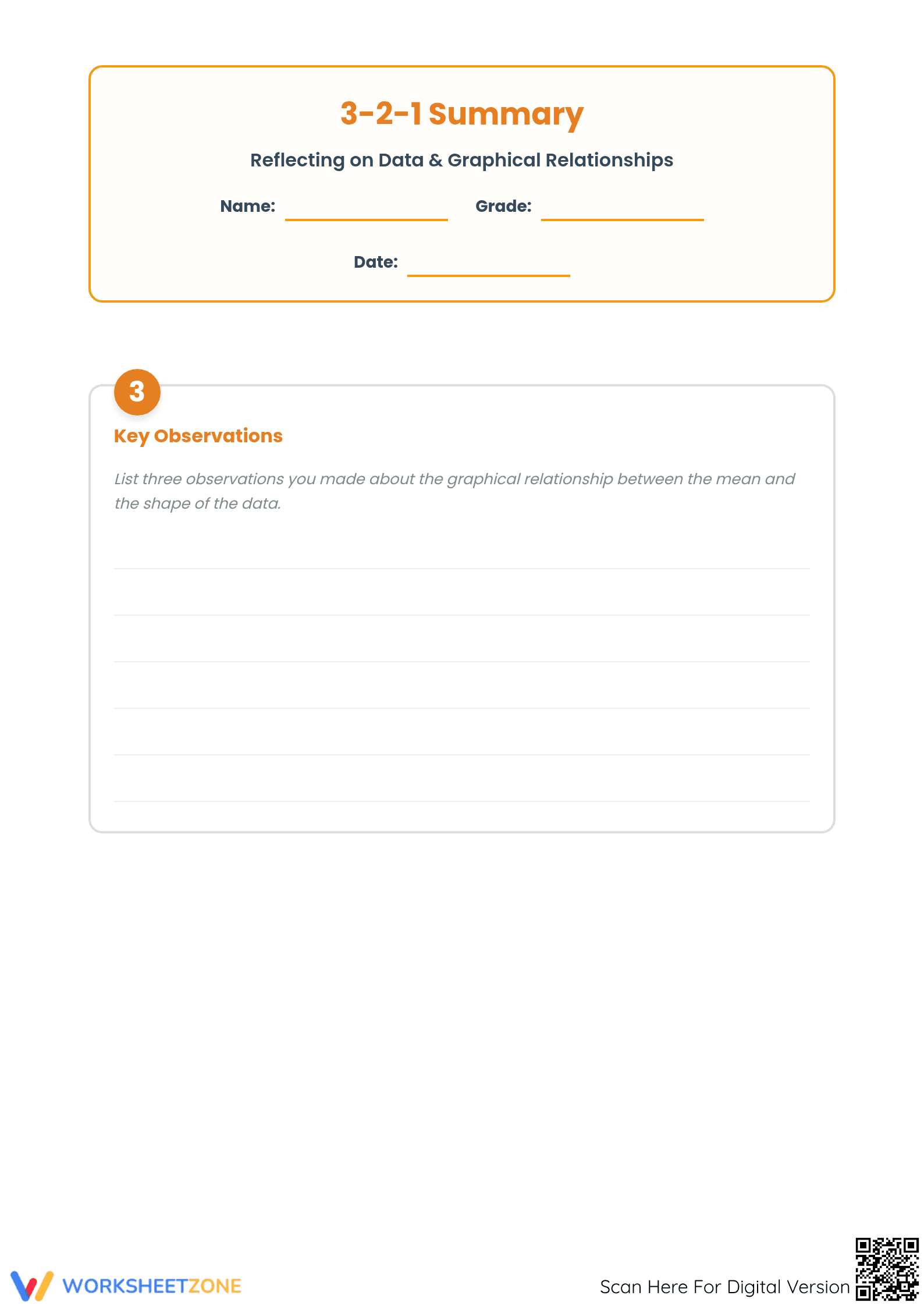


Printable 3-2-1 Data Summary Worksheet | Grade 6 Math
Paste this activity's link or code into your existing LMS (Google Classroom, Canvas, Teams, Schoology, Moodle, etc.).
Students can open and work on the activity right away, with no student login required.
You'll still be able to track student progress and results from your teacher account.
This printable 3-2-1 summary worksheet helps sixth-grade students synthesize their understanding of statistical data and graphical relationships. By structuring their reflections into specific tiers, students effectively articulate the complex relationship between the mean and the overall shape of a data distribution.
At a Glance
- Grade: 6 · Subject: Math
- Standard:
CCSS.MATH.CONTENT.6.SP.A.2— Describe a data distribution by its center, spread, and shape.- Skill Focus: Summarizing data and graphical relationships
- Format: 2 pages · 3 problems · No answer key · PDF
- Best For: Exit ticket or lesson reflection
- Time: 10–15 minutes
This two-page resource features a classic 3-2-1 reflection framework tailored for statistics. Students are prompted to list three key observations about graphical relationships, identify and explain two mathematical vocabulary words, and write one final realization or lingering question. The open-ended format encourages critical thinking and allows teachers to gauge conceptual understanding without a rigid answer key.
- Guided practice: Students begin with 3 observation tasks, anchoring their thoughts on how the mean interacts with data shape using high scaffold support.
- Supported practice: The second tier requires defining 2 specific math vocabulary terms, offering medium scaffolding for academic language.
- Independent practice: The final prompt demands 1 high-level realization or question, removing scaffolds for independent thought.
This structure perfectly mirrors a gradual-release model, moving students toward complete conceptual ownership.
Aligned to primary standard CCSS.MATH.CONTENT.6.SP.A.2: Understand that a set of data collected to answer a statistical question has a distribution which can be described by its center, spread, and overall shape. It also supports broader statistical reasoning goals. Both standard codes can be copied directly into lesson plans, IEP goals, or district curriculum mapping tools.
Use this worksheet as a formative assessment immediately following a gallery walk, carousel activity, or direct instruction on histograms and data distributions. It serves perfectly as an extended exit ticket. Teachers can quickly scan the "one question you still have" section to plan the warm-up for the next day's lesson. Expected completion time is 10 to 15 minutes.
Designed for sixth-grade math students developing their statistical reasoning skills. The open-ended nature naturally differentiates for varying ability levels, as students respond using their own vocabulary and observations. It pairs excellently with hands-on graphing activities or interactive data stations.
Integrating structured reflection protocols like the 3-2-1 method significantly enhances student retention of complex mathematical concepts. When addressing CCSS.MATH.CONTENT.6.SP.A.2 to describe a data distribution by its center, spread, and shape, providing a dedicated space for synthesis is absolutely crucial for long-term mastery. According to Fisher & Frey (2014), formative assessment routines that require students to independently articulate their own learning help consolidate memory and reveal hidden misconceptions before they become ingrained. This specific summary worksheet leverages that exact pedagogical mechanism, transforming the passive observation of statistical charts and graphs into active cognitive engagement. By prompting learners to explicitly connect visual data shapes to numerical means, educators can foster a deeper, more resilient understanding of foundational statistics that will serve students well in advanced mathematics.


