


























Views
Downloads


Multiplication Word Problems Worksheet | Grade 4 Printable
Paste this activity's link or code into your existing LMS (Google Classroom, Canvas, Teams, Schoology, Moodle, etc.).
Students can open and work on the activity right away, with no student login required.
You'll still be able to track student progress and results from your teacher account.
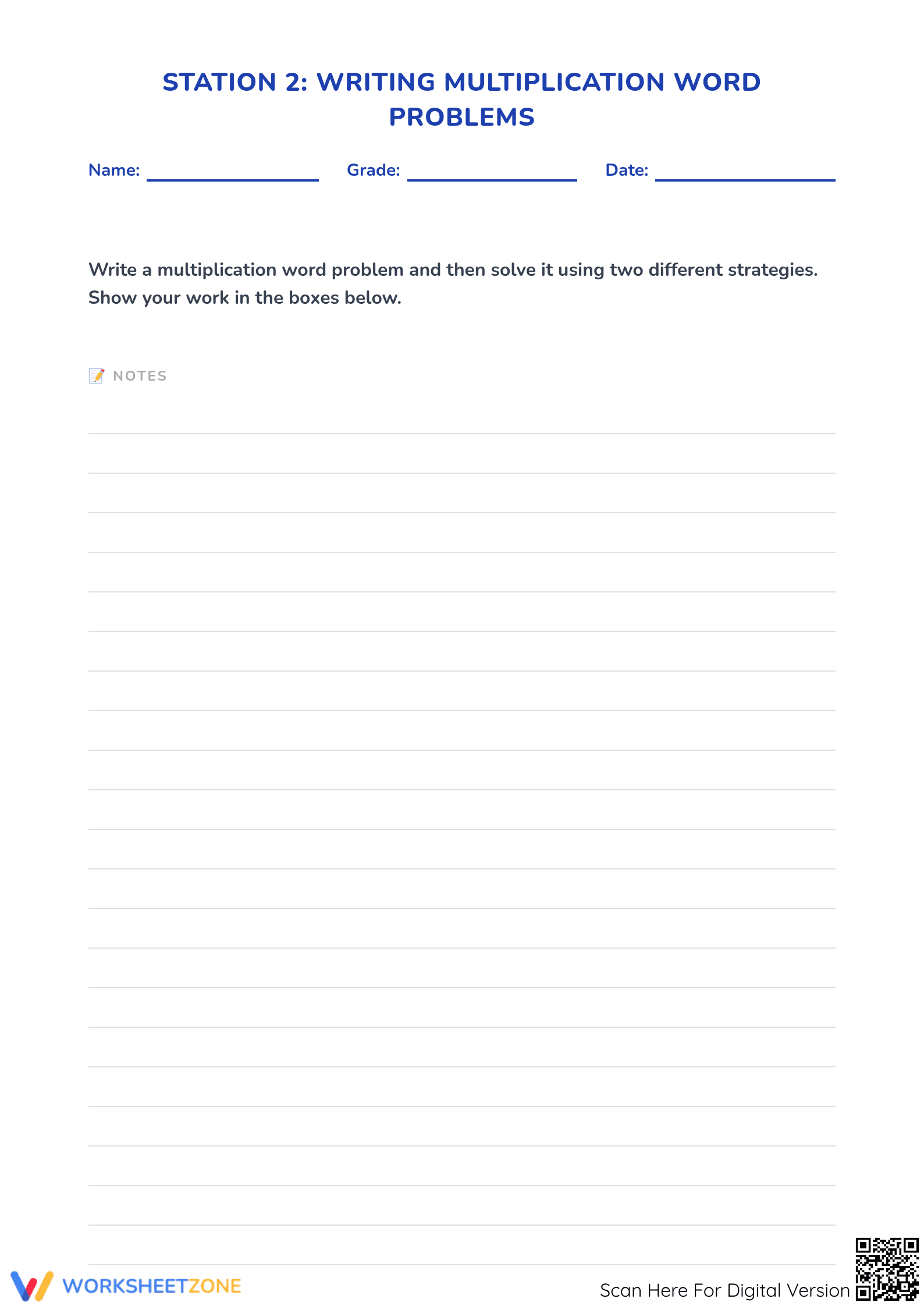
This Grade 4 math worksheet provides a structured template for students to write, solve, and analyze their own multiplication word problems. By asking learners to apply two different mathematical strategies and explain their reasoning, this resource deepens conceptual understanding and moves beyond basic rote memorization of multiplication facts.
At a Glance
- Grade: 4 · Subject: Math
- Standard:
CCSS.MATH.CONTENT.4.NBT.B.5— Multiply whole numbers using strategies and explain calculations- Skill Focus: Writing and solving multiplication word problems
- Format: 2 pages · 1 complex task · Open-ended · PDF
- Best For: Math stations and independent practice
- Time: 15–20 minutes
This two-page printable features a clear graphic organizer designed for math centers. The first page provides a notes section for brainstorming. The second page includes specific boxes where students write their final word problem, show work for Strategy 1 and Strategy 2, and write an explanation of which method they prefer. Because it is an open-ended template, no answer key is required, allowing for limitless reuse with different numbers.
This template supports a gradual release of responsibility by breaking down the problem-solving process:
- Guided practice: Teachers can model how to write a realistic multiplication scenario using the notes section on page one.
- Supported practice: Students use the graphic organizer to test two different methods (such as area models or partial products) side-by-side.
- Independent practice: Learners articulate their mathematical thinking by writing a justification for their preferred strategy.
This structured approach perfectly aligns with the I Do, We Do, You Do instructional model.
Aligned to primary standard CCSS.MATH.CONTENT.4.NBT.B.5, this worksheet requires students to multiply whole numbers using strategies based on place value. It also supports mathematical practice standards by asking students to construct viable arguments when explaining their preferred strategy. Both standard codes can be copied directly into lesson plans, IEP goals, or district curriculum mapping tools.
This template is highly versatile for classroom implementation. Use it during math rotations as a dedicated station activity where students roll dice to generate numbers for their word problems. Alternatively, assign it as a formative assessment after direct instruction. As students work, teachers can observe which strategies they naturally gravitate toward and read their written explanations to assess reasoning skills. Expect this activity to take 15 to 20 minutes to complete.
This resource is ideal for fourth-grade students transitioning from basic facts to multi-digit operations. The open-ended nature naturally differentiates instruction; advanced learners can use larger numbers, while students needing support can stick to simpler factors. It pairs wonderfully with anchor charts displaying various multiplication methods.
Developing mathematical communication skills is essential for long-term student success in elementary classrooms. According to EdReports 2024, instructional materials that require students to explain their reasoning and compare multiple solution pathways significantly improve conceptual mastery and retention. This worksheet directly supports that research by asking learners to engage with CCSS.MATH.CONTENT.4.NBT.B.5 and multiply whole numbers using strategies and explain calculations. By shifting the focus from simply finding the correct answer to understanding how and why a specific strategy works, educators can foster deeper mathematical thinking. The requirement to write and solve original word problems also bridges the gap between abstract computation and real-world application, ensuring students build a robust foundation for future algebraic concepts. This evidence-based approach transforms standard math practice into a rigorous exercise.


