


























Views
Downloads
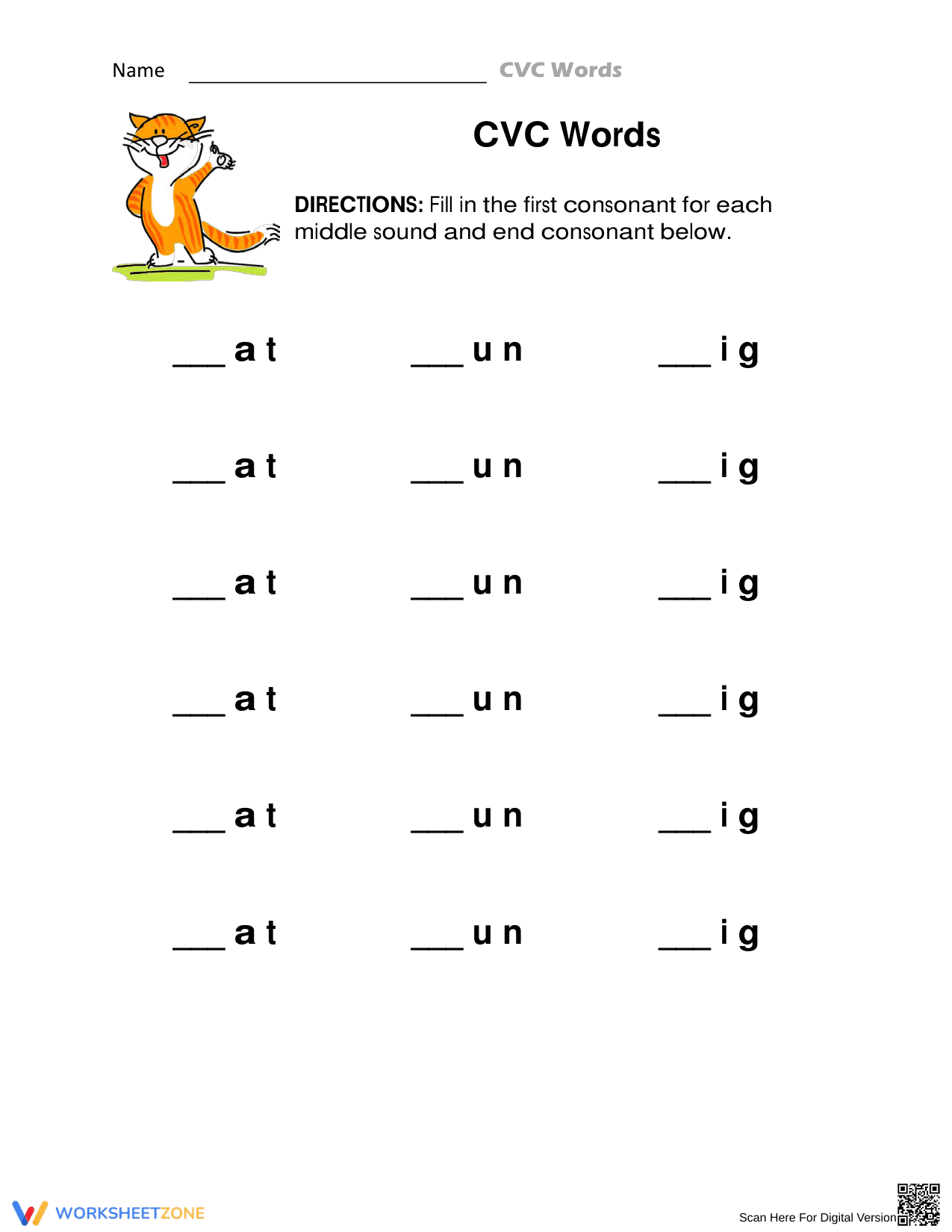

CVC Words Worksheet | Essential Grade K Phonics
Paste this activity's link or code into your existing LMS (Google Classroom, Canvas, Teams, Schoology, Moodle, etc.).
Students can open and work on the activity right away, with no student login required.
You'll still be able to track student progress and results from your teacher account.
This Grade K phonics worksheet provides foundational practice with CVC words, helping students isolate and identify initial consonants. By completing words in common word families, learners strengthen their phonemic awareness and letter-sound correspondence. This resource is designed to bridge the gap between letter recognition and early reading fluency through structured, repetitive practice.
At a Glance
- Grade: Kindergarten · Subject: English Language Arts
- Standard:
CCSS.ELA-LITERACY.RF.K.2.D— Isolate and pronounce the initial consonant sounds in simple three-phoneme CVC words- Skill Focus: Initial Consonant Identification and Letter-Sound Correspondence
- Format: 1 page · 18 problems · Answer key included · PDF Printable
- Best For: Morning work, literacy centers, or independent phonics practice
- Time: 10–15 minutes of quiet work
What's Inside
This single-page PDF contains 18 fill-in-the-blank tasks organized into three columns representing distinct word families: "-at", "-un", and "-ig". Each task provides the medial vowel and ending consonant, requiring students to supply the appropriate starting letter to form a valid word. The clean, distraction-free layout includes a friendly cat illustration to engage young learners. A complete answer key is provided to facilitate quick grading or student self-correction.
Zero-Prep Workflow
- Step 1: Print. This worksheet is ready to use immediately with no modification required, taking only seconds to prepare for a whole class.
- Step 2: Distribute. Hand out the sheets during your phonics block; the directions are self-explanatory for students with minimal instructional guidance.
- Step 3: Review. Use the included answer key to check student progress in under a minute.
Total teacher prep time is under 2 minutes, making this an ideal resource for substitute plans or emergency literacy centers.
Standards Alignment
This resource is primarily aligned to CCSS.ELA-LITERACY.RF.K.2.D, which requires students to isolate and pronounce the initial, medial vowel, and final sounds in three-phoneme words. By focusing specifically on the first consonant, it supports the mastery of phonological awareness. Both standard codes can be copied directly into lesson plans, IEP goals, or district curriculum mapping tools.
How to Use It
- Independent Practice: Assign this worksheet during literacy centers after a direct instruction lesson on CVC word families to reinforce the concept of onset and rime.
- Formative Assessment: Observe which students struggle to identify valid consonants; this can signal a need for targeted intervention in letter-sound correspondence.
Expected completion time ranges from 10 to 15 minutes depending on student familiarity with the target vocabulary.
Who It's For
This worksheet is perfect for Kindergarten students beginning their reading journey or 1st Grade learners who need remedial support with basic phonics. The repetitive structure provides necessary scaffolding for English Language Learners to practice vocabulary. It pairs naturally with pocket chart word family activities or letter tile manipulatives used during small group instruction.
Foundational reading skills, specifically the ability to manipulate phonemes in CVC words, are critical predictors of later literacy success as noted in NAEP reports. This worksheet targets initial consonant isolation, a key component of the CCSS.ELA-LITERACY.RF.K.2.D standard. According to research by Fisher & Frey (2014) on the gradual release of responsibility, providing students with structured opportunities to apply phonics rules independently—as seen in these 18 targeted tasks—is essential for moving from guided instruction to mastery. The focus on rime-based columns helps students recognize patterns, reducing the cognitive load required to decode new words. By isolating the initial sound, educators can verify that students understand the one-to-one correspondence between letters and phonemes. This resource serves as a high-utility tool for early childhood classrooms seeking to build robust decoding skills through evidence-based practice and repetitive exposure to common English word structures found in grade-level texts.


