




























Views
Downloads

Grade K Animal Classification — Printable No-Prep Worksheet

Paste this activity's link or code into your existing LMS (Google Classroom, Canvas, Teams, Schoology, Moodle, etc.).
Students can open and work on the activity right away, with no student login required.
You'll still be able to track student progress and results from your teacher account.
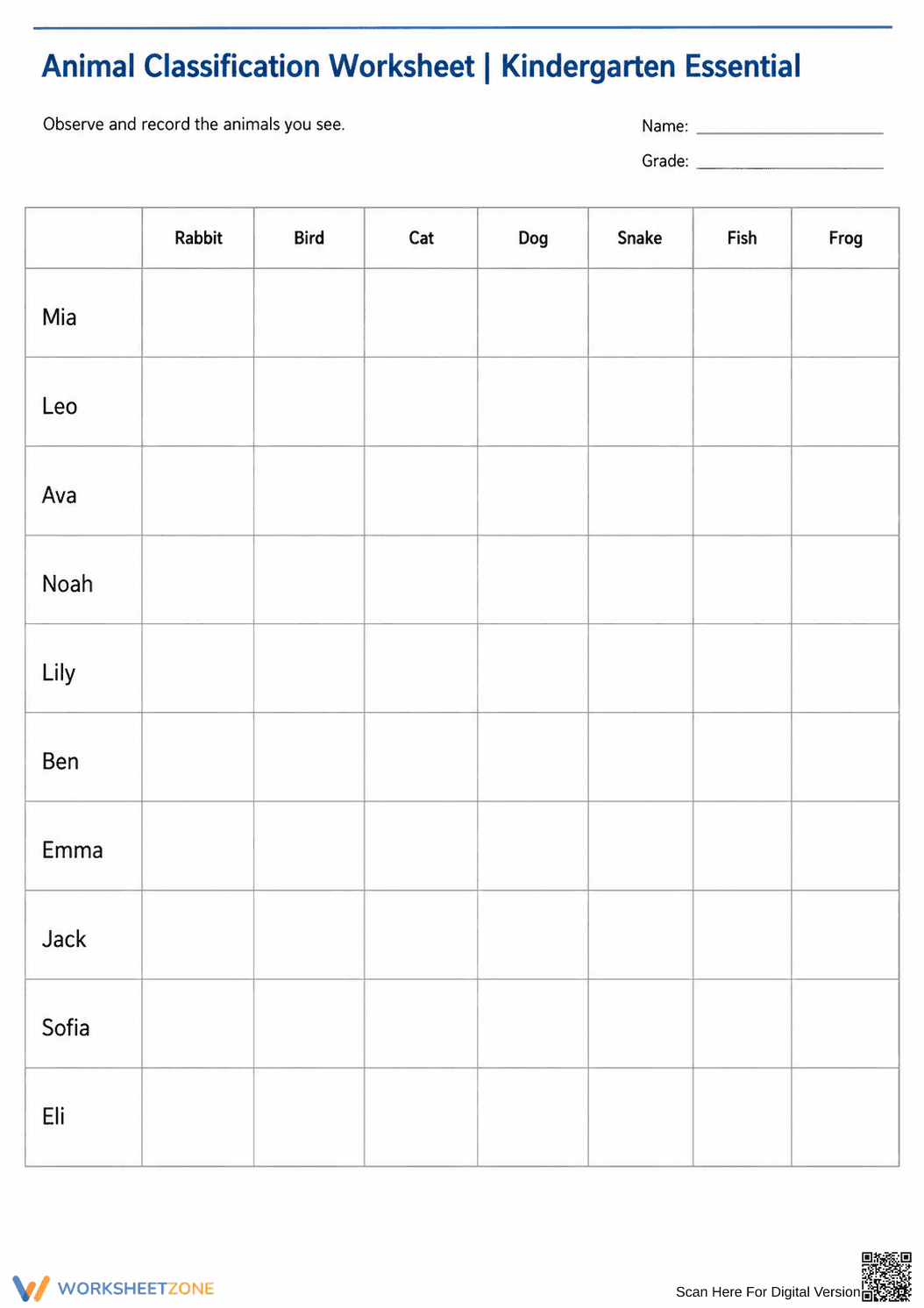
This Kindergarten animal classification worksheet provides a structured environment for students to practice identifying and recording data about living things. By using a clear grid format, learners observe and categorize animals like rabbits, birds, and frogs. This activity helps students identify patterns in the natural world while building early organizational skills.
At a Glance
- Grade: Kindergarten · Subject: Science
- Standard:
K-LS1-1— Use observations to describe patterns of what plants and animals need to survive- Skill Focus: Animal classification and data recording
- Format: 1 page · 70 data points · Answer key included · PDF
- Best For: Whole-class data collection and animal units
- Time: 15–20 minutes
What's Inside
Inside this printable PDF, you will find a comprehensive 10x7 observation grid. The vertical axis features ten student names for group tracking, while the horizontal axis lists seven animal categories including mammals, reptiles, and amphibians. This layout allows for easy tracking of individual student observations or group-based animal sorting. The document is a single-page worksheet that ensures clarity for young readers.
Zero-Prep Workflow
This resource is designed for a zero-prep workflow to maximize instructional time. First, print the single-page PDF for your class (30 seconds). Second, distribute the sheets during your science block and have students observe the animals listed in the columns (1 minute). Third, review the findings as a group to identify patterns in animal types (5 minutes). Total teacher prep is under 2 minutes.
Standards Alignment
This worksheet is primarily aligned with K-LS1-1: "Use observations to describe patterns of what plants and animals (including humans) need to survive." It supports the development of Science and Engineering Practices by encouraging students to collect and record data. Additionally, it touches upon supporting standards by helping students represent the relationship between different organisms. Both standard codes can be copied directly into lesson plans.
How to Use It
Use this worksheet during the "Explore" phase of a lesson on living things. Assign students to small groups and have them check off which animals they have seen in person or in a specific picture book. Alternatively, use it as a formative assessment after a lesson on animal traits to see if students can correctly identify and categorize the animals listed. Expected completion time is 15 to 20 minutes.
Who It's For
This resource is tailored for Kindergarten students but is also effective for English Language Learners (ELLs) due to its visual structure and repetitive vocabulary. It pairs naturally with an anchor chart about animal characteristics or a lesson on the differences between mammals and reptiles. It provides a low-floor entry point for all learners in the science classroom.
The K-LS1-1 standard requires students to use observations to describe patterns in the natural world, specifically regarding the needs and characteristics of living things. This worksheet facilitates this by providing a structured data collection grid where students record animal-related observations across seven distinct categories. According to the RAND AIRS 2024 report, providing young learners with visual organizers and simplified data entry points significantly increases their ability to recognize biological patterns and categorize organisms based on observable traits. By using this 1-page printable, educators can move from abstract discussion to concrete evidence-gathering, helping students master the foundational skill of scientific classification. The inclusion of specific animal types like rabbits, birds, and snakes allows for comparative analysis of species. This resource is designed to be a standalone assessment or a collaborative classroom tool for tracking animal data.


