


























Views
Downloads
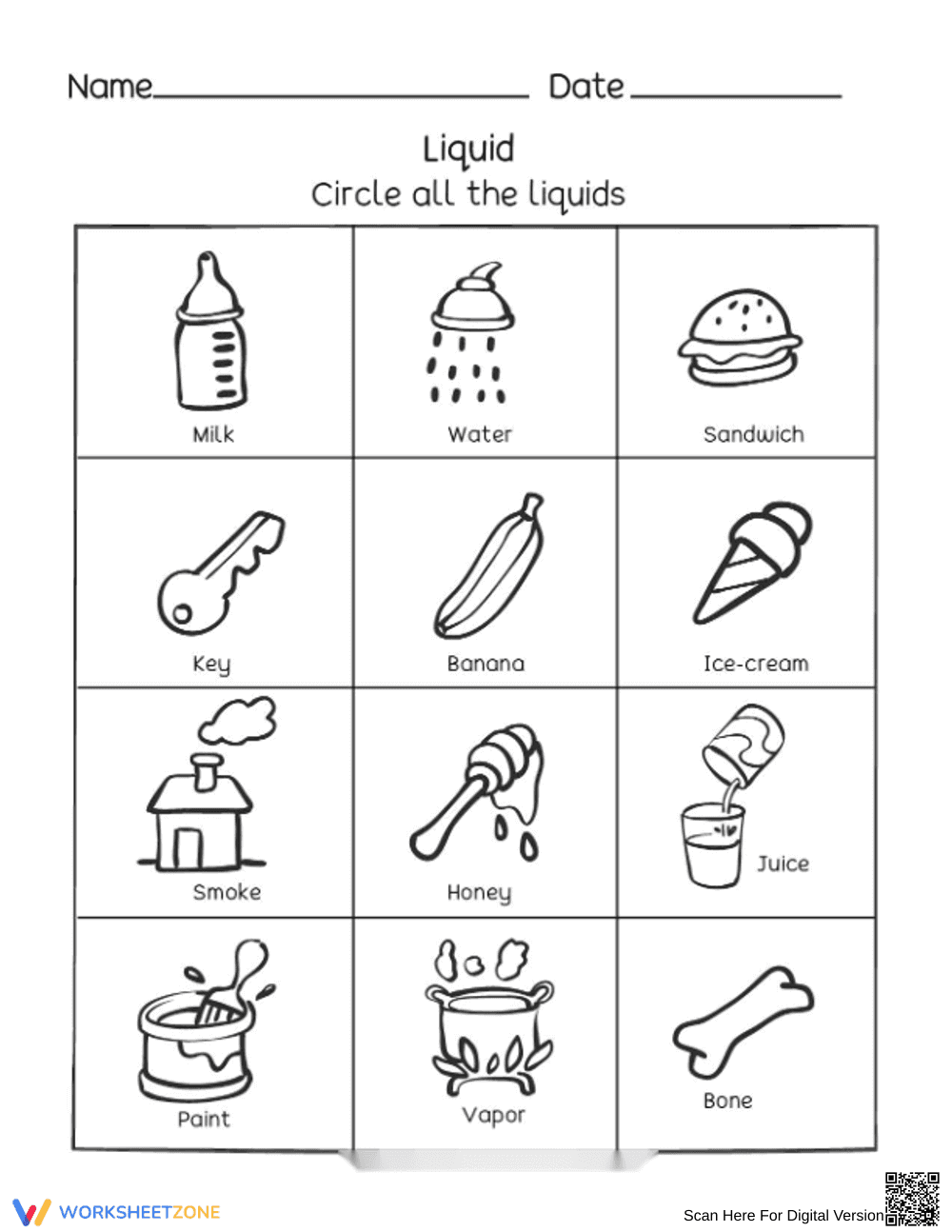

Identifying Liquids: Essential Kindergarten Worksheet
Paste this activity's link or code into your existing LMS (Google Classroom, Canvas, Teams, Schoology, Moodle, etc.).
Students can open and work on the activity right away, with no student login required.
You'll still be able to track student progress and results from your teacher account.
This Kindergarten science worksheet provides a focused introduction to the states of matter by challenging students to identify liquids within a diverse set of objects. By distinguishing between solids, liquids, and gases, young learners build foundational observation skills necessary for scientific inquiry and material classification in early childhood education.
At a Glance
- Grade: Kindergarten · Subject: Science
- Standard:
K-PS1-1— Classify different kinds of materials by their observable properties- Skill Focus: Identifying liquids
- Format: 1 page · 12 problems · Answer key included · PDF
- Best For: Introduction to states of matter
- Time: 10–15 minutes
The worksheet features a clean 3x4 grid containing 12 distinct illustrations, each labeled with its name to support early literacy. Students must evaluate items like milk, honey, and vapor to determine which qualify as liquids. The single-page PDF format is optimized for clear printing and includes a dedicated space for student names and dates to help with classroom organization.
This resource is designed for immediate classroom implementation with a total teacher prep time of under 2 minutes. First, print the required number of copies for your group. Second, distribute the sheets during your science block or as a transition activity. Finally, review the answers as a whole group to address common misconceptions regarding viscous liquids like honey or paint.
This activity is directly aligned with K-PS1-1, which requires students to describe and classify materials by observable properties. It also supports the foundational concepts of matter found in early state frameworks. Both standard codes can be copied directly into lesson plans, IEP goals, or district curriculum mapping tools to ensure compliance with state science mandates.
Use this worksheet as a formative assessment after a hands-on demonstration. It serves as an excellent check for understanding to see if students can transfer their knowledge from physical objects to 2D representations. Observe if students struggle with "Vapor" or "Honey" to gauge their grasp of viscosity and gas states. Completion typically takes between 10 and 15 minutes.
This resource is ideal for Kindergarten students and preschoolers beginning their exploration of physical science. It is particularly effective for English Language Learners (ELLs) due to the clear visual cues paired with vocabulary labels. Pair this with a physical sorting bin of real-world objects or a states of matter anchor chart for a multi-sensory learning experience.
Research from the NAEP highlights that early exposure to categorical classification in science significantly improves a child's ability to organize complex information in later grades. This worksheet targets the K-PS1-1 standard by focusing on the observable property of fluidity, a core component of the states of matter curriculum. By engaging with 12 specific examples, students move beyond simple definitions toward active discrimination of material properties. According to Fisher & Frey (2014), visual scaffolds like the ones used in this 1-page PDF are essential for the gradual release of responsibility, allowing students to practice independent classification after direct instruction. The inclusion of labels alongside images supports dual-coding theory, enhancing both scientific vocabulary retention and conceptual understanding. This resource provides a reliable, evidence-based method for assessing early mastery of physical science concepts in a time-efficient manner.


