


























Views
Downloads
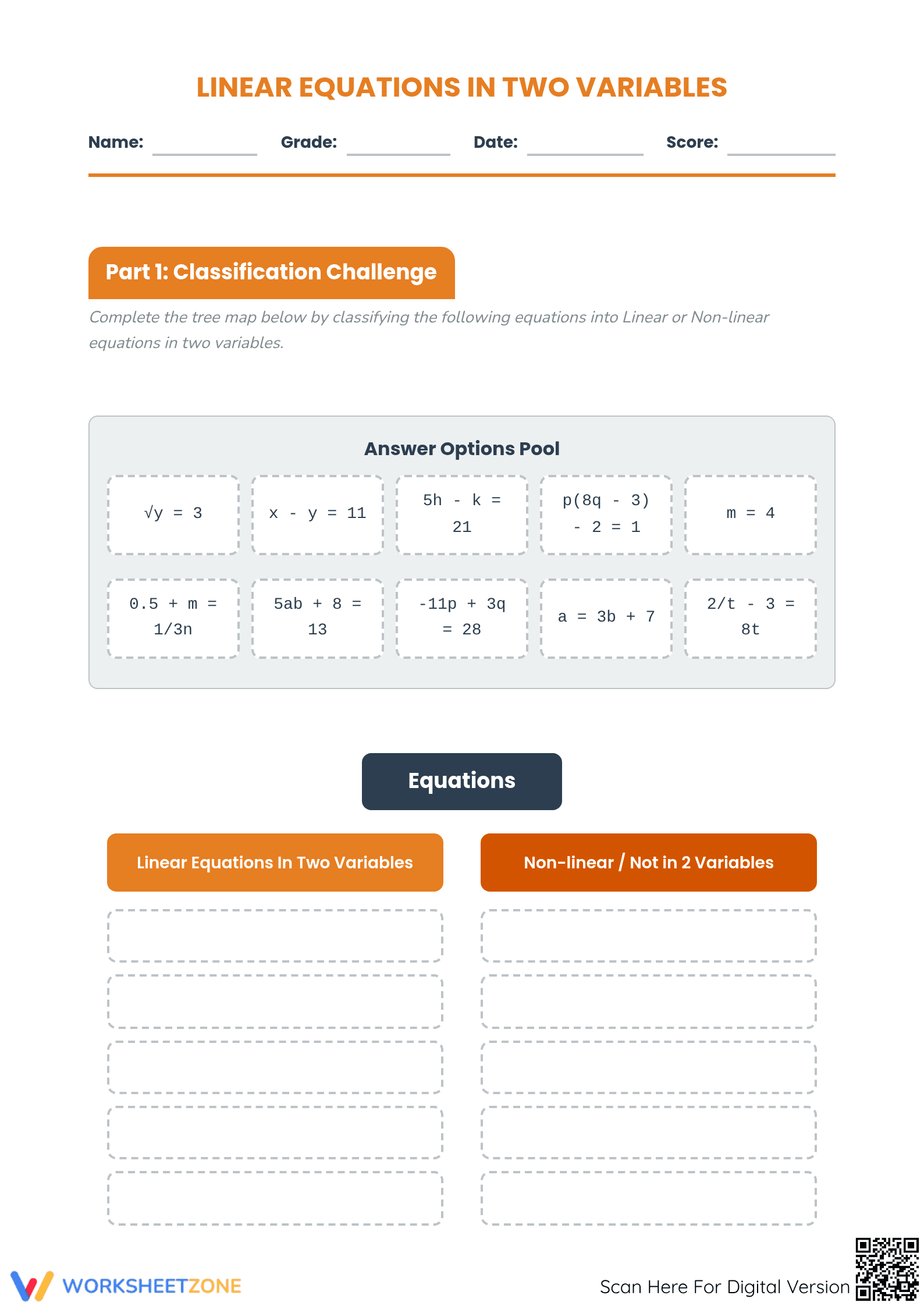
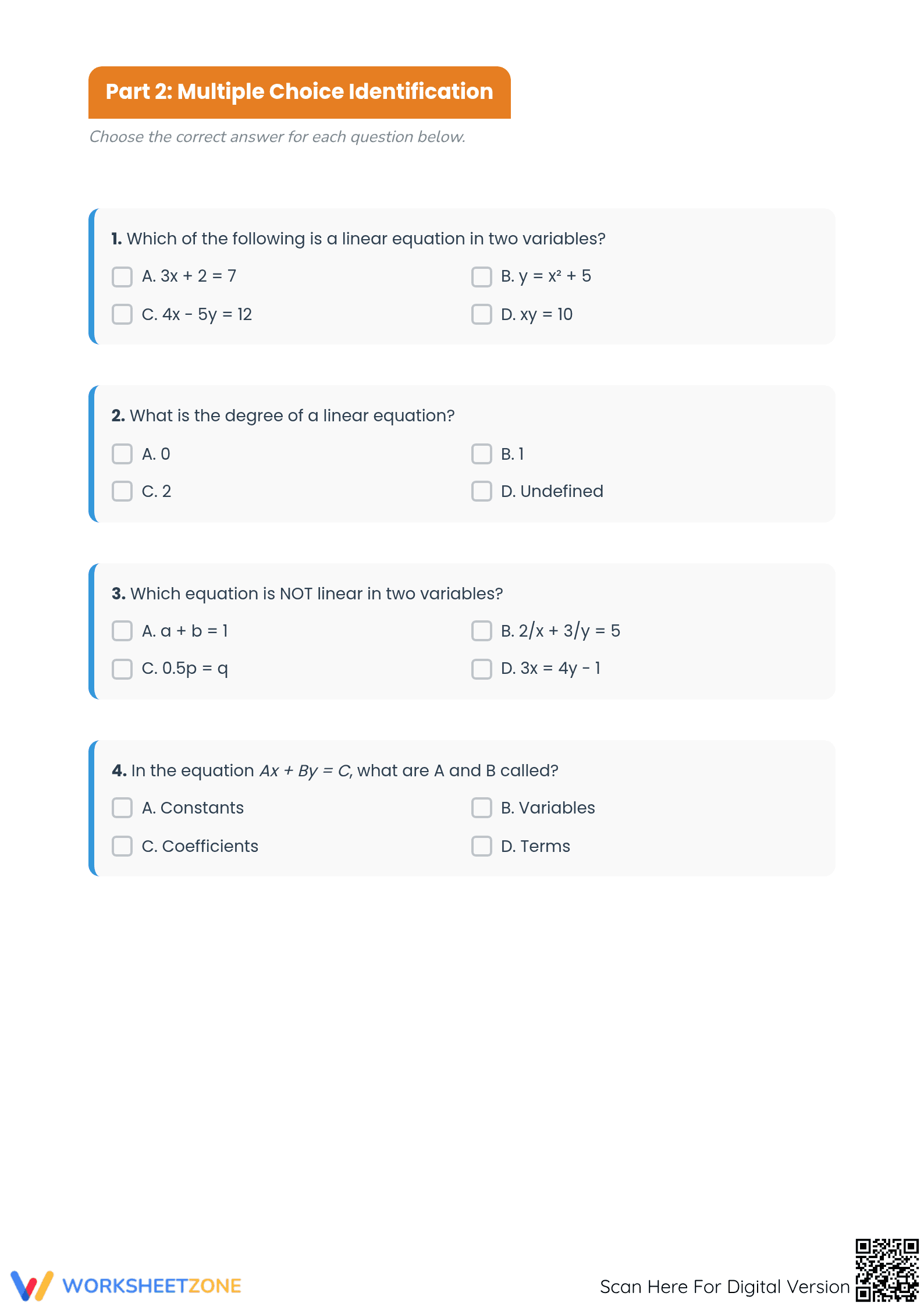
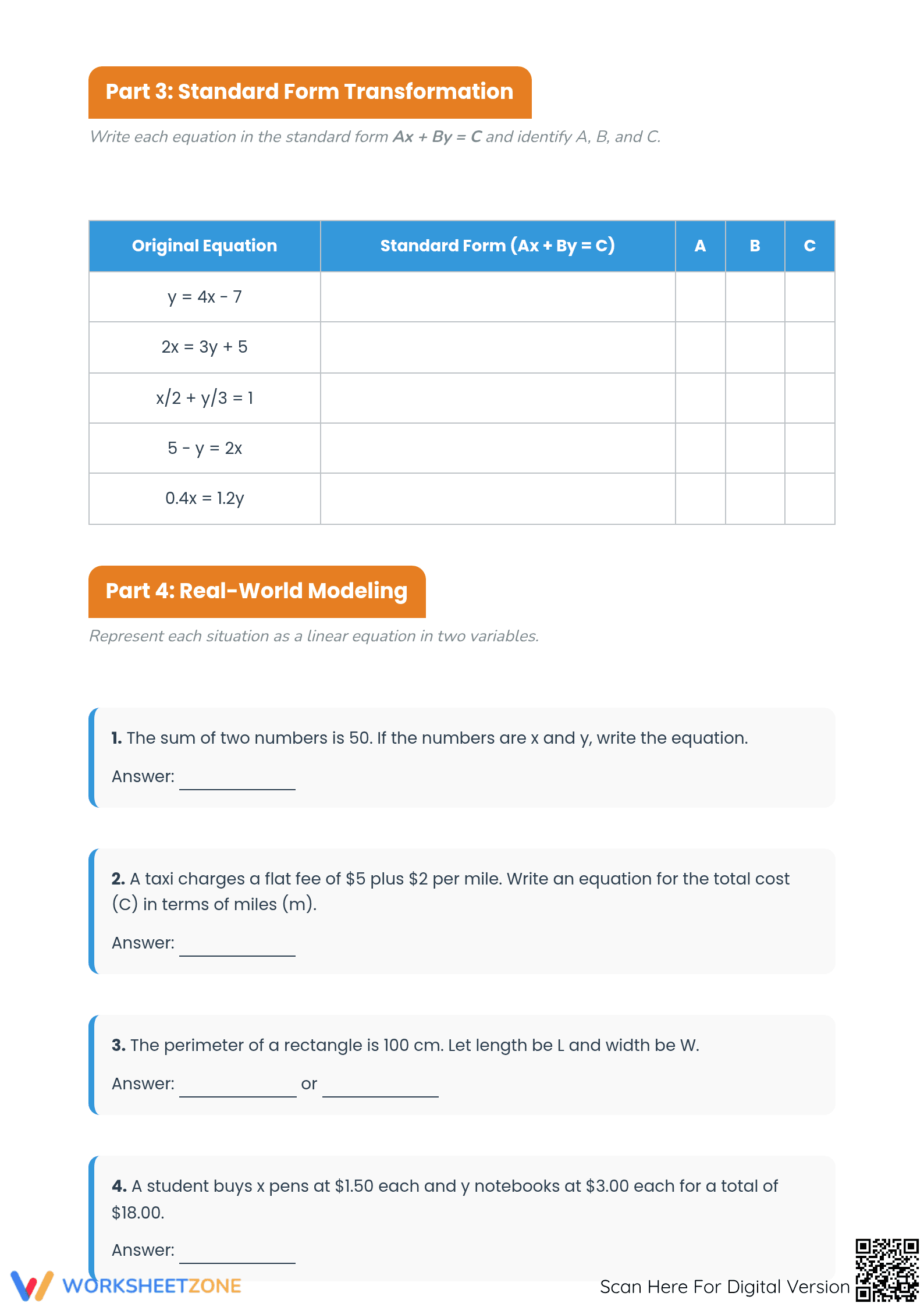
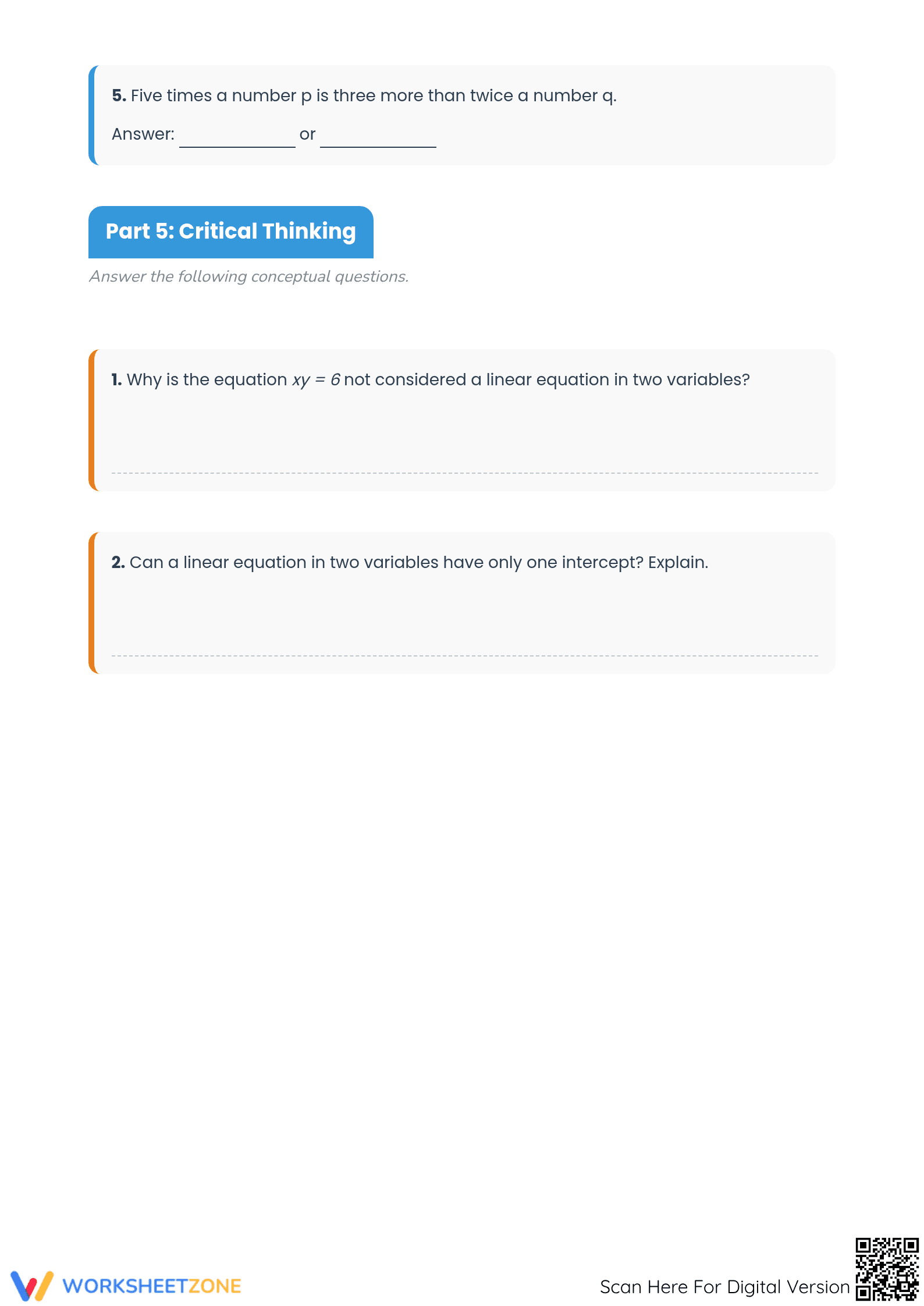

Printable Linear Equations Worksheet | Grade 8 Math
Paste this activity's link or code into your existing LMS (Google Classroom, Canvas, Teams, Schoology, Moodle, etc.).
Students can open and work on the activity right away, with no student login required.
You'll still be able to track student progress and results from your teacher account.
This Grade 8 math worksheet provides focused practice on linear equations in two variables. Students will progress from identifying and rewriting equations to finding solution pairs and applying their knowledge to solve word problems. It’s a complete resource for building foundational algebraic skills.
At a Glance
- Grade: 8 · Subject: Algebra / Math
- Standard:
CCSS.MATH.CONTENT.8.F.A.3— Interpret the equation y = mx + b as defining a linear function.- Skill Focus: Linear Equations in Two Variables
- Format: 4 pages · 26 problems · Answer key included · PDF
- Best For: Independent practice or skill reinforcement
- Time: 25–40 minutes
What's Inside
This four-page worksheet contains 26 problems designed to build a solid understanding of linear equations. The tasks include identifying equations, solving for a variable, finding value pairs, and applying concepts to word problems. A full answer key is included for easy grading or self-checking.
Skill Progression
The worksheet follows a clear gradual-release model to support student learning, moving from simple recognition to complex application across four distinct sections.
- Guided Practice: The first section asks students to identify which of 10 equations are linear in two variables, establishing the core concept.
- Supported Practice: Next, students rewrite 6 equations into slope-intercept form and find corresponding value pairs, applying algebraic rules.
- Independent Practice: The final section has 4 word problems, requiring students to formulate and solve linear equations from real-world scenarios.
This structure makes it an effective tool for classroom instruction.
Standards Alignment
This worksheet is aligned with Common Core standard CCSS.MATH.CONTENT.8.F.A.3, which requires students to "Interpret the equation y = mx + b as defining a linear function." It also supports skills in CCSS.MATH.CONTENT.8.EE.C.8 by preparing students to solve systems of equations. Both standard codes can be copied directly into lesson plans or curriculum mapping tools.
How to Use It
This resource is versatile. Use it as independent practice after a direct instruction lesson on linear equations. The 26 problems provide substantial reinforcement over 25-40 minutes. For a formative assessment, observe students during the word problem section. Note whether they can successfully translate the scenario into an equation; this reveals their depth of understanding.
Who It's For
This worksheet is designed for Grade 8 students beginning their study of functions and algebra. It also serves as a review for Grade 9 students or anyone needing extra practice with foundational concepts. It pairs well with a lesson on graphing lines or an anchor chart detailing properties of linear equations.
This worksheet provides targeted practice for a critical gateway skill in algebra: understanding linear equations in two variables. Aligned with CCSS.MATH.CONTENT.8.F.A.3, it helps students interpret the y = mx + b form as a linear function. Research consistently shows that a strong foundation in linear relationships is a key predictor of success in higher-level mathematics. According to the RAND AIRS 2024 report on foundational math skills, early mastery of algebraic concepts like linear equations significantly reduces the need for future remediation. The 26 problems on this worksheet offer the kind of structured, repetitive practice that helps cement procedural fluency and conceptual understanding. By progressing from identification to application, the resource builds student confidence and prepares them for more complex topics like systems of equations, as noted in analyses by Fisher & Frey (2014).


